by Jenna | Dec 22, 2015 | Writing Articles
I waited for years to start writing fiction.
Inside, I felt like I had to get some kind of stamp of approval before I was "allowed" to write. That I needed an expert or agent or mentor or master writer to see my potential and encourage me to pursue writing. That otherwise I was chasing a fool's dream or breaking the rules somehow.
Change Your Mindset
I think many writers or want-to-be-writers do this. It's tied to perfectionism. A belief that we have to be "good enough" before we start. That there's a qualification level we have to reach before we even begin.
But how can we learn how to do anything, until we actually start doing it?
One of my mentors, Hal Croasmun of ScreenwritingU.com, talks about how he makes a point, every two years, to learn a new skill, so that he always remembers what it's like to be a beginner. This helps him develop the programs he runs for new writers because he can put himself in our shoes. I'm willing to bet he doesn't wait for permission to learn karate or poker or horseback riding. I'm betting he picks something that interests him, and goes for it.
Why can't we do the same with writing?
Perfectionism, again. This has to do, in part, with the black and white nature of writing in this digital age. Back when I wrote drafts on paper, I didn't hesitate to scratch things out. I knew I was writing a first draft. (I can even recall telling my father that I didn't think I could ever write without real paper! How times have changed...) There's something about seeing our words looking so final that makes them seem like they should be final draft, publication quality. Which is entirely unfair to our early stream-of-consciousness drafts.
Underneath the perfectionism is also fear, the lurking originator of perfectionism and other writerly issues, which tells us to play it safe and protect ourselves from potential failure, ridicule, and rejection. It's a powerful force that works against us and our writing.
But again, how can we learn, grow, and develop ourselves as writers without actually doing the work?
We cannot.
We have to change our mindsets from a fixed mindset to a growth mindset.
And we have to stop waiting for permission -- for some kind of pre-approval that will guarantee our success -- otherwise, we are really just kidding ourselves.
Don't Wait for Permission
Here's the thing.
You do not have to wait for ANYONE to validate you or tell you that you are good enough or deserving enough or talented enough to write.
No one has to “see” or recognize your writing as “good enough” before you can write. There’s no outside evaluation or assessment of “potential” needed or required.
YOU ARE A WRITER.
You are a writer because you are CALLED TO WRITE.
You know you are called to write because you have been persistently nudged, cajoled, and pestered by your deeper, higher, wiser self to write.
That means, by definition, you have been invited by the Universe to write.
And therefore, you have all the permission you need, right now.

by Jenna | Dec 10, 2015 | Writing Articles
I believe in callings.
I believe that each of us has something that we were put here to do, and when we find what it is, we must do it with all our hearts.
And... it isn't always easy to get clear on what our calling is.
Why?
The noisy, busy world we live in and the noisy, busy minds we are encouraged to cultivate by the mainstream makes it hard to hear ourselves and the deeper whispers of our souls.
And that's often how a calling comes through, as a whisper.
It took me a number of years to come around to realizing that my deepest call is to write. I spent my 20s and 30s sorting myself out in that regard, changing careers, soul-searching, and more (like helping other people get clear on their life callings!), only to come back to the insight that my 6th grade self already had hit upon: I want to write.
Are you called to write?
If you're here, reading a website named "Called to Write", I'm going to assume that you also feel that call. That you have the inner compunction to put words to the page in some form. You may or may not be doing it yet, or maybe not yet quite the way you want to be doing it, but I'm guessing that one way or the other, you've been feeling the call to write for some time.
When I conducted a survey a little while ago, 71% of you said that you felt called to write without a doubt. That's huge. And fantastic!
And, interestingly, 71% of you also said that you struggle with procrastination.
Isn't that fascinating?
The very thing we feel called to do is the very thing we tend to avoid.
And it's entirely normal.
One of my favorite things Steven Pressfield says in The War of Art (aka "Jenna's Bible") is this:
"The more important a call or action is to our soul's evolution, the more Resistance we will feel toward pursuing it."
In other words?
The bigger the dream, the more we fear and avoid it.
by Jenna | Nov 26, 2015 | Writing Articles
It's Thanksgiving here in the U.S., so many of us are thinking about gratitude.
It occurred to me that since here at Called to Write we focus on writing, it might be worth thinking about what we are grateful for that writing has brought to our lives.
So here's a place to share, if you feel so inspired.
Let us know in the comments ... what has writing given you that you're grateful for?
I'll go first:
- The satisfaction of pursuing one of my two most deeply held dreams, alongside my dream of becoming a mother.
- The joy of playing in far off imaginary worlds that I've always loved but never believed I could be responsible for creating.
- Incredible amounts of personal growth, self-discipline, self-confidence, self-trust, new habits, and new beliefs.
- Exciting adventures in learning about writing fiction and screenwriting.
- A tribe of incredible writers I'm grateful to call friends and colleagues.
It's your turn. :)
What has writing given you that you're grateful for?
by Jenna | Nov 25, 2015 | Reflections, Science Fiction
I wrote recently getting a handle on online distractions that keep you from writing, and prior to that, about cutting back on the online distractions that were cluttering my head.
I've been highly interested in this topic because I could feel my life-energy being sapped by these distractions and it's been really bothering me, despite the many changes I've already made. I do a good job of protecting my actual writing time from email and other online stuff, but the rest of my life? Not so much.
And it was mostly because of my phone. My computer use feels manageable. My TV consumption is minimal (though I have been watching lots of Prison Break and Breakout Kings as I'm prepping a sci-fi prison movie right now!). Having said that, I like being able to use my phone to read ebooks in the dark late at night without waking the baby (who sleeps in the same room) and being able to write on it when I want to.
But I don't like feeling like I can't be without it. Ever. YUCK.
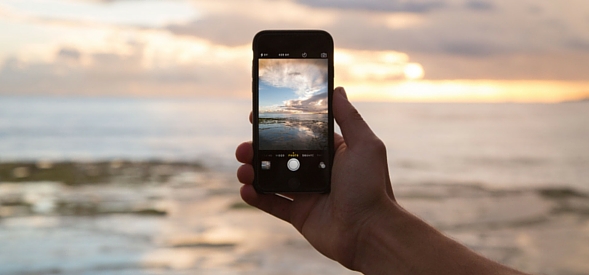
(And honestly, the picture I've chosen to accompany this post keeps freaking me out -- it seems entirely emblematic of how so many of us are viewing our world through the filter of a device... constantly.)
My email trap
It was email that was really my last "hook" — I rationalized that as a business owner, I need to stay on top of things and make sure nothing was falling through the cracks. But that notion kept me constantly checking to see if I had any new messages.
And not only did I feel guilty for oh so frequently "checking" my phone when I was around my kids, I didn't like the way my brain felt always cluttered by all the checking, even after I'd taken Facebook off my phone, turned off almost all the notifications in the lock screen and more. It was like being tied into other people's energy and needs was keeping me on edge, in a hyper vigilant state of awareness and constant readiness. Again, YUCK.
Finding the courage and support to make a change
So I decided to participate in a "Look Up" two week online use "detox" program and see what shifts I could make.
We worked through a four-step process of first defining what we want, noticing what impulses were driving the behavior to check in online, accepting that those feelings and impulses (often discomfort) would not necessarily change but that we could learn new ways to deal with them, and finally choosing what we wanted instead. Then, every day, we answered simple journal prompts every morning to set our intentions for the day about our online use and how we wanted our days to go, and every evening, about how it went and what we learned.
I deleted Gmail from my phone
Initially I found myself sort of skirting the edges of changing my phone use, testing the water, seeing how it felt just to consider cutting back. (Which just shows how powerful an addiction it can be!)
Even before the program started, I installed the app called "Moment" so I could see how much time I was actually spending on my phone, and how many times I was picking it up. So in some ways it was good that I wasn't changing anything initially, but just observing. And it was kind of scary. There was one day, prior to the program, where I picked up my phone FORTY-NINE times. 49!! It's embarrassing even to put that in print.
On about Day 3 of the 14-day program I decided to take Gmail off my phone entirely. For good measure, I took off Chrome too, so my second-biggest, "let me just look that up real quick" excuse was gone too. I still have Safari there but since it wasn't my go-to program it just doesn't have the same attraction. While I was at it, I turned off every other kind of lock screen, pop up, and banner notification I could find on my phone (except iMessage and Reminders, which I do use) and on my computer.
It was so worth it.
I felt sort of jittery for about 24 to 48 hours, still on that automatic "must-check-now" auto-alert. It was mildly frightening to feel so much like Pavlov's Dog. Again, YUCK.
What changed for me
After that, everything got a lot more calm.
I found myself feeling much more present in my life and to my family.
My brain felt quieter, calmer, more alert.
I had more energy.
I started reading REAL BOOKS and putting my hands on REAL THINGS like baking food, drawing, collaging. I noticed that when I felt the urge to "check" I could make tea, or snuggle with my boys, or GO OUTSIDE and look up at the beautiful amazing sky that helps make life on this planet possible.
I also found that I could still use my devices for certain things: Kindle, Netflix, the timer, the calculator, iMessages, writing, and other apps I love and find incredibly useful without it taking over my time and energy. My phone became a tool again, instead of a constant companion or savior or whatever it was actually doing for me. It's been interesting to walk the line of finding what online use works for me and what doesn't, at least for right now.
I found myself being crystal clear about times when I absolutely did NOT want to be consuming any online stuff at all and have had a few spans of totally unplugged time (something I used to do weekly) and LOVED it.
It's started to feel kind of gross to be looking at my phone.
So I just don't do it much anymore. It mostly stays in my office, on the charger, except when I need it when I'm out and want it for emergency phone calls, or if I need it for another purpose, like the calculator or timer. Again, it's gone back to being a tool, and I like that.
I also found that the days have gotten So Much Longer! All those "little" checks and moments of time that were getting sucked into online use are suddenly mine again. My mind is clearer. My intentions are clearer each day. I feel more focused.
How my writing has changed
And as far as my writing goes, I have not noticed a huge change in my writing time, but I'm not surprised by that, since I've already been writing regularly and protecting my writing time well.
What I have noticed is that I feel readier to write when I sit down to do it. Now what swirls around in my brain when I'm out in the world is what I'm going to be writing about next, whether it's a blog post, my current script, or the next big project that's coming down the pipeline. It might sound like a small shift, but it's huge. It feels like I've reclaimed my own territory again. And it's such a relief.

by Jenna | Oct 22, 2015 | Writing Articles
Yesterday I had the pleasure of listening to psychologist Jessica Michaelson speak about dealing with our "click and scroll" compulsions in the context of how they keep us from living the lives we want to lead. Jessica is a brilliant psychologist that I've worked with on a number of different issues and I adore her for her clarity, deep honesty, relentless compassion, and her willingness to embrace the darker sides of our psyches.
The trap of online use and how it affects our writing
I took the class because while I've gotten my past Facebook and Twitter compulsions under control, I still find myself checking email and for other alerts much more frequently than I'd like to, or that is ultimately necessary for my business and life. I also find myself getting distracted by online interactions at the wrong time -- meaning, they are interactions I actually want to be having, but I'm having them at a time that doesn't work in my life, with my kids in particular.
Also, I read a recent post of Jessica's that got me thinking about the effect my online activities were having on my general demeanor — I know I'm likely to be more snappish and distracted when I allow myself to try to do two things at once, and I don't feel good about myself when I'm like that.
The other thing that stood out for me from her post was how much more peaceful she was feeling and how much more energy she had as a result of cleaning up her online use.
Although I've mostly managed to prevent online activities from interfering with my actual designated writing time, I'm aware that having my mind occupied and distracted and busyified with other people's stuff and other online BS takes away from my clarity of mind and my ability to explore my own ideas, which can interfere with my writing. I instantly saw her point about how ceasing or reining in these kind of distractions would free up a lot of energy for me.
And I know I'm not alone.
A number of my writers in my Called to Write community and in the classes I teach talk about how hard it is to stop themselves from surfing the internet reading the news or articles, checking email, and scrolling through various online social media sites, and how it impacts their writing time-wise. Having now read what Jessica wrote and listened to what she shared today, I can also see how those seemingly innocuous activities may be draining some of our energy for writing.
It's important to note the "may" in that sentence and I'll tell you more about why in a moment.
Solutions for handling online impulse control
Here's what I learned from Jessica:
- There's no one right way here (a woman after my own heart!) when it comes to online use. Every one of us has to decide what it is that we want to create with and in our lives, and then make a decision about how much (if any) online time supports that. In my case, a significant part of my business, marketing, community-building, and social life happens online, and that's totally okay with me. It's only when it crosses the line into compulsively checking that I don't like it.
- Our brains love mindless, automatic, and habitual activities because they release dopamine, which feels great, so there's a biochemical reward for doing the same things over and over again without thinking. It feels good, so we do it.
- The problem is that being on autopilot means that we have let go of making conscious choices in our lives, and that's where most/many of us actually want to live, where we are in the driver's seat of our own lives.
- If we're going through a rough patch in our lives, we may NOT want to try to reduce or corral our online use because it serves as a buffer for the discomfort we are experiencing. This resonates for me; I know that when I've gone through difficult life phases, having some of these tools for distraction have felt like life savers.
- A big key to solving this challenge is to accept it. In other words, we will always feel discomfort in our lives in some form, and so we will always have urges toward numbing activities, whether they are online activities or another sort (like over eating, TV watching, etc.). Jessica says that the key here is to accept the discomfort, the urges, and the uncomfortable feelings as part of the package. To notice them, and breathe through them.
- The solution is, in fact, a four-part combination approach of defining what we want from our lives, noticing what's happening when we have the urge to click, accepting the discomfort we're experiencing and impulses to click to calm it, and choosing to make new choices and create habits and supports to help ourselves see them through. Jessica goes into a more detail on each of these points in the webinar.
The discomfort of writing
All this strikes an important chord around the discomfort of writing. Remember, we know that writing — because it is our biggest calling — will trigger massive amounts of resistance. And resistance comes from wanting to avoid fear and discomfort.
So it makes perfect sense that it's so so so easy to say "I'll just check the news/Facebook/Twitter/email real quick before I start writing". It helps soothe that discomfort with a nice dose of dopamine that makes us feel better ... for a minute. But then we feel terrible for not doing the writing like we said we would.
Taking time to instead define what we want in our lives, for our writing, and for our online use and making new choices to support that are a huge step in the right direction. Jessica pointed out though, that we can't skip the steps of noticing and accepting, if we truly want to create lasting change.