My Sci-Fi Circuit article on Script Mag originally published on March 15, 2023.
“The important thing to focus on is preserving how the source material made you feel when you read it, and to hold on to that feeling and making sure it’s preserved in your adaptation.” -Eric Heisserer
Shadow and Bone magnificently expands its rich world-building and heart-capturing characters in Season 2, releasing Thursday, March 16th on Netflix.
If Season 1 was a strong takeoff for the show based on two of Leigh Bardugo’s bestselling YA book series — The Shadow and Bone trilogy and the Six of Crows duology — Season 2 soars even higher.
For those not already in the know, Season 1 begins with Alina Starkov (“newcomer” Jessie Mei Li) transforming from a lowly orphaned cartographer on a military assignment with her childhood friend, Malyen ‘Mal’ Orestsev (Archie Renaux), into a newly discovered and developing “Sun Summoner,” believed to have the rare power to destroy a shadowy and dangerous “Fold” that has divided the country of Ravka for hundreds of years, created by an ancient, dark magician experimenting with power beyond his control. Alina aligns with General Kirigan (the inimitable Ben Barnes), attracted to his power, and hoping to learn from him to control her own power, and together destroy the Fold that killed her parents.
Their story collides with a band of thieves — the “Crows” — featuring Inej (Amita Suman), a beautiful and stealthy knife fighter, Jesper (Kit Young), a gunslinger extraordinaire, and Kaz (Freddy Carter), their surly and mysterious boss, who are hired to capture the Sun Summoner. When their plans go awry, and nothing turns out quite as expected, Alina is on the run by the end of the season.
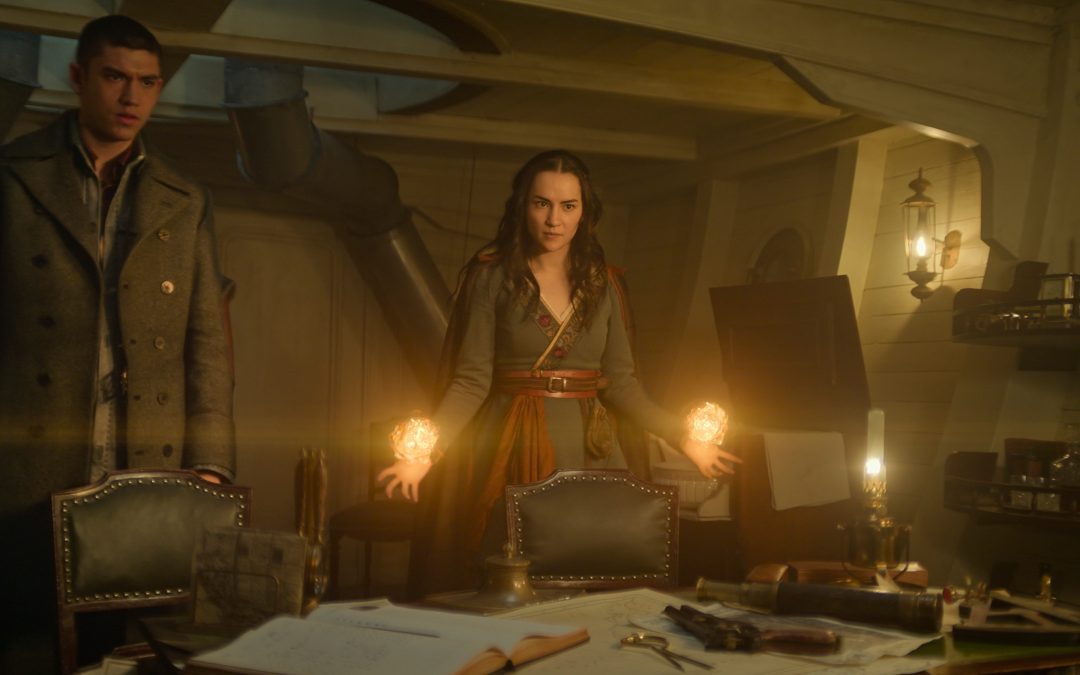
As Season 2 opens, Alina is still on the run, now with allies and reunited with Mal, and determined to seek two mythical creatures to amplify her power so she can destroy the Fold once and for all. She’s opposed by forces who’d prefer to use the Fold to leverage it as a weapon and keep the balance of power in their favor. Alina and Mal, aided by some excellent new characters, including Sturhmond, a privateer with uncertain interests, a pair of twin sibling fighters (Tolya and Tamar, pictured above), and Wylan, a charming demolitions expert.
With the diversity and excellence of the cast, well-drawn characters breaking tropes (sharing power instead of constantly competing), unique “tsarpunk” costuming and settings, intriguing magical abilities and methods, and beautiful world-building, Shadow and Bone is fresh, intriguing, and delightful. And it truly takes off in Season 2.
I had the pleasure of speaking with Eric Heisserer, the series creator and showrunner, and the screenwriter behind Arrival and Bird Box,about how he came to work on the show, his approach to the adaptation, and how he runs the show.
Heisserer originally read the books for pleasure, starting with Six of Crows. He fell in love with the story with the chapter titled, “Inej,” after being introduced to the world and to Grisha abilities, with a characters who “came alive on the page,” saying, “I’m still in awe of Leigh’s writing ability to do that.”
Series author Leigh Bardugo attends Netflix’s Shadow & Bone Season 2 Premiere at Netflix Tudum Theater on March 09, 2023 in Los Angeles, California. (Photo by Rodin Eckenroth/Getty Images for Netflix)
He so enjoyed the read, he tweeted about it to author Leigh Bardugo. He had made a resolution that year “to reach out to authors of anything I love to give them joyous praise,” in counterpoint to “the other side” (negative critiques).
A little over a year later, Netflix reached out, surprising Heisserer, who’d forgotten entirely about his tweet. He was in the middle of developing a pilot project at another network based on another story by Ted Chiang (Arrival is based on the short story “Story of Your Life” by Chiang), when Netflix approached him about becoming involved in the adaptation of the Shadow and Bone trilogy. Heisserer related how he turned the project down because they didn’t also have the rights for the Crows duology, feeling confident that the pilot project was a sure thing. He laughed about it ruefully, saying, “I definitely had the Charlie Brown voice of, ‘I’m absolutely kicking the ball this time.’ And Lucy yanked it from me.”
Luckily, Netflix was interested in his take to integrate the two series and picked up the rights to both, bringing him on board as showrunner and lead writer.
Because the Shadow and Bone series is a prequel to the Six of Crows duology, Heisserer had a unique challenge — essentially inventing a prequel story for the Crows to play during the Shadow and Bone timeline — and which ended up being “just as difficult as adapting something, but also just as rewarding.”
Heisserer described the work as something akin to a Back to the Future Part IIeffort, in that they were integrating characters into the main storyline that “could have absolutely been in the first book,” but weren’t. The writers had to do some of this in Season 2 too, particularly because they hadn’t yet reached the point where the Six of Crows duology begins (and had to navigate a hard and fast rule from author Leigh Bardugo to not have a certain something show up before that point). They compressed the remaining two books of the trilogy for Season 2, in part to get to that point in the timeline, as well as to navigate around some of the “palace intrigue” that otherwise would have kept too many of the large (and excellent) cast off-screen for too long.
Although the writers began writing the Season 2 scripts in January 2021, well before Season 1 aired and before Netflix renewed for Season 2, they haven’t followed the same approach this time around with a third season. Happily, however, they’ve written a season’s worth of scripts for certain characters that can “live alongside a Season 3, should we be so lucky as to get a Season 3,” per Heisserer, who added, “Book fans will know what I’m talking about.” (I’m hoping this means an adaptation of King of Scars, featuring Patrick Gibson (The OA), who was fantastic in Season 2 as Sturhmond, but since I haven’t read the books yet, that’s pure speculation on my part.)
Heisserer worked as the solo showrunner for Season 1, but “when [Netflix] green-lit the production of Season 2, they also green-lit the writer’s room for this side project, and I made it very clear I could not do both at the same time, and live. And we all agreed that Daegan Fryklind, who was my EP and right hand in Season 1, should absolutely ascend to be co-showrunner for Season 2. And I’m grateful that she said yes — great boots on the ground for so much of that on the production, and I joined her as soon as I could.”
Eight writers comprised the writer’s room for Season 2, including Heisserer and Fryklind, plus other “fresh voices” working on the mysterious side project (Heisserer mentioned an Inej-focused episode which immediately caught my attention). The writer’s room included two assistants who moved up in the ranks, one from show assistant to writer’s assistant, and another from writer’s assistant to staff writer. Heisserer said, “[This] is part of the process — looking to bring people up in the business and have them ascend to greater positions of writing — the way it used to work.” (We love him for this, right, writers?)
He added, “I have clung to this creative team and stuck with them as much as I could throughout. They’re a good group of people and know the material so well. There’s a genre fluency and a fluency to the world, and they know how to write for our actors. So we kept a lot of that same team throughout.”
On the subject of adaptation, Heisserer had this brilliant piece of wisdom to offer, “The important thing to focus on is preserving how the source material made you feel when you read it, and to hold on to that feeling and making sure it’s preserved in your adaptation. There will be a lot in the aesthetic fidelity of the project that you’ll try to preserve, but discover that does not translate in the adaptation.”
As an example, he shared that “one of the most frustrating elements in Shadow and Bone was that in the books [a character] was called ‘the Darkling’ constantly and had no other name. And we struggled with that. We tried to make it work for so long and it got frustrating for two reasons. One was that we found in so many early auditions that if there’s a slight enunciation problem with an actor, it sounded like ‘darling.’ It worked so well in that source material and it fell apart for us in the show. [Second], we didn’t want to divulge his first name until early in Season 1, when he’s making a gesture of closeness and intimacy to Alina. When we thought about having him give a fake first name, we realized it would seem like he was lying to her about everything and wasn’t being emotionally honest with her, which was a betrayal of his character at that moment. So we knew that was going to be too troublesome for people to understand. We only hope they can empathize and understand that it came out of us holding on as hard as we could to what worked in the books that didn’t work in the adaptation.”
With world-building in fantasy, Heisserer fought a battle for all writers: “On adapting fantasy or creating fantasy — particularly second world fantasy where you don’t have the portal of the real world that someone can ground it in — there is so much world-building that needs to happen. The fight I had — that I hope will make it easier for other fantasy writers — is in how much you have to define and explain, particularly for the executive who doesn’t read and doesn’t necessarily care about fantasy, and wants a text crawl or a 10-minute voiceover describing all the hierarchies, caste systems, currencies, and histories so that it turns into a BBC documentary about a show versus an actual fictional narrative.
“And the fight I had was this, ‘If this were a medical show and our character — our lead — was a neurosurgeon who threw around a ton of jargon about the brain, about surgical tools, medicines, and whatnot, that you didn’t know about, you wouldn’t care. You wouldn’t bat an eye. You would be happy with it because you understood the stakes are life and death. If I can get you to the place where you believe the stakes are life and death, then let us have this use of foreign terms, and trust the audience, because today’s audience has such a genre fluency that we wouldn’t have 30 years ago. We’ve been weaned on Game of Thrones and Lord of the Rings and all these other shows that have paved the way for us, and we think viewers will give us that faith and hang in there until it clicks.’”
Amen.
Season 2 of Shadow and Bone is out on Netflix on Thursday, March 16th. I hope you enjoy it as much as I have.
Note: I screened Seasons 1 and 2 for review.
About the Series
Co-Showrunners / Executive Producers / Writers: Eric Heisserer (Chronology) and Daegan Fryklind
Author and Executive Producer: Leigh Bardugo
Executive Producers: Shawn Levy, Josh Barry, Dan Levine, and Dan Cohen for 21 Laps Entertainment, Pouya Shahbazian (Loom Studios) and Shelley Meals
Directors: Bola Ogun (Episodes 1 & 2), Laura Belsey (Episodes 3 & 4), Karen Gaviola (Episodes 5 & 6) and Mairzee Almas (Episodes 7 & 8)
Cast: Jessie Mei Li (Alina Starkov), Archie Renaux (Malyen Oretsev), Freddy Carter (Kaz Brekker), Amita Suman (Inej Ghafa), Kit Young (Jesper Fahey), Danielle Galligan (Nina Zenik), Daisy Head (Genya Safin), Calahan Skogman (Matthias Helvar), Lewis Tan (Tolya Yul-Bataar), Anna Leong Brophy (Tamar Kir-Bataar), Jack Wolfe (Wylan Hendriks), Patrick Gibson (Nikolai Lantsov) and Ben Barnes (General Kirigan)
My Sci-Fi Circuit article on Script Mag originally published on February 3, 2023.
Dean Devlin’s new sci-fi series, The Ark, debuted February 1, 2023 at 10 p.m. ET/PT on Syfy and on February 2 on Peacock and Electric Now.
Devlin, the creator of Independence Day and the original Stargate, teamed up with longtime collaborator Jonathan Glassner (Stargate SG-1) to create this new, contained sci-fi series set in the high-stakes world of a colony ship running on fumes to reach its final destination: A new planet for humanity to claim.
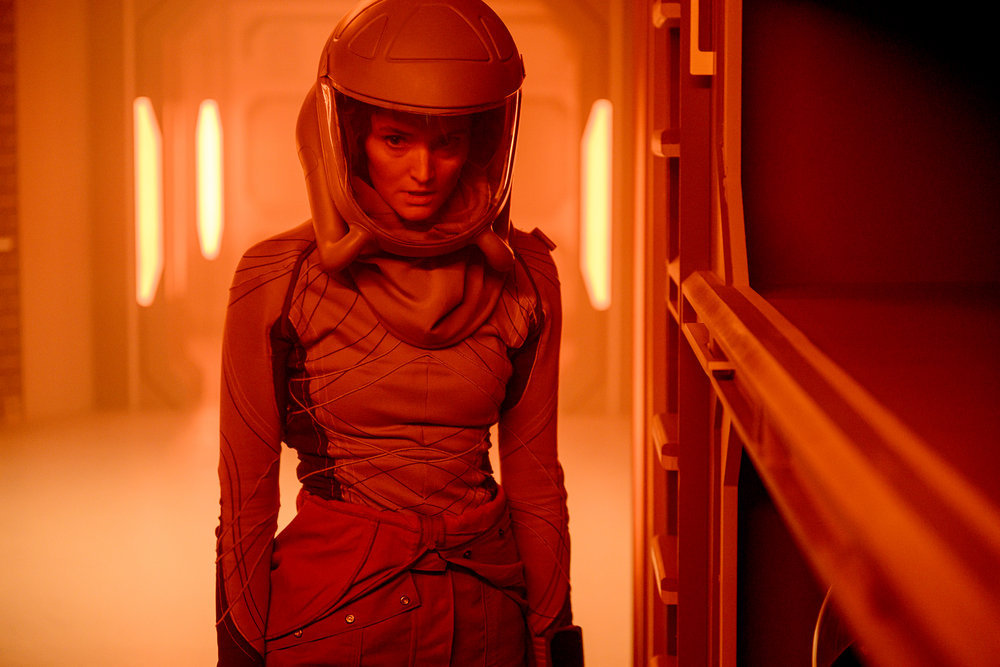
The Ark begins 100 years from now with the first planetary colonization mission designed to ensure the survival of the human race, leaving behind a planet Earth dying under the impacts of climate change. But when their ship, Ark One, is disastrously impacted by an unknown object, much of the command crew is killed and the remaining crew members are awakened early from cryogenic stasis. They’re quickly thrust into facing one challenge after another simply to stay alive, confronting dangerous system failures and limited resources — including “little” things like food, oxygen, and water.
Alongside the life-and-death stakes of a damaged ship outfitted for a sleeping crew — ill-equipped to house and feed an active crew still a full year out from their final destination — the series is riddled with intriguing mysteries from the get-go. What hit the ship and caused such catastrophic damage? What’s going on with the various interpersonal relationships between the characters, of whose backstory we get only tantalizing glimpses?
Christie Burke as Lt. Sharon Garnet in The Ark. Photo by Aleksandar Letic/Ark Tv Holdings, Inc/SYFY
The characters also wrestle with sorting out their chain of command, because their higher ranking crew mates are lost in the accident, pushing them into direct and frequent conflict. They’re also quickly swept up into a murder mystery to solve. The first four episodes, which I screened before chatting with Devlin and Glassner, set up a number of intriguing storylines and possibilities I expect will grow richer over the course of the 12-episode season and as the characters develop more fully.
Devlin’s goal was to create “a microcosm of our world,” saying, “The fun of a spaceship show is that you can really turn it into a pressure cooker. So, we had this uniting problem that they need to survive, but what else could happen that divides them? So, we wanted mystery. We wanted complexities. We wanted different philosophies on how to rule or how to run things, and to watch that clash together.”
With overtones of Lost In Space and Battlestar Galactica, The Ark stars the fresh faces of Christie Burke, Richard Fleeshman, Reece Ritchie, Stacey Read and Ryan Adams, all of whom bring a bright energy to a new adventure story set in space.
When I asked Devlin and Glassner about how things have changed in the world of sci-fi, and what they see coming next, Devlin recalled his path to getting the original Stargate movie made, saying, “Obviously, I grew up in a time of fantastic science fiction, whether it was Star Trek or Silent Running or Omega Man, but science fiction fell out of fashion. And when I did the feature film Stargate, every single studio passed on it. They all said, ‘Science fiction is dead.’ And I said, ‘No, just bad science fiction is dead.’
The Ark. Photo by Aleksandar Letic/Ark Tv Holdings, Inc/SYFY
“Finally we got MGM to release it — only because they had a hole in their releasing schedule — and it was a gigantic hit. And suddenly sci-fi was back in fashion again. It’s been fun to watch it ebb and flow. Probably the biggest difference with science fiction now is it’s finally being treated like it’s not a second-class citizen. For the longest time science fiction was relegated to, ‘Oh, that’s just for the kids.’ But now science fiction is taken seriously and that’s a great thing.”
Devlin also commented on the way streaming has changed the world of sci-fi, because so much more scripted entertainment is possible now. When he was growing up, the few networks around were careful about losing their market share or making mistakes with television shows. But because movies were “falling apart” back then, they more or less “handed the keys to the kingdom to these hippies, and they created these unbelievable movies because nobody was really paying attention to what they were.” Now, though, he says, “you’ve got kind of the exact opposite. Movies cost $200 to $300 million to make and no one wants to screw them up, so they’re overly handled. But television — with all these different platforms — there’s more scripted entertainment now than ever, and the only way to get noticed is to do something different, to take a chance to be riskier. So, we’re living in a time where we’re actually seeing some of the better writing, but it’s happening on television.”
Devlin is quick to credit Glassner with teaching him about TV writing, saying, “I had never done serialized television until Jonathan and I worked together the first time on a show called The Outpost. He taught me so much about serialized writing and storytelling. I wrote The Ark pilot and set it up at Syfy, but the second Syfy wanted to do it, my first call was to Jonathan saying, ‘Please come on board with me on this,’ and I’m so grateful he said, ‘Yes.’ And I have to give him so much of the credit for the development of this show. Because once I had set it up, I put the baby in his arms and he did just this miraculous job with it. I was almost never in the room, John ran the room, did all this, and then he would come back to me and then he and I would work kind of separately, but he did so much of the heavy lifting on this show, and I’m so grateful for him.”
[L-R] The Ark Creator/Co-Showrunner/EP Dean Devlin, Christie Burke, Reece Ritchie, Richard Fleeshman and Co-Showrunner/EP Jonathan Glassner at the NBCUniversal Press Tour. Photo by Trae Patton/Syfy.
For his part, Glassner seems to have fallen for the show based on the characters. “For me, any television — whether it’s genre or not — is about the characters. And Dean created some great characters on the show, and we got very lucky and cast some great actors to play those characters. And from there it really just flows. There’s so much to explore with these characters and they’re put in such an amazing situation in which to explore them.”
Although Devlin wrote the pilot script, Glassner then primarily ran the writers’ room with two other writers, taking things back to Devlin to work on between the two of them. “We run it much like any other serialized television show,” he said. “We boarded pretty much the whole season before we started writing, and then we figured out where to reveal what and when.”
The team met in a Zoom room because they were just coming out of Covid when writing it. About meeting over Zoom, Glassner says, “Aside from the social aspect of it — because I missed the contact and the camaraderie, the joking around and stuff — Zoom works better for me because of the computerization of it. We have the board on one screen, and we can literally drag things around on the board, and cut and paste and all those great things, which you can’t do so easily with real cards on a real board. So, things actually move a little more quickly, and it’s easy to save the board and then say, ‘Now let’s try this, and move everything around. And if that didn’t work, go back to the other one. So, if we went back into a room, I’d probably still use the electronic board.”
As a sci-fi writer myself, I asked Devlin and Glassner about what tips they have for sci-fi writers wanting to break into the genre. Glassner commented, “you need to be a fan of the genre.” (No problem there!) “I’ve had writers come in and pitch who clearly don’t watch science fiction, don’t read science fiction, and that doesn’t usually work unless the concept they’re working on is something so completely new and different and doesn’t have really have any of the traditional science fiction in it.”
Devlin added, “The thing is, with science fiction it’s almost impossible to do a science fiction show that does not have roots in something else. So, if you don’t love those roots, if you don’t know what you’re referencing, the sci-fi fans will. I couldn’t agree with John more. We write this stuff because we actually like it, right? This is what we love. I once in my life had the privilege of making a movie with Martin Scorsese and I can tell you that his love and passion for art house movies is the same as my passion for genre. They’re equally as intense. One has Oscars, the other doesn’t, but to do this well, you have to really love it.”
I also asked about climate storytelling, something that’s becoming (thankfully) more commonly talked about amongst filmmakers, such as NRDC’s Rewrite the Future event recently at Sundance Film Festival.
In The Ark, the cli-fi aspects are “really just the backstory,” according to Glassner. “I don’t know that if I or if anyone can write a show or a story that’s just about climate change, but if so, go for it. I can’t imagine doing it. There’s so much science involved that to make it interesting as a piece of fiction is going be very challenging.”
Devlin agreed, ruefully recalling his experience with Geostormtrying to create a climate-focused story: “I did it and failed spectacularly. When I did Geostorm, it all started because my daughter, who was eight at the time, turned to me and asked me about global warming and climate change. And I tried to explain it to her as best I could. And she looked at me and she said, ‘Well, why can’t we just build a machine to fix it?’ And that was the genesis of Geostorm. But as we went to make the movie, I discovered the studio didn’t want to ever say ‘climate change.’ And so suddenly we were trying to make cli-fi movie where we’re not allowed to really talk about climate change . . . and we all know how good that movie came out.”
He added, “On this show, we’ve had nothing but support from our creative executives at Syfy. They haven’t asked us to back away from anything. And when that happens, you really can tell stories that are about something else, even though you’re hiding it in the guise of science fiction.”
Ryan Adams as Angus Medford in The Ark. Photo by Aleksandar Letic/Ark Tv Holdings, Inc/SYFY.
We laughed over the benefits of having 3D modeling and CGI to create the spaceship and other visual effects for the show alongside the cons of weeks of rendering time required to create the exterior space sequences and effects for the series. “Traditionally digital effects are more expensive than models, right? The hardest part is rendering. We built a very, very complex digital model of the spaceship so that we could go very, very close and have it be photo-real. But it means every single time you do a shot, you’re looking at three, four weeks of rendering. So, on a television budget such as ours, it’s very difficult. And Jonathan and I have big appetites for what we want to do on screen, and those appetites far exceed our budget or the time we have to do it. So literally — luckily Jonathan’s also a director, as I am — we reach into the bag of tricks every single time to try and solve the problem. How do we do what we want to do without curbing our appetite?”
Talking further about the impacts of streaming on writing and creating sci-fi, Devlin says, “The danger is some of these platforms look to science fiction to be their big event. And so they’re overly focused on the digital effects and the scope at this scale. And you can have the greatest, most expensive effects of all time, but if you don’t care about the story and the character, you don’t have a show. And conversely, you can have [more] mediocre effects if you have a really good story and really good characters. People are very forgiving if they’re emotionally connected. So, the danger going forward is if we focus on the wrong elements of science fiction, and forget that at the end of the day, it’s always about character and story.”
As far as the rest of the season? Devlin invites us to join him for many more mysteries to come. “Hopefully surprises,” he says. “Hopefully the journey’s going to take some twists and turns and hopefully you don’t see them coming. And even if you do, hopefully you enjoy them . . . be surprised by where the characters go, where the story twists, stay compelled by these people, and be rooting for (at least some of) them.”
Considering the list of pending spoilers past the four episodes I’ve already seen and I’m not allowed to talk about, I’m highly intrigued to see what happens next. When I asked Devlin and Glassner about their long-term vision for the series, they confessed that they “both feel it’s a big mistake when shows overstay their welcome and go on beyond it. And so we made a plan and said, ‘Look, no matter what, we’re not going past 18 seasons.’ That’s it, 18 years, and then we stop no matter how much more we want to write.”
In all seriousness, they shared that along with the secrets, twists, and turns, we’ll see a little bit more backstory this season as the story unfolds, more about some of the characters, and “if we’re lucky enough to have another season, we’ll probably do a little more” in the way of backstory.
In closing Devlin shared, “The underlying theme of the whole thing — which is something that Jonathan and I share — is a great deal of optimism about the human spirit. And that’s really where we wanted to focus on with this show. It’s fashionable nowadays to be super dark and edgy and that can make very compelling television, it’s fun to watch — but I don’t want to live there. Jonathan doesn’t like to live there. And so this show is really about the triumph of the human spirit.”
My Sci-Fi Circuit article on Script Mag originally published on November 30, 2021.
Needle in a Timestack is a time-travel romance focused on whether or not true soul mates will always find each other, no matter what happens to them, their memories, or time itself. Directed by John Ridley, and based on a short story by Robert Silverberg originally published in Playboy magazine in 1983, Timestackexplores an intriguing nexus of love, memory, and time travel.
Though many reviews of the film have been less than glowing — and raise valid points — I viewed Timestack through the lens of what I could learn from it.
Here are seven of my key takeaways.
1. Begin with a compelling, personal, emotional opening.
Science fiction can often feel cold, sterile, even practical, particularly when there’s a lot of backstory to deliver. Timestack, however,opens with a powerful, personal, and compelling opening delivered by actor Cynthia Erivo, who plays Janine, the wife of Leslie Odom Jr’s character Nick.
Erivo’s voice and presence are beautiful and mesmerizing, and set the mystical, romantic, and even metaphysical tone for the story, right from the start. We instantly know there is love, sadness, grief, and loss in this story, and it’s personal, and immediate.
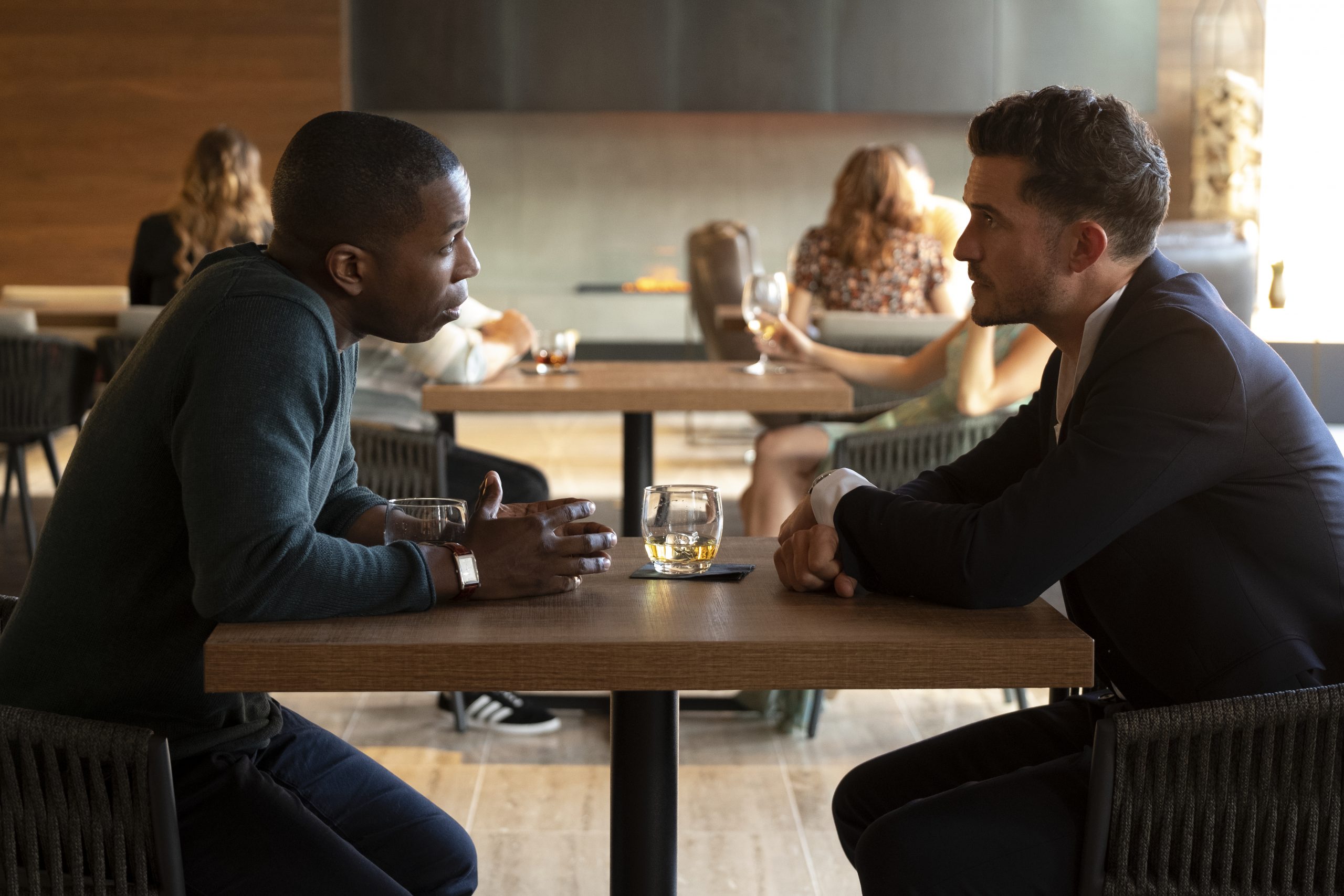
[L-R] Leslie Odom Jr. and Orlando Bloom in the romance/sci-fi film, NEEDLE IN A TIMESTACK, a Lionsgate release. Photo courtesy of Lionsgate.
2. Study the art of efficient explainers.
Beyond the romance genre the film establishes early, we’re also quickly introduced to the sci-fi elements of the story as well through the use of efficient explainers.
One of the treats of a good sci-fi film is getting to see some kind of new technology demonstrated. Between a new flip smart phone, digital pages to turn on a tablet, and the beautifully rendered time shifts, Timestack honors the “demonstrate new technology” convention of science fiction, and does it quickly, showing how this new tech is part of day-to-day life. No explanations needed.
On the other hand, some things do require a level of telling. Timestack uses one of the most efficient explainers I recall seeing. Early on, a strange energy wave travels toward the office building Nick (Odom) works in. After it passes, the woman next to Nick curses, saying, “These f**king time shifts.” Through the character’s reaction, we instantly know so much about the world the story and characters inhabit: time shifts happen, and they’re disruptive, common, annoying, and frequent. The characters further react by reaching for their phones; their boss tells them to go ahead and call home, to make sure everything’s okay. From there we quickly learn how the time shifts impact people — things can change in their lives, where they live, who they’re married to, what pets they have, what they’re wearing — from large to small, their lives may change. Worse, they only have a few minutes after a time shift where they may remember the time before, until those memories are long forgotten.
Study this art of efficient explanations to transfer sci-fi backstory and world-building to your audience.
3. Explore big ideas in a personal context.
Sci-fi does well when it both explores big ideas and keeps it personal. How might regular time shifts affect the lives of every day people? What kinds of concerns would they have? What would they worry about? How would it affect them?
The main character, Nick (Odom), indulges himself in fearful, controlling jealousy and doubt. Is his beautiful wife Janine’s wealthy ex-husband Tommy, played by Orlando Bloom, traveling through time, trying to break them up and get her back for himself? Nick reads like a fearful, obsessive man, on the verge of pushing away a woman he clearly loves beyond reason and who — although she clearly loves him passionately — struggles with his behavior and fantasies of harming Tommy by time traveling himself.
Although Nick is far from perfect, he is human in his flaws, pettiness, and not-unfounded jealousy. Timestack’s big questions about life, love, fate, and time thus have a personal lens through which we can explore them.
[L-R] Cynthia Erivo and Orlando Bloom in the romance/sci-fi film, NEEDLE IN A TIMESTACK, a Lionsgate release. Photo courtesy of Lionsgate.
4. Don’t let time travel questions unravel the story.
Another convention of most time travel sci-fi is to include some kind of illustration about how the time travel mechanism works, but Timestack doesn’t exactly fulfill this brief — except through the most basic offhand comments about time crimes being committed if you change someone’s past significantly (though it’s unclear how that would be found out). Otherwise, we’re mainly left to wonder and piece together how it works through the character’s reactions and understanding of their lives in a reality where time travel is readily available, at least to those with the means to pay for it.
Generally, I found the lack of a time travel explanation didn’t bother me because I was focused on the relationship elements of the story. Peter Sobczynski says, arguing that the short story gets away with this while the film does not, “Anyone attempting such a story needs to tell it in as clean and efficient of a manner to avoid inspiring those mood-destroying questions, at least until after it’s over.” To my mind, the minimal time travel explanation in this story worked well enough to not become distracting until after having watched the film, when I had time to mull over some of the complications and paradoxes created by it. Other reviewers disagreed. This may be a gray area for writers to explore: What’s the level of time travel rationale that works for you?
5. Reckon with universal themes.
Speaking of conventions, another powerful convention of sci-fi is reckoning with both universal and current themes. In Timestack, one of the aspects I found most compelling was the impunity with which the world’s super rich are able to make life-altering decisions for the rest of the world. With enough money, you can “jaunt” through time and alter others’ futures. The parallels to our own timeline are readily evident: billionaires launching rockets, engineering social algorithms, impacting the climate, influencing elections, and setting up missions to Mars. It’s a great challenge of our time, that the ultra-wealthy can have such outsized impact on the rest of us and potentially the course of human history. Timestacktakes this idea and spins it further down field. What’s fair when it comes to having money, and how the choices made by world’s richest people guide and create the future we get to live in? Something worth thinking about.
When writing sci-fi, keep in mind the big questions and themes you’re interested in and want to bring to life on screen for contemplation, reflection, and perhaps even to point out inequity or make an embedded call for change.
6. What stories do we want to tell about women?
As some reviewers and commentators point out, Timestack tells the story of two men vying for what feels uncomfortably close to ownership of a woman and her affections, as well as another character, Nick’s sister (Jadyn Wong), seeking to control the fate of her best friend’s life. The film walks a difficult line between romance, rescue, power struggles, ownership, and fate, and seemingly has blind spots about the way the story removes agency from the primary female character, though Nick’s sister at least passingly acknowledges that they’re fighting over Janine “like cave men.”
The negative reviews and comments beg a number of questions. Do we want to perpetuate romance storylines where men believe they have the right to control a woman’s future because they believe they belong together? What if they do“belong” together, according to both characters? What if your memories have been altered, and you don’t actually know anymore where you “belong” or with whom. If someone was trying to destroy your relationship with someone you love, would you fight back? Is there romance in that storyline? If the gender roles were reversed, would the story feel any different? Would that make it any less right or wrong?
Whether you agree with the reviewers or not, there’s a question here about what we want to normalize and perpetuate through our storytelling. Sci-fi is a genre particularly well-suited to exploring complex issues, turning old paradigms inside out, and reflecting on the kinds of stories we want to tell.
7. A different take on a villain.
(Spoilers)
Although John Ridley says of his film, “There is no villain. There is no bad person,” when it come to Timestack, Orlando Bloom’s character Tommy Hambleton is positioned as the likely villain: a wealthy, selfish man determined to stop at nothing to break down Nick and Janine’s relationship and reclaim his ex-wife’s affections. Early on, Nick even makes comments that hint at a standard Hollywood mano a mano showdown.
This story takes a different path, however, toward something more restorative than the traditional battle, something I’ve taken to calling a “collaborative” ending. Rather than a final, fierce oppositional battle against an antagonist, a collaborative or restorative ending sees the characters working together, healing a wrong, or restoring something for the better. (As another example, think of the end of Moana, where Moana heals Te Kā, the lava demon she’d originally set out to conquer, rather than destroying her, thereby restoring the beloved island goddess Te Feti in the process.)
Late in Timestack, Nick — no longer even remembering Janine, just knowing that something’s wrong with the life he has — makes a restorative change to the timeline that heals his opponent’s past in multiple powerful ways, making a new pathway to what he wanted (but forgot) in the first place: to be reunited with his soul mate. This sets him up for a twist on the standard fare of the “final battle.” Nick does in fact overcome something, but it’s the lost, self-absorbed part of himself he triumphs over, even in the haze of a time-shifted confusion, before he finds his way back to where he belongs.
***
Though Timestack faced scrutiny for the relationship structures it normalizes, its excellent cast, intriguing theme of a wealthy elite impacting others scot-free, painful lessons around loss and love, and thought-provoking questions about time and memory gift it with redeeming qualities and useful genre takeaways nonetheless.
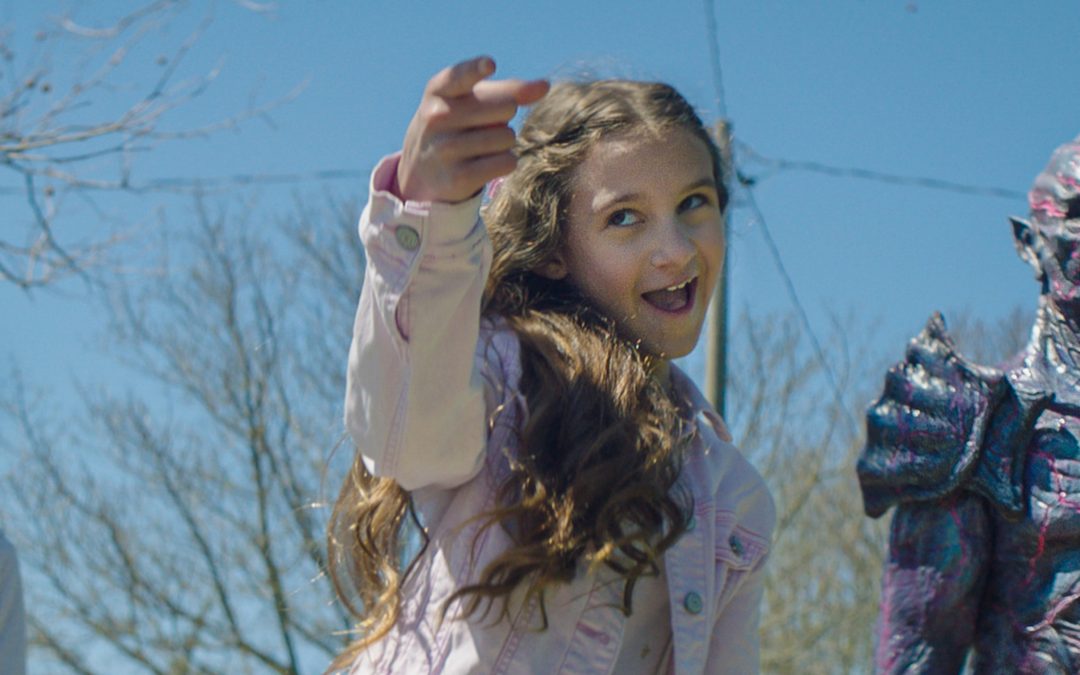
‘Psycho Goreman’ Is a Wacky Homage to Campy Sci-Fi Monsters
An article over on the Final Draft blog with PG: Psycho Goremanwriter-director Liam O’Donnell about his writing process, how he spends time on the visual aspects of his stories, and making monsters and aliens galore — all on a meager budget. [read more on the Final Draft blog]
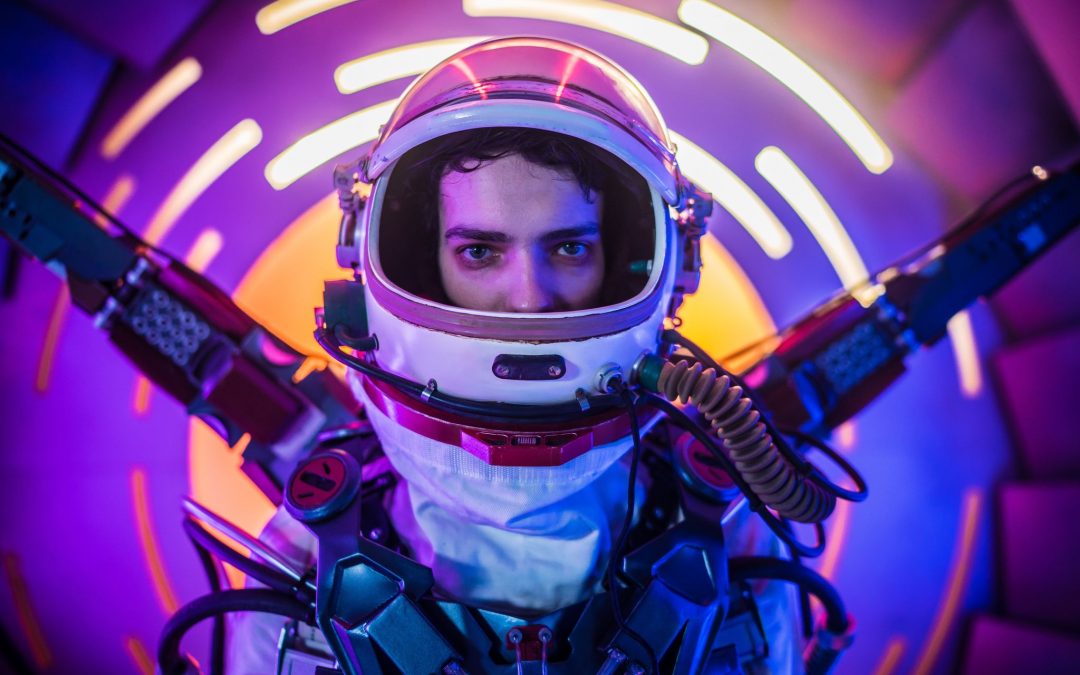
A new article over on the Final Draft blog with five screenwriting takeaways from 2067 to draw on as you craft your own sci-fi scripts.
1. A compelling “what if” premise
2. A hook that keeps your audience wondering
3. Global and personal stakes tied together
4. A time travel explainer moment
5. An inevitable but surprising and satisfying conclusion
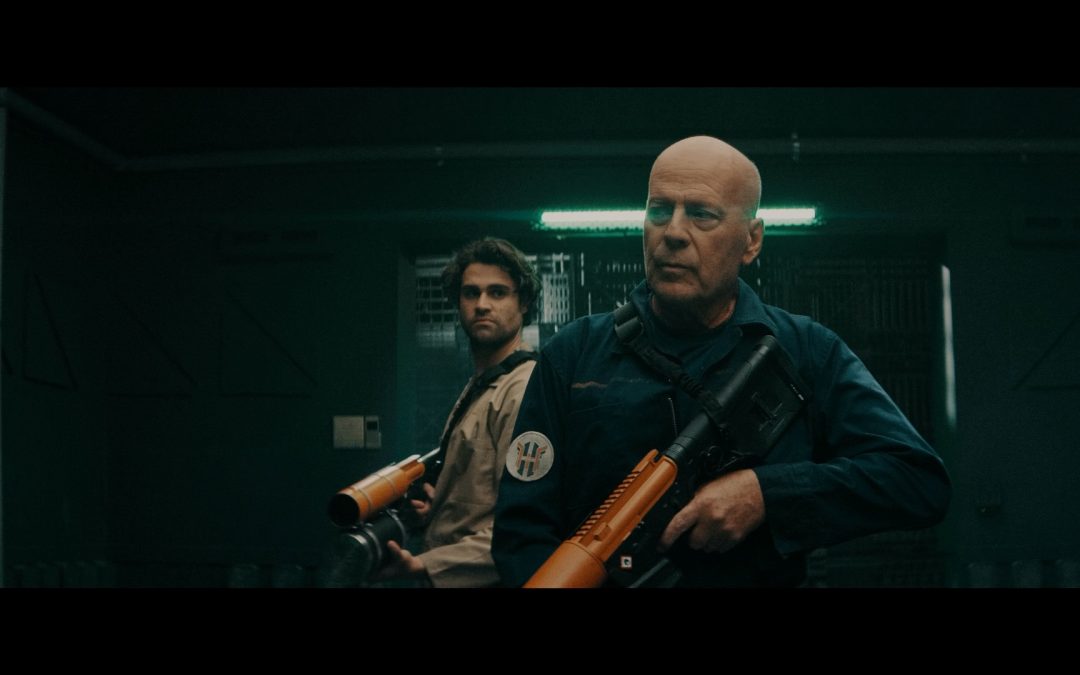
A new article over on the Final Draft blog with five takeaways sci-fi screenwriters can draw on in their own scripts from Breach, a sci-fi space thriller in the vein of the original Alien and The Thing — but with a twist.
1. Sci-fi is a flexible ‘reality’ genre
2. Ordinary characters in extraordinary circumstances come with a built-in character arc
3. A-list actors lend credibility to a film
4. Tie the global stakes to personal stakes
5. Your title makes a promise to the audience