
by Jenna | Feb 16, 2012 | Writing Articles
I’m sharing a free series on “How to Find the Courage to Tell the Stories You Are Longing To Tell.”
Today’s fourth and final post completes the series with thoughts on “How to Make Writing A Whole Lot Easier.”
- To read the first post in the series, “Why It Requires Courage to Write,” click here.
- The second post, “How to Spot the Stealthy Smokescreens that Stop You From Writing,” is here.
- Yesterday’s post, “How to Find Your True Stories,” is here.
 How to make writing a whole lot easier
It can sound like the easiest thing in the world to write. But when it comes to sitting down and facing the blank page, writing can be downright terrifying. Perhaps surprisingly to some, it takes a lot of courage to overcome all the fear, self-doubt, stories, and resistance to making it happen.
What I’ve seen is that when you take action to do the following things for yourself, writing becomes much much harder NOT to do. And that makes it SO much easier.
- Find peer support.
Connect with other writers. Be part of a community. Live and breathe writing and talk about it with other people who are actively engaged in writing and are firmly committed to their writing, come hell or high water.
Personally, I’m part of several writing communities, including my Called to Write community, my screenwriting class, and the online Scriptchat community. I make it a priority to hang out with writers who are writing regularly — and not just talking about it.
- Create social accountability.
Give yourself public deadlines and set public goals to use the tool of social accountability. When other people know you are promising and intending to do finish your writing project by a certain date and you know they are watching, it’s a LOT harder not to do it.
- Create solid writing habits.
Make yourself a writing schedule, use a timer to write in sprints, start early in the morning or write late at night — what matters is that you write and that you write regularly. And by the way, regularly means as close to daily as you can muster (my preference is 6 to 7 days per week).
Writing regularly, and sticking to it, surprisingly makes writing much, much easier. Back in the days when I used to write my newsletter on a monthly basis, it felt like scraping my fingernails over a dry chalkboard just to get myself going. But now that I’m blogging on a weekly basis and screenwriting on a daily basis, I find that I’m always running article ideas and story lines through my mind, which makes it oh-so-much easier to jump into when the writing clock chimes at 6 a.m. (actually it’s 5:45 a.m. these days, but who’s counting?).
- Have a willing spirit of adventure.
Enjoy the ride — have a willing spirit of adventure. Writing is an up and down journey. I LOVE it, AND, there are days when I feel like being run over by a truck might be a little bit easier. Thank goodness I have my writing communities to cheer me up on those days. Ride the highs and surf the lows, knowing you’ll make it to the other side.
- Be deeply honest with yourself.
You want to write, right? Be honest with yourself about that and what it will cost you if you don’t write. Also be honest with yourself about how scared you are to do it and about how you are creating obstacles to your writing. Only then can you face and overcome them.
- Make a commitment to write.
Decide, right now, that you are going to write, no matter what. Then do it.
Make a “Life Decision” about this, as Dr. Phil calls it, to follow your dream of writing. Once you’ve made that decision, there’s no turning back. Stop dipping your foot in the pond of your dream and start making it a reality. There’s no way to do it but one step at a time, even if it’s two steps forward and one step back for a while.
- Have the courage to write regularly.
Having the courage to write means doing it without fail, even in the face of fear, self-doubt, and those savage attacks by your inner critic telling you that you won’t succeed.
One day when I came home from dropping off my son at school, I realized that I was terrified to work on the next scene in my script, and I felt like I was frogmarching myself to the guillotine as I approached my computer. I said to myself, “I see you, fear, and you cannot stop me. I can at least write out the scene heading. I can at least chose the characters for the scene. I can at least brainstorm what I’d like to see happen.”
And with a little coaxing and a lot of courage, I was off and writing.
This concludes our series on “How to Find the Courage to Tell the Stories You Are Longing To Tell.” Thank you for reading along!

by Jenna | Feb 15, 2012 | Writing Articles
I’m sharing a free four-part series on “How to Find the Courage to Share the Stories You Are Longing To Tell.”
Our series continues with Part 2: “How to Spot the Stealthy Smokescreens that Stop You From Writing.”
To read yesterday’s post, “Why It Requires Courage to Write,” click here.
How to spot the stealthy smokescreens that stop you from writing
If you’re longing to write, but not doing it, you’re probably doing a number of other things instead. I think of these as “smokescreens”, because very often we don’t realize that we are fooling ourselves about why we are not writing — our fear. Our smokescreens mask that raw, naked fear and keep us busy thinking something else is going on.
Most people who say they want to write but aren’t doing it are usually instead:
- Retreating into fantasy.
When you’re retreating into fantasy instead of writing, you’ll notice yourself dreaming about the day when you finally have enough time to write.
You’ll usually have a story about needing to deal with something else first, like: Making more money, getting enough childcare, getting the house clean, finishing that other big project, just getting through this one rough patch in life, etc., but the truth is that there is nothing stopping you from writing right now.
- Procrastinating.
If you’re graduated from fantasy land about writing someday, but still not writing, you’ve probably moved on to procrastination or one of the other tricky smokescreens below.
Procrastination turns up when you’ve made the time to write, but when it comes time to do it, your bathroom suddenly looks really dirty or you realize you are massively behind on [your email, your laundry, your sex life, your book keeping, your fill-in-an-excuse-here].
I’ve seen some writers say that procrastination is a good thing — that we’re allowing our creative ideas to build up before they come bursting out of us — but I read procrastination as fear, often wrapped up with perfectionism.
- Feeling apathetic.
Apathy rears it’s ugly head and tells us that we don’t care. It sounds like, “I mean, what’s the point? I don’t even FEEL like writing today. I’d much rather watch Castle or catch up on polishing my silver. Writing isn’t that important.”
ANNNH. Wrong answer.
What’s really going on here is again, you guessed it, fear. This is fear masquerading as apathy, only it’s so tricky it’s got you believing you aren’t even interested. Think again.
- Wandering in a fog of creative confusion.
Creative confusion is the stealthy partner creative apathy. Creative confusion keeps us spinning in circles, telling us that we don’t know what to write. It keeps you vacillating between having too many ideas and not knowing where to start.
The antidote for creative confusion is often brainstorming, putting ANY words on the page, asking yourself a great question (“What do I really want to say here?”) or simply picking a project to start with. Sometimes we just make it too complicated, again because we’re letting our fear get the better of us.
Takeaways
Here’s what I want you to take away from this: When you are fantasizing about writing, procrastinating about writing, or feeling apathetic or creatively confused about writing, you are operating out of fear. It might not LOOK like far, but the odds are high that it’s fear running the show.
But because you know this now, you have the chance to bust that fear wide open and move past it.
“Ah ha! You can’t fool me,” you will say to your fear and self-doubt. “I see you, and I know you are trying to stop me… but it won’t work.”
Then coax yourself to the page, and start writing. ANYTHING. Seriously. Because the antidote to any of these creative smokescreens is ACTION.
Stay tuned for the next post in this series coming your way tomorrow, “How to Find Your True Stories.” Watch for it on the blog or subscribe here.

by Jenna | Feb 14, 2012 | Writing Articles
This is part of a series on “How to Find the Courage to Share the Stories You Are Longing To Tell.”
Today’s post starts the series with thoughts on “Why It Requires Courage to Write.”
Why it requires courage to write
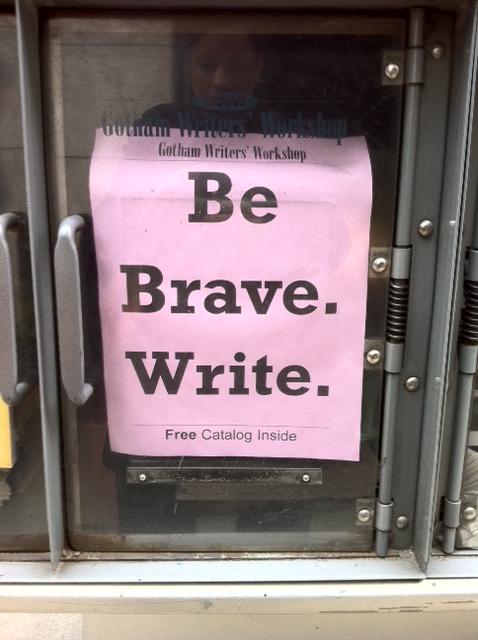
Special thanks to John Klymshyn for this image
I’ve dreamed of writing for years, since I was a child. And I have. Over the last 9 years I’ve written hundreds of articles, blog posts, and newsletters through my coaching business. Before that, I wrote city plans. Before that, my graduate thesis.
But I’ve always dreamed of writing a proper something — a larger writing project with a definitive end, like a book or a screenplay.
Somehow, I never seemed to find the time to write until recently — just in the last year or so. And now I’m writing on a daily basis, soon to finish my first feature length screenplay.
What I didn’t understand, until now, was that my lack of writing WAS NOT tied to all the things I believed about what it would take for me to write, like that I needed more time, better ideas, sudden divine inspiration, the proper writing space, a better computer, or any of the other things I was telling myself.
Instead, I discovered that what was going on at a deeper level was that I was afraid. I was afraid to write.
And this is what I’ve seen with many people who say they want to write but aren’t doing it.
Just like me, they are afraid.
Common fears
If you have fear coming up around writing, you might be experiencing some of these common concerns I hear from writers:
- You’re afraid the writing you’re longing to share isn’t serious, artistic, engaging, funny, clever, dramatic, or fill-in-the-blank enough.
- You’re afraid that you’ll embarrass yourself if you put your words out there for other people to see.
- You’re afraid that you won’t be able to do a good enough job telling your stories — you won’t be able to do them justice and you’ll let your ideas down.
- You’re afraid you won’t be able to come with good ideas.
- You’re afraid that other people will be hurt if you write things they don’t like. You’re afraid they will see themselves in your stories and be offended.
- You’re afraid you don’t know how to write well enough, but you don’t give yourself the chance to learn how because you believe that writing requires innate talent and that if you had it, you’d already be writing.
- You might even be afraid that your best work is already behind you.
What you need to understand is that these fears are ONLY fears. Nothing more, nothing less. They MAY come true, we may fall on our faces and have to pick ourselves up again, just like my son did on his way to school this morning.
You also need to understand that these fears are your ENEMIES. They are the enemies to your dream of writing, and courage is your antidote.
Stay tuned for the next post in this series coming your way tomorrow, “How to Spot the Stealthy Smokescreens that Stop You From Writing.” Watch for it on the blog or subscribe here.
by Jenna | Feb 8, 2012 | Writing Articles
Are you waiting for the right mood to strike before you work on your creative project?
Are you waiting until you have the right room to write or paint in?
Are you waiting until you have the right computer before you can start writing?
Are you waiting until you have the right “voice” or platform before you start sharing your message?
Are you waiting until you’ve picked the right project to start working on?
Are you waiting until you have more money before you do your art?
Are you waiting for big blocks of time before you write songs, start your novel, or get that screenplay off the shelf for a rewrite?
Are you waiting to be divinely inspired before you start your project?
Are you waiting for permission to create?
Wait no longer.
Your art will not happen unless you do it. And sometimes that means showing up and doing it even if you don’t know what you’re doing yet.
Besides, in a study by Robert Boice about academic writers, he found that writers who committed to writing daily were TWICE as likely to have a creative thought as writers who wrote when they “felt like it.”
The key here is consistency. Making the effort to show up every day to your creative passion will foster and spark your creativity, not the other way around.
Warmly,

by Jenna | Feb 1, 2012 | Reflections
Yesterday was a tough one.
It was a dark, drizzly day after a bad night of sleep, followed by a bit of bad news. And it was on the heels of a wicked cold that had me laid up Wednesday through Sunday. Not a good cocktail for a sensitive soul with work to be done.
Needless to say, I came home after dropping off my son to feeling rather adrift.
I didn’t know what I wanted to work on. None of the many items on my idea list or to do list was the least bit appealing. Even though I had come up with some nifty ideas on the way home in the car, when I sat down at my desk and confronted my computer screen, a strong feeling of despondency — and resistance —came up.
I didn’t want to do anything.
Or did I?
I checked in with my heart.
I checked in with my spirit.
I asked, “Is there anything I DO want to work on?“
The answer came back, “Yes. My script.”
(And this was even after doing my first round of writing first thing in the morning.)
So I did. I got out my latest set of assignments, turned on my timer, and dug in.
An hour later, I felt like myself again. I even went on to have a happy, productive day working with my clients and revamping my website (you can see the evidence on my Shop and Home pages).
By doing my work, by turning to my calling rather than away from it, I found myself.