by Jenna | Jan 19, 2012 | Writing Articles
The other day I had an email from a friend about me screenwriting at 6 a.m. every morning. She said, “I admire your discipline. It must come from a deep passion.”
I thought, “Is this passion? Is this discipline? Is that what this is? That doesn’t quite feel right.”
Perhaps this is because I’ve struggled for so long to be clear about what I’m passionate about that the word “passion” has lost meaning for me.
Then, last week I found myself saying to my writing community participants how you would have to fight me off with a sword to keep me from writing.
And I thought, “Huh! Passion.”
But the clincher was when I saw Jeanne Bowerman‘s tweet:
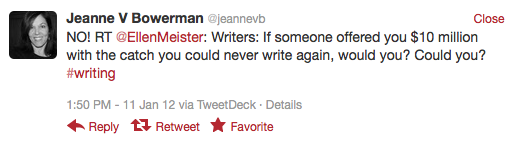
I knew my own answer was “No. Way.”
Then I got it. This is beyond reason, it’s beyond passion. It’s a kind of fierceness I never expected.
What shocks me is that this fierceness has been born out of the discipline of writing on a daily basis, not the other way around. And I hesitate to even call it discipline, because there are days when I have to drag myself out of bed with bribes and threats alike. The funny thing is that it’s gotten more scary NOT to write than TO write.
I didn’t know I would love writing like this. I had no idea until I started doing it regularly. Daily. At ungodly hours.
I’m also fascinated to have discovered that taking a day off or two DOES dwindle this feeling. I find myself drifting and uninspired when I stop.
But as long as I write every day or darn close to it, I’m good.
And I’m doing this by making it a LOT harder NOT to write than it is TO write:
- I set my clock early. If I don’t get up and write immediately, I’ll miss my chance before my husband goes to work and I’ve got kid duty.
- I set public goals with my writing community EVERY DAY. And they notice if I don’t show up.
- I have assignments due every day for my ProSeries screenwriting class. And they’re counting to make sure we’re doing the assignments.
- I’m the coach for the writing community too, so I have a responsibility as a role model too.
I’ve got multiple layers of accountability. Plus a healthy fear that if I stop writing, it’ll be hard to get started again. And a fierce belief that I’ve found my true calling.
by Jenna | Jan 12, 2012 | Writing Articles
One of the most common excuses I hear from people who say they want to write but aren't doing it is that they don't have enough time to write.
If you're attached to that excuse, you might not want to keep reading. (I'm feeling a little feisty today!)
I see frequent articles on the web about "how to find time to write" — and I've even written one of them myself — and yet people are still not writing. This is interesting when you consider the fact that over 81% of Americans answered "Yes" when asked "Do you think you might have a book in you?" in a 2002 study from the Jenkins Group.
ƒSo the desire is there, but not the action nor the results.
Why?
What you're telling yourself:
I know you think you are too busy and that you don't have enough time.
I know you're longing for a whole day off where you can finally sit down and focus on your Big Writing Project, but when that day comes, you remember that the laundry really needs to get done or that you promised Jane you'd go with her to that party and you don't have anything to wear so you have to go shopping and while you're out you remember that you forgot to... Well, you get the picture.
I also know you have too much work to do and the kids need you. And that those things are true.
I know you also want to write but you aren't sure where to start or what to write about. I know you think you need to get a little farther along with your career and save some money (or get the right room or the right computer) before you can devote yourself to your writing career.
I know this because I was telling myself these same things for too many years to count.
And I know something else. These things? They are Not True -- at least not in the larger sense.
Let me tell you what is True.
What is true is that the reason you are not writing is because you are scared.
You are scared that you don't know how to write, or what to write about.
You are scared that your writing won't be good enough, original enough, or that maybe someone else has already said it better.
You are scared to do the hard work of writing, and overwhelmed by the thought of such a big project.
You're scared you might hurt people if you write your truth. Or disappoint them.
So you don't give yourself a chance to do it.
This thing about time is just a story.
You can go on telling yourself that story if you want to, but we both know it isn't true. Because we both know the real reason you aren't writing is that you don't believe in yourself.
I've found the time to write every single day after years of telling myself I didn't have time. Years! And I'm busier now in my life than I ever was before.
Sometimes it exhausts me. But more often, it is the fuel that fires my LIFE. I found myself saying to my writing community participants yesterday that you would have to fight me off with a sword to keep me from writing. And this from someone who thought she could never write fiction to save her life -- except in her wildest dreams -- up until a year or so ago.
Here's what else I know:
I know that if writing means as much to you as you say it does, you will find a way to make it happen. If you want some help, that's the purpose of my writing community.
"The antidote to exhaustion is wholeheartedness."
To close, here's a passage to inspire you:
"You know that the antidote to exhaustion is not necessarily rest?"
"The antidote to exhaustion is not necessarily rest," I repeated woodenly, as if I might exhaust myself completely before I reached the end of the sentence. "What is it, then?"
"The antidote to exhaustion is wholeheartedness."
~ An excerpt from Crossing the Sea by David Whyte, here.
by Jenna | Dec 28, 2011 | Writing Articles
A few weeks ago, I wrote about getting up at 6 a.m. to write. I’ve continued with the experiment and I’ve been enjoying the results very much.
I’ve been surprised to notice a number of interesting side effects:
I feel better rested.
I’ve been going to sleep no later than 10 p.m. if I can possibly help it, and usually more like 9 or 9:30 p.m. I’ve read that you get the most regenerative sleep between the hours of 10 p.m. and 2 a.m., and I’m finding that it is true.
I’m using my time much more wisely.
Something I’ve struggled with over the past year in particular is how I use my time in the evenings.
I was watching shows on streaming video… and then watching just “one more” until the evening was gone and it was far too late. Or obsessively playing iPhone games or looking at things online.
I felt like an out of control addict who was doing unhealthy things in the name of having “alone time.”
Instead, now I reward myself with little nibbles of these formerly addictive devices when I complete a task, and it doesn’t stop me from being efficient and effective. If anything I feel more effective because I’m enjoying these little breaks as true play.
I feel calm.
In part this is due to Just. Doing. The. Writing., but I believe it also has to do with doing it so EARLY.
Getting up at 6 not only demonstrates my commitment to myself and to my writing, but also helps me get it done. Instead of having it hanging over my head for an entire day (“When am I going to fit it in?”), which makes me feel incredibly guilty, I feel at peace when I do it first.
It’s like I’m saying, “I’ve done my hardest work. Now, what else is there?”
I feel happy.
A big part of feeling happy is the result of actively working to fulfill my calling as a writer.
But there’s also a kind of freedom and joy that comes from doing it first that is highly compelling.
Contrary to how it might appear from the outside, writing triggers a huge amount of fear for me, so facing it first (while still half asleep, I might add), creates such a huge sense of relief that happiness seems to rush in and fill the void.
How cool is that?
by Jenna | Dec 8, 2011 | Writing Articles
Being trapped between a “day job” and your true creative destiny can be awkward.
It doesn’t have to be.
All too often, having a “day job” or “support job” looks like doing work you don’t enjoy in the name of paying the bills, while you pursue your true creative calling on the side.
In a more optimal scenario it looks like doing work you enjoy, ideally closely akin to your creative work.
For a long time, I’ve wanted to be a “real” writer. You probably know that already. *grin*
And for a while it felt like my coaching business was preventing me from doing that.
What I’ve since learned is that I was the only one stopping myself from pursuing my creative writing, and I had to make a few adjustments to change my relationship with my business to make my writing life a priority.
Inner & Outer Adjustments
Here’s what I mean:
- I had to start seeing myself as a writer and believing that my creative destiny and future success lies in that direction.
- I had to reorganize the structure of my days and life around my writing.
- I had to start thinking of my coaching business as my day job — luckily one that I like very much, and fully intend to keep doing — but one that is not the only center of my universe.
- I had redesign my business model to be more in alignment with my writing so it didn’t feel like such a departure from my own creative work.
Ideal Support Job Alignment Checklist
Some things to take into consideration:
- Make sure your support job pays well. Support jobs are Good Things, because they give you breathing room, usually financially, so you can pursue your creative destiny free from needing to rely on it to keep a roof over your head. (Not setting it up this way = a recipe for feeling creatively blocked if I ever heard one. I made this mistake when I first started my coaching business.)
- Make sure your support job leaves enough time and energy that you feel like you have the bandwidth left to pursue your creative work. Support jobs are Good Things only when they work for you, so check to make sure your “day job” is truly supporting your creative work. If it is draining and deadening you, it’s time for a recalibration. Having a good support job that feels good to you can make all the difference in the energy, spirit, and passion you’re able to bring to your creative work.
- Ideally, make sure your support job is aligned with your creative work. In an ideal world, your support job will match or resonate with your creative work. If it’s not, can you make any adjustments? Your spirit will be so much happier.
by Jenna | Nov 30, 2011 | Writing Articles
I’ve been getting up at 6 a.m. lately to do something that feels remarkable.
Before you think I’m “just an early bird” let me tell you that up until recently: 1) my ideal sleep scenario involved NO alarm clocks and waking up naturally, usually between 8:30 and 9, and, 2) after a fairly recent and excruciating bout of sleep deprivation à la new baby turned into toddler, …
… if you had had the audacity to suggest that I would get up at 6 a.m. for ANYTHING I would have reacted with revulsion.
So.
That said, here I am, pretty much daily — even on weekends! — getting up at 6 a.m. to WRITE.
And I LOVE it.
Love it!
How insane is that?
My Fear of Writing Has Turned Into a Fear of Not Writing
Today a friend asked me to think back to what it was like before I was writing regularly, about what that was like. I almost cried. And a wave of fear went through my stomach.
See, the thing is, I’ve crossed a line.
It’s the invisible line between terror in the face of writing and terror at the thought of not writing.
How did that happen?
I mean, of course I know the answer (decision, commitment, regular and consistent action, accountability, passion, etc.) but How. Did. That. Happen?
It feels truly amazing.
Why Does Getting Up Early to Write Work So Well?
But why, you may be asking, why does it really matter if you get up at 6 a.m. to write? Why not write at 9 a.m.? Or 3 p.m.?
Here’s why it’s working for me:
- When I start writing before I’ve entirely woken up, my inner critic is a LOT quieter. In fact, I hardly hear from him at all. And that makes my life SO much easier.
- When I get up early to do my soul’s true work first, I feel a deep answer to the Powers That Be saying, “Here I am. I am doing my part.”
- When I put my Big Dream FIRST in my day, I feel calm for the rest of the day. And that calm is highly addictive.
- Because I’m showing myself, deep down, that I’ve reorganized my life around my passion for writing and I really, really mean it.
I don’t know if I’ll keep doing this — I think I will — but so far, it rocks as successful experiments go. I was inspired to try this by hearing about so many writers that get up so early to write. I figured they must know something I don’t.
Holy smokes, they were right.