My Sci-Fi Circuit article on ScriptMag originally published on October 25, 2013.
One of the primary reasons I love sci-fi is that it provides a powerful vehicle for exploring social issues that might otherwise be too politically incorrect to tackle head on. I cut my sci-fi teeth watching Star Trek, which is known for its many messages and moral explorations, and I'm quite sure that it hugely influenced my own perspectives on how we treat each other on this small planet we call home.
Although many people argue that of theStar Trek series the Voyager story lines in particular were too heavy-handed with their moral overtones, I adored watching Captain Janeway tackle issues of ethnicity, equality, sexism, and more. I loved that she was a female in the captain's chair, one with a strong mind and moral compass. Yes, I've seen articles bashing her moral inconsistency online. Yes, I've seen arguments that she's the worst captain of them all, that her decisions were questionable, etc. etc. I don't care. I loved her, and I loved watching her think. (My only complaint about Janeway was that she was rather asexual, rarely (if ever) getting involved romantically, nor having children.) The fact that her character has sparked such debates about whether her morality was consistent shows that her moral explorations were a central hallmark of the show.
The Messages of Elysium
Recently, watching Elysium, I was again struck by the power of how well a message can be delivered with science fiction. Elysium gives a rather direct illustration of social inequality, of the haves and the have-nots, and the desperation forced on the people who have less -- they'll do anything, rush across guarded borders at the risk of their own lives to get what they need. In Elysium, it's miraculous medical care that can cure anything instantly that drives much of the struggle.
The parallels between our current world and this invented world are crystal clear. Some of us have more than others, and we aren't willing to share it with those who don't. In fact, we'll fight hard to keep those who don't from having it, even if it means taking lives. And to people without Western medical care, our own level of access must look like the most miraculous of resources. Look, let's face it, in the Western world, we take so much for granted. This movie picks up that reality and puts it right in our faces.
What Worked
What I thought Neil Blomkamp did so brilliantly was to SHOW us the contrast. There wasn't a lot of pontificating or exposition about how unfair the medical system was, or the pain, struggle, and risks people faced to get care, but he illustrated that lack through the action of the story. Whether or not you think Elysium was a good storytelling, Blomkamp put us right into the position of feeling the unfairness. The closing scene, which finally shifts the inequity, left me thinking, "Why didn't they do that before?" And indeed, why can't we do that now? He leads us to ask the questions OURSELVES.
To me, this is the essence of sharing a powerful message. To illustrate it clearly, and to design it such a way that the audience itself can't help but questioning the way things are.
The Power of District 9
I had a similar experience watching Blomkamp's District 9. Again, it portrayed an obvious example of the social inequities and racism in South Africa. The story didn't tell us it was wrong, it just showed us. And the chilling tale of a man caught up in the apartheid-driven events only illustrated the story at an even deeper level.
Blomkamp showed us not only the bad behavior of our own past, but also where we are highly likely to go under similar circumstances. I felt entirely convinced by his depiction of one possible way human-alien relations could play out.
And again, I felt that he delivered the message in such a way that left me asking questions and wondering how we would react, what we would do, and what we are and are not doing right now. Bam!
Not So Much With Avatar
On the other hand, as much I loved Avatar, I felt the many, many messages of spirituality, corporate greed, private militarism, and environmentalism (among others) were heavy-handed and hard to swallow. Just when I was hit by one message, another would come along.
And what's the difference? Is the core of the problem just the sheer quantity of message-laden scenes in Avatar? Or did it just fail to deliver fully on an emotional level? Again, don't get me wrong, I enjoyed the movie very much, but at the same time, there were some very awkward notes hit along the way. (I still can't get that scene out of my mind where they first introduce the concept of extracting the "unobtanium" from under the Hometree.)
Just One Message?
I'm reminded of Chris Soth's interview with me for Sci-Fi Circuit, where he mentioned the importance of changing only one thing in the sci-fi world in order to have the greatest impact, to avoid watering the story down, and to keep from wandering into fantasy instead of sci-fi. Perhaps the same is true for movies with a message: Focus on one core message and illustrate that with your storytelling, lest it becomes too on-the-nose, preachy, or heavy-handed.
Perhaps the adage "show don't tell" is the key here.
What are your favorite examples of messages in sci-fi movies? What made them work?
My Sci-Fi Circuit article on ScriptMag originally published on September 27, 2013.
As a sci-fi screenwriter, I'm interested in more than just big tent pole movies. I want to write and see sci-fi stories with heart, stories that make me feel, stories that reveal character. I've always been a huge fan of Firefly and Serenity for that reason, and Joss Whedon continued to impress me particularly with his character work in The Avengers too, even though it also fit the bill of big summer blockbuster.
I recently connected with my fellow ScriptMag columnist Jeff Lyons around the subject of the Enneagram, which he is an expert at using in writing, and asked him how we might see the Enneagram showing up in sci-fi and how we can use it to improve the impact of our stories. Turns out, the Enneagram can be used for for more than character development -- which is what most writers tend to think it's for -- and even get into story structure with it!
I invited Jeff to talk to us about what the Enneagram is and how it can be used in sci-fi storytelling. Let's see what he has to say.
Thanks for being here, Jeff. First, why don't you start off by explaining a little bit about the Enneagram and what it is, and how you help writers use it to become master storytellers?
The Enneagram is the most powerful system available today that describes the nine-core personality drives underlying all human behavior. Each of the nine drives is rooted in thoughts, feelings, and actions that largely determine how we interact with the world, for good or ill. The Enneagram is not our personality, but it is the crankshaft of our personality; it is the thing that drives us through our personhood and through our lives. Everyone has an Enneagram style, including fictional characters and even stories themselves!
All writers and storytellers face the same problems when developing new work: how do you make characters ring true; how do you develop plots that are believable; how do you seamlessly connect all the pieces of a story so everything makes sense; how do you find the right, true, and natural structure of any story?
Traditionally, writers and storytellers familiar with the Enneagram approached these problems with the only tools they knew: Enneagram typing and breaking down characters within stories by core styles, wings, subtypes, tri-types, etc. This is not new news; Enneagram practitioners that are also writers and/or storytellers have been using it to develop characters for novels, plays, and screenplays for years.
While these conventional approaches may have helped develop multi-dimensional characters, they were never meant to solve the problems associated with developing a story from scratch, or fixing one in desperate need of a rewrite. Writing detailed characters is not the same as developing the full structure of a story from inciting incident through final climax. The reality is that traditional Enneagram approaches cannot stand alone in solving the big story problems faced by storytellers. They must be part of a bigger methodology; one that leverages the power of the Enneagram as well as the power of story structure.
What I teach writers is not just how to write great characters using the Enneagram system, but how to use the Enneagram to reveal the underlying structure of any story -- thus making them masterful storytellers.
I understand that there's a particular Enneagram type that lends itself to each genre. Can you describe for us which type is best suited for the sci-fi genre and how it so naturally lends itself to sci-fi?
There are several configurations that relate to sci-fi:
The pure sci-fi story (with no mixed genre elements) is best represented by the Five Enneagram style. This is the thinker style. Typically, in these stories you have the scientist or “expert” faced with an intractable problem or puzzle that has to be solved, usually through mental powers. This is stereotypically seen most clearly in the old sci-fi “B” movies from the 1950s: the formula of these old movies is pure Enneagram five character development.
Five stories are basically situational or problem-solving focused, rather than deep, complex narratives about human dynamics (there are exceptions). These stories are focused on how to solve the problem of staying alive, or remaining human, and this is achieved primarily through the Five’s intelligence and cool-headedness.
There are some general qualities of sci-fi five protagonists that generally get expressed in most pure sci-fi stories:
The Five protagonist uses his or her mental prowess to survive an irrational and threatening world.
The Five protagonist is intelligent, observant, and most importantly unemotional.
The Five protagonist is brilliant at solving scientific problems.
The Five protagonist keeps a cool head when others lose theirs (literally).
The Five protagonist mistrusts emotions and is basically a loner.
Through his or her brainpower, the Five destroys or controls the irrational force or malevolent power that is threatening the world.
The Five does not seek leadership, but can be decisive and commanding when forced by circumstances to take over the role.
(These qualities are modified slightly from those developed by Judith Searle, author of The Literary Enneagram.)
The sci-fi/adventure mixed-genre is very common today. This is a combination of Five (the thinker Enneagram sytle) and Seven (to have fun Enneagram style). In this configuration the adventure is seen as adventurous—not a trial by fire or a crucible. The Five-Seven protagonist has a sense of excitement, fun, and adventure. Some examples of this in books and film include: Star Wars, Star Trek, Close Encounters of the Third Kind, Cocoon, and Back to the Future.
The other mixed-genre form of sci-fi that is very popular is the sci-fi/horror story. Horror is another basic Five Enneagram story. So, even though it's mixed genre, the sci-fi/horror mix is more like pure sci-fi, meaning a strong Five protagonist as outlined above.
These days, there are almost no stories that do not combine genres. The most successful stories are those that combine genres for maximum impact. The Enneagram points you to very tight and condensed narrative design that makes story development more accurate and more dramatically compelling.
And you use the Enneagram not only to design your characters, but also to design your plot and structure, correct? Can you tell us a little more about how that would work?
Yes, the Enneagram is an amazing tool for revealing any story’s structure. I've developed a system called Rapid Story Development™ that uses the Enneagram to cross the gap between idea to story. It shows you how to connect plot to character and character to plot. It reveals the main character traits, quirks, and flaws that spawn the perfect opponents, the right supporting characters, and the essential story milestones (inciting incident, midpoint complication, low point, final battle, etc.) necessary to move a story along its right, true, and natural dramatic path. These concerns are not character development issues -- they are structural issues that determine character.
Story structure tells you who your protagonist should be, who the opponent should be, what core relationship needs to exist to drive the middle of your story, and how all these pieces fit together to generate dramatic action.
And the Enneagram is simply the best tool available for identifying these pieces.
How would we see this playing out in a sci-fi story? Can you give us any examples or illustrate it for us in some way?
The Matrix gives a great example of how story structure is informed by the Enneagram (and vice versa).
First, let’s look at the Enneagram elements divorced from any story per se, meaning let’s look at the sci-fi genre as a Five Enneagram protagonist.
5-Thinker Enneagram:
The Five is smart, intellectual and voracious for more information. They are only safe in the world if they can figure out how it works. Once they figure out their environment, then they can control the people around them, because the world would be a wonderful place if it wasn’t for all the stupid people mucking everything up.
At their worst, Fives control their environment by controlling the information. They share their knowledge strategically, only in a way that keeps them safe. They keep people at a distance, hating strong emotion, which they see as needless and wasteful (silly humans). Those damn emotional people! Their greedy desire to keep data close to the vest leads them into paranoia and isolation in their ivory tower. All of this constriction is driven by a core fear they may be wrong or incompetent, so they disintegrate into useless specialization—a pathetic way for them to feel "expert" at something. Their ultimate desire is to be capable and competent—and know it.
The low point of this type is where our character's arc begins.
The Five protagonist's path to change is that they must learn their that they are capable, competent, and wise, and it is their knowledge that finally lifts to the vision that moves them into their Enneagram "integration" point.
They move from their ivory tower of intellectualism to bring their light of knowledge to the world as a visionary, and in their vision they step up and lead. This is the natural growth arc of the Enneagram Five protagonist: moving from being a paranoid, greedy, and fearful jerk into competent, confident, wise visionary that leads others out of the darkness to a new vision of the world.
And this is how it plays out structurally in the actual story:
Neo is isolated and devoid of human contact (silly humans). He lives in his bedroom surrounded by a world he controls through his technology. The world only knows him through his hacker persona. He controls information, and so he controls his environment and the people who might want access to him and what he knows. He is flat emotionally, he clearly does not like emotionality in himself or others. Driven by a fear to be more, to be capable and competent beyond his imagination, his world is turned upside down when smarter people control him with information he doesn’t not have. He is now proven to be wrong and incapable. His worst nightmare is realized. He is now forced to regain his equilibrium, but to do so he must rely on people he doesn’t even know -- another nightmare for a Five Enneagram caught in the downside of their style.
But, what this all leads to is his evolutionary change from paranoid, greedy, fearful jerk to his competent, confident, wise visionary self -- he is THE ONE -- who will lead others out of the darkness to a new vision of a world. Neo’s growth is classic Enneagram integration to the upside of the Five Enneagram, i.e., visionary, self-reliant leader who empowers others, rather than controlling them.
What the above illustrates is how the Enneagram qualities find an amazingly accurate reflection in Neo as the protagonist, in an almost scarily accurate mapping across the abstraction of the pure Enneagram style characteristics to the story beats of The Matrix.
Any other thoughts you'd like to share with us today?
It’s important to understand that writing and storytelling are not the same thing. Storytelling is about story structure. Writing is about language, the use of language, and the romance of the rhythm of words to convey emotion and ideas through rhetoric.
Storytelling and writing use different skill sets and serve different functions. Rarely do both skills exist in the same person. Few writers do both well. And the one most people fall short on is storytelling. Most people are good writers, or at least passable. But, their storytelling skills are almost always lacking.
The Enneagram can help you become a better storyteller, because it can help you learn story structure and can thus shore-up any weakness in story development. If you are like me, you have specific strengths and weaknesses as a writer. One of the weaknesses is undoubtedly story structure and development. I only say this because this what I experience with 90% of the writers I work with (novelists or screenwriters). It’s not a judgment that you are bad and wrong, no—you’re just human. Get over it. Suck it up and do the work needed to strengthen where you are weak. Learn story structure, learn the Enneagram. Both have learning curves and you won’t become masters of them overnight. As with anything, mastering any art takes putting in your ten thousand hours (see Malcolm Gladwell’s book Outliers: The Story of Success). Put in the time, put in the sweat, and put in the tears. You will only excel in the end, and you will succeed.
Thanks, Jeff!
About Jeff Lyons
Jeff Lyons is a working screenwriter and author. He is a regular guest lecturer at Stanford University's Online Writers Studio and at the UCLA Extension Writers Program, as well as a webinar instructor for The Writers Store and Writer's Digest University. He is also a regular contributor to Script Magazine, where he writes his popular column: “Story Talk,” and to Writer’s Digest Magazine, one of the oldest and most widely read writing magazines published in the U.S. Jeff is the founder of Storygeeks, a professional services company offering story consulting, training and editorial services to screenwriters, novelists and nonfiction authors. His film Billy Miske is currently in pre-production in the U.K. through M4West Pictures Ltd. More information can be found on his website, storygeeks.com. Follow @storygeeks.bsky.social on Bluesky and “like” Storygeeks on Facebook. In 2013, he will be publishing an e-book entitled Anatomy of a Premise Line: 7 Steps to Foolproof Premise and Story Development.
My Sci-Fi Circuit article on ScriptMag (part II of II) originally published on August 30, 2013.
This is a continuation of my last article, "Sci-Fi Circuit: Sci-Fi Storytelling, Part I -- Story Type, Mistakes, & Big Ideas", with screenwriting mentor Chris Soth. In Part 2 of this series, we'll explore the classic structure of a sci-fi screenplay, talk about an overlooked aspect budgetary considerations, and look at coming up with the next big sci-fi idea.
Structuring Your Sci-Fi Screenplay
As we discussed last week, Chris uses ten story types along with his mini-movie method to structure a screenplay. For sci-fi, he uses a supernatural story type(read more about what this means and why he uses it in last week's article).
The Opening
First, make it clear this is a supernatural sci-fi story. Chris says, "A supernatural story will have something supernatural occurring in the prologue or opening to demonstrate that the supernatural exists here. In a sci-fi story we might see advanced scientific phenomenon that defies laws of physics as we know them."
For example, Chris says, in the The Terminator, the time travel "bubble" appears right away with the Terminator. "Arriving naked in his blue electric bubble, he appears in our time. We know from perhaps the first frame that something supernatural is occurring."
So the movie begins with something to state the rules of this world -- something that doesn't exist in our present-day lives.
Other examples could include seeing a monster or an alien right away (Men In Black) or an asteroid headed toward Earth (Armageddon), or a space ship mining vessel being hailed from an nearby planetoid (Alien).
Often these openings do not feature the protagonist of the story. As an example Chris describes Men In Black, "It opens with illegals trying to cross the border from Mexico into the United States -- but they are space aliens. In that first scene, we see that aliens do live among us, and that we have an agency that deals with these space aliens and documents them. Those rules are set right away in the first scene." And Will Smith, our protagonist, does not appear in that sequence.
End of the First Sequence
Then, "about 15 minutes into the story (or about 15 pages in), the protagonist will be confronted with a vestige or repercussion of this same supernatural phenomenon and realize that something strange -- something scientifically unnatural -- is going on." The protagonist will be the reluctant hero who doesn’t want to deal with this phenomenon in his own world.
Sarah Connor (Linda Hamilton) meets Kyle Reese (Michael Biehn) at this point in The Terminator. In Men In Black, Kay ( Tommy Lee Jones) meets the future Jay (Will Smith) and invites him to come to work with him.
End of the First Act
By end of first act, "our reluctant protagonist is locked in to taking action to deal with this supernatural phenomenon," like Sarah Connor is locked in to staying with Kyle Reese in The Terminator -- he's her only chance for survival.
At the end of the first act in Men In Black, Jay has become "locked in" to the MIB with the removal of his fingerprints and the erasure of his identity.
The Second Act
In the second act, the protagonist battles the supernatural phenomenon. This might look like a series of battles between alien and human spaceships (Independence Day) or between the protagonist and a monster (antagonist) (The Terminator or Aliens).
"At the midpoint," Chris explains, "classically, there will be an unexpected expansion on the rules of the supernatural or sci-fi phenomenon. For example, in Alien, the creature grows much, much faster than anyone thinks is possible."
"Or in The Terminator, Sarah is told she’ll be mother of the savior of the human race, John Connor. At the midpoint, there's a sex scene between her and Kyle Reese, and we realize he’s conceived then. She is now bearing the progeny of future, fathered by his own best friend -- an unexpected consequence of the supernatural phenomenon."
End of the Second Act
At the end of Act 2, this phenomenon threatens to destroy our hero and the world.
To develop the low point at the end of Act Two (as well as all your structure beats), Chris recommends asking yourself, "What is this idea? How is the world different? What would it be like to live in a world like that? At end of second act, how could that spin out of control and threaten to destroy the world?"
For example, The Planet of the Apes movies delves into the question of "What if we had apes who were our slaves? Then they might revolt and overthrow us and become the masters of the human race" to come up with the low point at the end of Act Two.
The Third Act
In Act 3, "very generally, there is a battle in which the hero destroys and vanquishes the supernatural power or is vanquished and destroyed by by it. Or she or he goes up against an enemy with a similar power. At a minimum, the phenomenon will destroy our hero or change him or her, and the world, forever."
Budget Considerations
Although sci-fi is typically thought of as something only big studios can do, Chris points out that "Everybody makes an indie movie to react against what studios can with supernatural and sci fi, and yes, it's true you can’t do what the studios can do with big budgets. But you can have aliens. You can write to budget. There are movies that feature aliens that look like human beings but are defined as aliens. You could make a movie about an alien who came to dinner for same price as a movie about anybody who came to dinner. Look for sci-fi conceits that don’t rack up huge effects budgets. There are some good low budget sci-fi films out there, like Safety Not Guaranteed."
He also mentions the importance of knowing "what's been done." If you're writing a big budget script, give some thought to "pre-branding" with a novel, a graphic novels, or webisodes if possible. It's useful to have the project perceived as a success in another area before trying to sell it as a big budget screenplay. Luckily, he points out, "there's a lot of precedent for success in the sci-fi genre. It's got the biggest franchises in the world, like Star Wars. The supernatural story paradigm is huge and beats everything up -- it's a huge part of the box office every day."
Be On the Look Out For the Next New Idea
Chris says "the real excitement in sci-fi is coming up with the new idea. As technology advances, that’s where sci-fi ideas are going to come from, like magical cell phones that get smarter and smarter, the technology we all run into every day. Super powers people have that can be given a scientific explanation, like Superman, which is actually a sci-fi conceit -- he is an alien after all, come here from a different planet in a spaceship. Tony Stark of Iron Man is all about the technology. Avatar came the closest to being something new. It was a new type of sci-fi story (that verges on fantasy) made by setting a classic revolt story on an entirely different world."
And while you're at it, Chris advises, "Always ask yourself, what’s this got to do with people and humanity now? How is this a metaphor for understanding the human condition? Use sci-fi to reveal the truth about the world as it is now. For example, you might regret a past action, keep revisiting it, and but then realize you would do it again the same way." That idea could be explored in a time travel story.
Thank you, Chris!
About Chris Soth
Chris Soth is a writer, director, and producer who has authored over 28 screenplays and is a frequent speaker on the topics of story structure and independent filmmaking, teaching screenwriters around the world how to write great screenplays and pitch them for success. Chris is the writer of Firestorm, released by 20th Century Fox, and the independent hit Outrage: Born In Terror. He has taught at USC and UCLA, and has guided screenwriters from concept to FADE OUT using the “Mini-Movie Method” through his mentorship program. He is the author of the ebook “Million-Dollar Screenwriting: The Mini-Movie Method.”
My Sci-Fi Circuit article on ScriptMag (part I of II) originally published on August 16, 2013.
When it comes to screenwriting structure, “Mini-Movie Method” guru and screenwriting mentor Chris Soth (Firestorm) is one of the best. I’ve been astounded listening to him break a logline into a plausible screenplay in mere minutes using his mini-movie methodology, including the dreaded second act so many screenwriters struggle over.
Knowing Chris as a master of structure (he is one of my screenwriting mentors), I reached out to him to talk sci-fi and the mistakes he commonly sees sci-fi screenwriters making, what it takes to structure a solid screenplay in the genre, and what he sees as the next untapped realms in sci-fi.
In Part 1 of this two-part series, Chris and I talk about the sci-fi story type he uses and the mistakes he sees writers making around their sci-fi “rules,” including not sticking to one big idea.
In Part 2, we dive into how he recommends structuring a sci-fi screenplay and overlooked budget considerations he thinks sci-fi screenwriters should be aware of, and gives some nuggets of wisdom about where to find new ideas for sci-fi stories.
The Sci-Fi Story Type: Supernatural
When it comes to structure and plotting, Chris works with ten major story types along with his mini-movie method. He defines sci-fi as a “supernatural” story type, which means that the story “defies the natural laws of physics and science as we now understand them.”
While this definition includes fantasy, magical and occult stories as well as science fiction, the distinction he makes for sci-fi is that the supernatural aspect of the story has a scientific explanation in the sci-fi genre, whereas the supernatural might be explained by mystical, magical, or spiritual explanations in other supernatural stories.
For example, he differentiates between the magic-based time travel in Harry Potter and the Prisoner of Azkaban and the science-explained time travel in Back To The Future or Terminator.
However, since we don’t have time travel now, scientifically or otherwise, we defy the natural laws of physics and science with that concept, and therefore have a supernatural story type.
Don’ts of Sci-Fi Screenwriting
In sci-fi screenwriting, Chris says that the biggest mistakes he sees writers making are not knowing what their rules are, not sticking to their rules once they’ve laid them out, and changing too many aspects of the natural laws of physics and science at once.
Don’t take too broad an interpretation of the rules. Sometimes writers say, “There are no rules” in sci-fi, when in fact, as Chris says, with sci-fi “the rules become even more important than with any other movie.” This is because clearly establishing the rules for the viewer is part of what helps them become engaged with the world you're creating. Change too many rules, and they can't suspend their disbelief or the story becomes muddled.
Don’t change your rules on the fly or break your own rules. Not sticking with the rules you’ve set out can leave an audience feeling betrayed, he adds.
Don’t change more than one natural law. “Know what your rules are and stick to one change,” Chris says. Just pose one "What if?" In other words, don’t have a movie with “flying cars AND time travel AND psychic abilities AND aliens. Pick one change, go with it, and examine just the repercussions of that idea.” Because if everything is so very different than our own world, then we’re really writing fantasy, not sci-fi. (For instance, Star Wars has -- albeit successfully -- has crossed the bridge into space fantasy rather than “true” sci-fi.)
Do’s of Sci-Fi Screenwriting
Use the single change you make as a metaphor. Show us “something that could actually happen to a person in the world with the rules as we understand them now.” Give us an understanding of our current world using this scientific change as a metaphor.
Introduce the rules at the outset of the film. Bring us into the world, show us the way things are different in the story world and how the rules are different. For instance, Independence Day opens with a shadow passing over the moon. We instantly know we're not in the ordinary world as we know it. Contact opens with radio signals and shows us how they travel away from the Earth.
Go deeper and deeper into the big idea of the story. Stick to that one "What if?" or change and play out the unexpected consequences of it. Contact poses the question, "What if there's someone out there, and they picked up our radio signals out in space?" and examines it further throughout the film.
The Structure of the Big Idea
As we talked, we dove more deeply into his tip about just changing one thing and how that shows up throughout a story. When I mention being distracted by all the technology in the remake of Total Recall (2012), like the flying cars and subcutaneous cell phones, he describes in counterpoint how “the original version of Total Recall (1990) with Arnold Schwarzenegger goes deeper and deeper into its central rule which is, ‘Are our memories real?’"
He continues, “The movie starts out with a rule that says, ‘You can have a memory implant of something going to Mars that we can implant into your mind.’ By the end of the first act, the question is being posed, “What if all your memories, including your memory of your own identity and who you claim to be, are false or have been implanted as well?’ That’s an expansion on the first idea. It doesn’t get off into, ‘And by the way, we have cars that can fly.’
“At the midpoint, that question is raised as well, where they say, ‘You’re actually still back at Recall having this memory implant and you’re freaking out.’
“The movie ends with the main character Douglas Quaid (Schwarzenegger) turning the camera and saying, ‘But how do I know it’s really true?’ So it ends by asking the question again, ‘How do we know any of what we saw in the movie happened, maybe it’s all the memory implant he had at the end of the first sequence?’
“Then we can draw a line connecting all of those major plot points as expansions on the original question, ‘What if we could implant memories in your head?’ On that same ‘What if?’
“It’s not like the original version doesn’t go off into other ideas and there isn’t other technology, but it’s set dressing, and the story never becomes about it. And that would be the mistake, going off on a tangent like that and saying, ‘and now the story is about flying cars or something else."
He caps this with, “I’m perfectly willing to see a movie about the first flying car or a remake of Cannonball Run but with cars that can fly, because those movies are about cars. But I wouldn’t want that movie to be clouded up with memory implants or anything else. I would want that story to stay on its central idea and dig deeper into that idea, rather than not being able to get deep enough into the idea that is central to the story. That’s a classic mistake made everywhere in every genre, but more easily perceived in sci-fi.”
Next week, stay tuned for Part 2, where Chris and I delve more deeply into the classic structure for a “supernatural” sci-fi story... and more.
About Chris Soth
Chris Soth is a writer, director, and producer who has authored over 28 screenplays and is a frequent speaker on the topics of story structure and independent filmmaking, teaching screenwriters around the world how to write great screenplays and pitch them for success. Chris is the writer of Firestorm, released by 20th Century Fox, and the independent hit Outrage: Born In Terror. He has taught at USC and UCLA, and has guided screenwriters from concept to FADE OUT using the “Mini-Movie Method” through his mentorship program. He is the author of the ebook “Million-Dollar Screenwriting: The Mini-Movie Method.”
My Sci-Fi Circuit article on ScriptMag originally published on June 14, 2013.
Does sci-fi serve a purpose beyond that of entertainment or escapism? Why do we write, read, and love sci-fi?
Arthur Clarke (2001: A Space Odyssey) once said,
"There's no real objection to escapism, in the right places... We all want to escape occasionally. But science fiction is often very far from escapism, in fact you might say that science fiction is escape into reality... It's a fiction which does concern itself with real issues: the origin of man; our future. In fact I can't think of any form of literature which is more concerned with real issues, reality."
Here are some thoughts on the important role sci-fi plays in our culture:
1. Sci-fi makes us think, wonder, and ask what if and why.
I recently watched the movie Contact with my 5-year-old son. The next day I was over the moon with delight at the myriad of questions he asked me. "Why didn't we see the aliens? Are they coming back? Is there going to be another movie where we get to see them? Why didn't anyone believe her except the people outside that big room?" I'm sure when he's older he'll have even more questions to ask about it, like, "Is that what it could really be like, to make first contact? Is it possible that other races are capable of such travel?"
Carl Sagan wrote the book Contact in an attempt to answer such questions, and in doing so, to my mind, provoked even more such questions in asking of them. And isn't that a beautiful thing?
2. Sci-fi allows us to ask hard questions about gender and racial equality and how we treat each other.
Gene Roddenberry, the creator of Star Trek said, "For me science fiction is a way of thinking, a way of logic that bypasses a lot of nonsense. It allows people to look directly at important subjects."
The beauty of sci-fi is that it allows us to stand outside the experience of our own culture and look back to face otherwise emotionally-charged and complex questions in a more neutral manner. When we can be separate enough -- by looking at how we might fictionally treat an alien race, for instance -- we see things with new eyes. District 9 is a powerful example of not only of what might happen if an alien race arrived that was in need of help (another "what if"), but also of our own bad treatment of other people we don't understand or relate to, just as we've done countless times in our own history. District 9 itself is a chilling examination of apartheid and oppression in South Africa.
Similarly, there are countless Star Trek episodes that ask moral questions, including issues of equality, sexism, and racism. The original Star Trek was groundbreaking in terms of women and people of non-white ethnicities playing valuable roles; it had a life-changing impact for me to see that as a young girl. And while we can reasonably discuss the many flaws of Star Trek then and now in this regard, I think we can agree that it has done much to change the landscape of expectations about gendered and racial roles.
3. Sci-fi looks ahead to the future and asks, is this where we want to end up?
So many dystopian visions are put forth in science fiction. And why? Because sci-fi writers are futurists; we look ahead to see where we are going if we continue along our current trajectory. And let's face it, it ain't pretty, folks. Sometimes I think sci-fi writers are our best hope for waking people up to the travesties we're wreaking on our own planet. The Day After Tomorrow, anyone?
Along these lines, there's a terrific book called The Windup Girl by Paolo Bacigalupi that looks at the possible future of agricultural disaster, the end of the oil age, bio-engineered viruses, and posits major social struggles over seed banks and energy sources. I Am Legend looks at a future where an attempt to save humankind from cancer results in its downfall.
As Isaac Asimov (I, Robot, Nightfall) said, “Individual science fiction stories may seem as trivial as ever to the blinder critics and philosophers of today, but the core of science fiction -- its essence -- has become crucial to our salvation, if we are to be saved at all.”
4. Sci-fi is a powerful place to dream up and imagine new technology.
Didn't you want a hand-held communicator back in the days of early Star Trek? Flip phones were like a dream come true when they came onto the market. Hand-held computers and tricorders? I think of them whenever I hold my iPad in my hands. Self-propelled cars won't be too far off -- Google already has a prototype. So many technologies have been devised on the pages and screens of sci-fi -- inspiring scientists and inventors to "make it so." I've always been fond of Arthur C. Clarke's third law, "Any sufficiently advanced technology is indistinguishable from magic." I love the idea that the things we think are so preposterous now, may well be possible in the not too distant future, simply because we've dreamed of it now.
So keep dreaming.
And remember the wisdom of Ray Bradbury (Farenheit 451) who said,
“Science fiction is the most important literature in the history of the world, because it's the history of ideas, the history of our civilization birthing itself. ...Science fiction is central to everything we've ever done, and people who make fun of science fiction writers don't know what they're talking about."
What would you add to this list? I'd love to hear from you in the comments.
My Sci-Fi Circuit article on ScriptMag originally published on May 10, 2013.
As a sci-fi screenwriter, I'm fascinated with understanding what the current market is looking for in terms of science fiction spec scripts. This question is usually on my mind in some form or another:
When it comes to breaking into the spec market as a sci-fi screenwriter, what does it take?
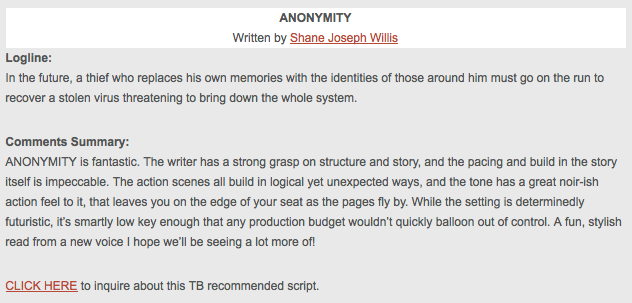
To begin to answer this question, I reached out to Shane Joseph Willis, a Australian screenwriter writer and director whose sci-fi action/thriller script Anonymity recently attracted a lot of attention. It all started with his submission of his script to the Tracking Board's coverage service, which promptly earned him a position on their "Recommends" page due to the quality of his writing and his high concept. The listing of his script in turn generated a number of script requests, which Shane was then able to leverage into landing representation with a Hollywood manager -- all the way from Australia.
I suspected the process might have also given him insight into breaking in to the sci-fi spec market, so I interviewed Shane to get his take on what he's learned from his recent success.
Here's what Shane had to say:
Shane, would you first tell us about Anonymity? What inspired you to write it?
Anonymity deals with the idea of personal data and the potential for the great abuse of our information at the hands of those who control it. It takes place "20 minutes into the future" and asks; at what cost do we give away our personal information? It deals with identity, memory, and the idea that our privacy is constantly being eroded; more and more about us is becoming stored online and in databases. Whoever has access to that information has power over us. The story takes that to an extreme.
The inspiration really came from a vision I had of the main character. I wanted to create a chameleon, someone who was constantly changing identities, so much so that he has forgotten who he originally is. He doesn’t fit in with the world; he’s out of step from his surroundings. A classic cyberpunk character. The story seemed like the perfect situation for a character like that to be in. I definitely did a lot of ‘what if-ing’, in generating this concept.
Tell us a little bit about yourself and your writing too, including your relationship with sci-fi. Is it a passion for you? An exploration with this particular script? And how many sci-fi scripts have you written besides this one?
I’m based in Melbourne, Australia, so landing representation in Hollywood was a huge coup for me. In addition to other writing, I've written and directed two shorts, Monarch and Run to the Horizon.Anonymityis my second sci-fi feature script.
I’ve been exposed to sci-fi since before I can remember, it impacted on my psyche from a very young age; put a hook in me. It’s definitely a passion, but it’s more than that, it’s a way through which I look at the world. Writing sci-fi gives you an opportunity to say and do things you normally couldn’t do in a story, in terms of metaphors and analogies. There’s always so much more going on under the surface. If you look at all great science fiction films, they transcend the genre. Alien is a gothic horror story; Blade Runner is a noir detective story. Anonymity tries to achieve that.
What happened when you submitted the script to the Tracking Board coverage service? You've had a great response, right? What was that like for you?
The Tracking Board offers a great coverage service, which I submitted the script to. I got an email back with the coverage attached congratulating me and offering to showcase the script on their "Recommends" page. Naturally I jumped at the chance. I went from sending out dozens and dozens of query letters to managers, agents and producers, to having them contact me to read the script. I can tell you it was a nice reversal. After speaking to several managers, Sidney Sherman at Rosa Entertainment was definitely the best fit for the direction I want to go in my career. He’s a huge sci-fi fan too, and was a fan of my work.
About how long did it take you to complete this project, from inception to submission to the Tracking Board? How many revisions did you go through?
From inception to submission it took about 6-7 months of work. There were lots of revisions during that time, more than I care to remember. Then there was also a one month period from when I got coverage back to when they placed it on their website. I used that time to polish it up based on their notes.
What in particular do you think was so appealing about this project?
From what I was told from the managers and producers who contacted me, the write-up that the Tracking Board posted on their website definitely generated the initial buzz, the story premise was something that cemented the interest. I was told that an elevated genre piece that could be done on a budget is what is driving the market in terms of original sci-fi projects right now.
Has anyone made any guesstimates about the budget for the project?
Regarding the budget, it can be hard to tell at this early stage. It depends on a number of factors like actors and other talent that gets attached to it. It can be compared to a film like Looper, which is a smart sci-fi film made for a price -- the kind Hollywood wants right now. Looper was made for $30 million, and we expect this project will come in at that point or lower, again depending on the factors I mentioned. The budget won't be more than that because the script is quite contained, which means there are no major special effects or CGI sequences, the number of characters is limited, and the setting is quite contemporary, so it doesn't require large scale sets. The tone of the script could almost be compared to Memento in that it has a noirish feel to it and inasmuch as that film was quite contained too.
What have you learned about the industry and what the market is looking for in terms of sci-fi, based on the response you've received?
I think sci-fi will always resonate with the marketplace. Again, the elevated concept is a strong selling point. Make sure that the script is a strong as it can possibly be before sending it out. Sometimes as writers we need to put on a producers hat, and ask ourselves the questions a producer would ask… like, how am I going to sell this script? Essentially everyone in the business is looking for the same thing; a marketable project. It’s our job as screenwriters to bring it to them.
What have you learned that will inform your next project, sci-fi or otherwise?
The next one is a sci-fi project! That script was previously a finalist in the PAGE Awards and I am currently rewriting it. I’ve learned that there is no limit to elevating the story. Knowing what makes a script marketable is important to any writer trying to break in -- understanding what sells and being willing to embrace the business side of screenwriting while still maintaining the integrity of your vision. Sometimes it’s a fine balance.
What recommendations do you have for other writers looking to get traction in the market with sci-fi projects?
Be aware of what’s trending in the marketplace but don’t be bound by those trends. Everyone’s looking for the next big thing, so don’t try and emulate what someone else has done previously. Let your own voice be heard.
What were your early sci-fi influences? What are your favorites now? What have you learned from them?
Star Wars was my first love. I think we can all relate to that. I remember bugging my dad to rent me a copy of Terminator 2 on VHS when I was a kid… I was too young to see it in the theater. He finally caved on that one. Mad Max and The Road Warrior were huge early influences as well as anything cyberpunk like William Gibson and Phillip Dick, but also a lot of lesser known sci-fi movies like Stalker or Alphaville or World On A Wire. I draw influences from lots of different sources... too many to list! I’ve learned many things, but one thing in particular that I’ve taken away is that an audience or reader needs someone they can relate to, like an everyman character to take us through the journey, particularly when the world we’re exploring is mythical or fantastical. I think that’s the key to great sci fi.
What are your next steps with this project?
The script will be going on the market soon. Fingers crossed it will resonate with buyers.
Thank you, Shane! We wish you the best of luck and much success with Anonymity.
If you'd like to follow Shane's journey with Anonymity and his progress, you can connect with him on Twitter.