by Jenna | Jun 15, 2013 | Science Fiction, ScriptMag Articles
My Sci-Fi Circuit article on ScriptMag originally published on April 12, 2013.
What does it take to make a sci-fi world real?
As a science fiction fan, I love to be transported into new and fantastical worlds. As a sci-fi screenwriter, I'm fascinated by understanding what it takes to make that happen, and happen well?
It's Not Just A Pretty Gadget
Part of the appeal as fans, I think, is that just like in James Bond movies, we sci-fi geeks love to see new and clever ideas and how they work. It seems to be something of a thing, to have at least one super cool new piece of technology per sci-fi film, like the hand-embedded phones in the re-release of Total Recall(2012).
But clearly a little fancy new technology isn't the only thing it takes to make a futuristic world seem real.
What Else Is It?
The kind of world-building I deeply admire is what I've seen Joss Whedon doing with his sci-fi masterpiece series Firefly and even with The Avengers. The world-building is all part of the background. It makes sense. We get it. When it comes to our attention, it's part of the story but doesn't overwhelm it. Everything serves a purpose. He does a masterful job of showing and not telling.
And that IS an issue with sci-fi.
As Carson Reeves puts it in his excellent book Scriptshadow Secrets, "Science fiction is a memory hog." He goes on to say, "You know that WHIRRRRR noise your laptop makes when Firefox starts sucking up your memory? That's the exact same effect sci-fi has on a screenplay. 20-25% of your screenplay will be dedicated to exposition when you write sci-fi. This is due to all the rules and backstory and futuristic shit that needs to be explained... So make sure if you're tackling this genre, you're willing to put in the extra effort to minimize and hide all that exposition..."
So how do we build convincing and beautiful worlds while reining in the exposition?
First let's start with the science, context, and backstory. To answer this question, I dragged out my early version of How to Write Science Fiction and Fantasy by Orson Scott Card (additional version*) for a look at the ingredients that go into building a world.
Setting the Rules
Card lists first coming up with the "rules" for space travel, time travel, and magic.
For instance, pretty much at the outset of Star Wars and Star Trek we see that lightspeed and warp speed work in these universes. Even though the technology for traveling faster than the speed of light is currently seen as highly unlikely if not impossible in the scientific world (classified by Michio Kaku in Physics of the Impossible as a "class II impossibility", meaning that it "sits on the very edge of our current understanding of the physical world"), we take it as a given that we can whip across the universe at enormous speeds without any time dilation effect.
In other universes, however, like those depicted in Aliens and Prometheus, cryo travel is required to traverse any kind of long distance, the impact of which is clearly seen when Ripley in Aliens asks, "How long was I out there?" and the answer, "Fifty-seven years," produces a real shock for her character.
Similarly we must convey the rules of time travel -- and as the writers of these tales, we get to decide on the rules.
For instance, think of the various ways time travel plays out in movies like The Butterfly Effect, the Back To The Future trilogy, and Déjà Vu. In each of these, we quickly learn the time travel rules for the particular story, such as, do people travel back through time into their own minds? Can they observe their earlier selves from the outside? Affect the past and alter the future? Or does time remain elastic and resilient, regardless of the changes we might try to make?
And even though we usually think of "magic" relative to fantasy stories, many of the sci-fi worlds we see encompass some kind of magic, whether with technology or something like the Force in Star Wars.
Regardless of whether it's magic or science, from the outset, we have to know the rules.
Detailing the Past
We also need to understanding the past, including for example how a particular alien race has evolved to appear the way it has, and how it communicates -- at least as the writers of the script. I love how Card describes understanding the backstory for a particular town with a mob led by a demogogic preacher and deeply understanding the kind of people that follow him. He says, "Now, maybe you won't even use an incident like that in the story. But you know it, and because it's in there in the history of that town, the people in that mob are no longer strangers to you, no longer puppets to make go through the actions you want them to perform. They've come alive, they have souls -- and your story will be richer and more truthful because of it." (Emphasis added.)
In my own work and reading on this subject, even while I am at times tempted to throw up my hands and say, "It doesn't matter, I don't care about that!" I find that my work deepens the more care I put into thinking about the world and story behind what we're seeing.
Understanding Language
Joss Whedon's brilliance shines when it comes to language, which is the next of Card's world building items. Ever the erudite communicator, not only has Whedon thought through a likely political and cultural evolution for the future of the human race in Firefly, he has extrapolated slang words like "ruttin'" and "gorram" along with the notion that characters will swear in Chinese. Along with subtle Asian cues in clothing, lettering, and set design, we quickly grok that China's culture has become an integral part of these new worlds.
There's nothing like a good delivery of language, whether we're talking Aliens or Much Ado About Nothing to get us well-immersed in the tone and spirit of a particular world.
Designing Scenery
According to Card, designing the scenery "... is the part that most people think of when they talk about world creation: coming up with a star system and a planet and an alien landscape."
Carolyn See writes convincingly about the importance of "geography, time, and space" in her Making A Literary Life. Although I've been tempted to ignore such specifics along these lines at times since I'm writing "in the future," I can see the validity of her point that we can become boring when we try for "universal" by neglecting the details.
I'm again reminded of the beauty of the ship "Serenity" in Firefly, and the careful thought that went into creating it, down to the flowers painted on the dining area walls. If we're paying attention, we surmise they were added by one of the characters on the ship.
But here's a question I wonder about: How much of this happens on the set, and how much happens in the writing stage?
As I contemplated that question, I remembered hearing Jane Espenson talk about writing the episode "Shindig" for Firefly. She described coming up with the idea for transportable door knobs that function as futuristic hotel room keys. And guess what? It's in the script. So the writer does and can play a role at this level too.
And What About Exposition?
Carson Reeves suggests that most sci-fi projects need some kind of backstory introduction to help avoid overly expository dialogue. He points out the well-known use of the title card in the Star Wars franchise, but also references voice-overs in Avatar (and the video journaling did an admirable job there too, in my opinion), and the documentary-style footage in District 9.
I love this point from Michael A. Banks from his chapter, "Science Fiction: Hard Science and Hard Conflict" from How To Write Tales of Horror, Fantasy, & Science Fiction (from Writer's Digest) about the degree of attention one must give to the science behind the fiction: "More detail is necessary, because you are frequently showing the reader things that don't exist. You'll have to depend on intuition to tell you just how far you can go without being a bore. ... If the science is to be part of the conflict, you'll have to take it quite a bit further. Because conflict is so closely tied to characterization, motivation, and the overall success of plot, you will have to give the science behind a conflict as much attention as you would any of the other basic story elements."
He also says, "The ground rules are simple: Don't tell the reader everything you know, and don't dump the information you do use on the reader all at once. ... Use only detail that adds necessary color, moves the plot, or helps the reader understand events, characters, or background.
I know that as I'm writing, I'm constantly asking myself, how can I convey this more concisely? How can I show it? How can we feel it? Can I make it tighter or clearer? If it means my reader "gets" my story more clearly, it'll be worth the effort.
Lest We Forget
Last, here's a point I think is worth remembering, again from Orson Scott Card, about the value and importance of sci-fi in our own world today: "Indeed, one of the greatest values of speculative fiction is that creating a strange imaginary world is often the best way to help readers see the real world through fresh eyes and notice things that would otherwise remain unnoticed."
[Original article at ScriptMag]
* All book links herein are affiliate links for Bookshop, which means I earn a small referral fee
if you purchase from them, and which helps me keep my writing ship afloat. Thank you!
Image by Reimund Bertrams from Pixabay
by Jenna | May 18, 2013 | Science Fiction, ScriptMag Articles
My inaugural "Sci-Fi Circuit" article on ScriptMag, originally published March 15, 2013.
I was indoctrinated into the world of sci-fi by my father at the tender age of nine, when he handed me my first sci-fi book, The City and the Stars by Arthur C. Clarke. Right around the same time, I saw Star Wars.
I was hooked. Together, they changed my life.
No longer was my world limited to the known and the knowable.
It expanded into the realm of possibility, discovery, and exploration. The idea that there might be so much more than I could see and know was endlessly exciting.
Star Trek reruns, the original Battlestar Galactica series, and a steady stream of sci-fi novels were my salvation — the barest of bare minimums to tide me over until The Empire Strikes Back was released. George Lucas became like a god to me, delivering tales to satisfy this unending thirst for more.
I gobbled up sci-fi as fast as I could get my hands on it.
I lived inside Anne McCaffrey’s dragon books, read and re-read thrice over Marion Zimmer Bradley’s hybrid world of Darkover where magic and technology were interwoven, and fell in love again and again with the works of Orson Scott Card (his outstanding book Ender’s Game will be released as a motion picture in December 2013).
At some point, my hunger became a desire to create my own sci-fi. I got my hands on a copy of How to Write Science Fiction and Fantasy by Orson Scott Card (additional version*), and I still consider it to be a seminal work on the subject.
His comment about sci-fi and fantasy precisely encapsulates my abiding love for both genres: “... science fiction and fantasy are the genres in which stories can hew closest to the archetypes and myths that readers in all time and places have hungered for.”
Sci-fi and Fantasy: Both Are "Speculative Fiction"
Yes!
What’s always stayed present in my mind (even years later) is Card's distinction between sci-fi and fantasy.
Because let’s face it, they are often lumped together -- even in the title of his book!
And yet to me -- to most of us paying attention, to be sure -- they are quite different.
Card does a useful job of explaining WHY they're often put together. Despite the fact that apparently in the publishing world, sci-fi and fantasy often function as separate animals, with different trade magazines, publishing departments, and labels, in the bookstore realms, they’re put together, because, as Card says, sci-fi and fantasy “have a largely author-driven market.” A reader wants to find all the books by a certain author together, not scattered pell-mell throughout the store.
Card explains this author-driven aspect behind this adroitly, saying, “Most of us who write speculative fiction turn with equal ease from fantasy to science fiction and back again.”
Of course we do.
On the other hand, on the movie shelves we see both sci-fi and fantasy put together, sometimes with weird results. The other day I was on Hulu.com and noticed they’d categorized “Once Upon a Time” as science fiction, something I’d never consider to be the case.
But I still like Card’s definition of them together as “speculative fiction.” He describes them this way because they both tend to be stories “that take place in worlds that never existed or are not yet known.”
He also says, “The intrinsic difference between speculative and real-world fiction is that speculative fiction must take place in an unknowable world. At some point, every science fiction and fantasy story must challenge the reader’s experience and learning.”
But what’s the difference between sci-fi and fantasy?
Does it matter?
It matters when it comes to audience. In both genres, our audience has be educated about the world we've created and the rules the world operates within. We have to tell them which one we're in. And fast.
Sometimes it's obvious. Sometimes less so.
Time travel machines?
Flying cars?
Spaceships?
Sci-fi.
Magic spells?
Flying carpets?
Enchanted princesses?
Fantasy.
Magic spells that cause time travel? Fantasy.
Dragons that are the result of careful genetic manipulation and crossbreeding? Sci-fi.
Dragons who speak and foretell the future? Fantasy.
Or as Carson Reeves, author of ScriptShadow Secrets (whom I hope to interview in a future column) says, "I define science fiction as any fictional story with space, futuristic, or time-traveling elements. I like to keep it simple! Fantasy on its own is definitely not sci-fi. You wouldn't categorize Lord Of The Rings as sci-fi. However, there are science fiction movies that incorporate both elements, like Star Wars."
Yes, so true.
Regardless of the genre, we have to 1) establish the facts early on with our world-building, and 2) clue the audience into whether it's driven by science or magic. Luckily -- and perhaps in a slightly clichéd manner -- we can often do this quickly with the landscape. If we're seeing metal and spaceships, chances are it's sci-fi. If we're in the natural landscape or riding horses into courtyards, it's most likely fantasy.
The Bottom Line
Are we switching a lever or waving a wand?
Perhaps the most important distinction here is that sci-fi should theoretically require less explanation than fantasy, because as Card says, “If the story is set in a universe that follows the same rules as ours, it’s science fiction. If it’s set in a universe that doesn’t follow our rules, it’s fantasy.”
More rules?
More explanation.
Is There a Cross-Over Point?
What about the pseudo-science that masquerades as fact in so many of the sci-fi features we see today?
I've seen more than few complaints about the careless science of sci-fi films disrupting the reality, including a discussion on the science of Prometheus that pointed out several logic flaws (e.g. the star formation that pointed out the location of the alien planet would have shifted significantly over the many thousands of years since the maps were left in the caves on Earth).
Here's my take:
- Yes, geek cred is important. We need to make sense, and if we're truly following the known laws of the universe, then we need to stick to them.
- It's our job as sci-fi writers, just like in any story, to make sure that we do the research and weave the threads together to make sure the internal logic holds. We need to ensure that our audience -- including the science geeks who love this work -- can reasonably suspend their disbelief.
- And, if we're stepping outside the parameters of what's known so far (because let's face it, even scientists are still sorting out whether or not things like time travel are truly impossible), we have a responsibility just like we would in any story, to carefully and credibly establish the rules of our world.
Where Do We Go From Here?
As a sci-fi screenwriter, I'm interested in a number of questions, particularly about the marketability of spec sci-fi projects from unknown screenwriters and writing issues inherent to the genre. Stay tuned for more about genre, sub-genre, breaking in, adaptation, novelization, interviews of sci-fi screenwriters and industry experts, and more.
[Original article at ScriptMag]
* All book links herein are affiliate links for Bookshop, which means I earn a small referral fee
if you purchase from them, and which helps me keep my writing ship afloat. Thank you!
Image by Stefan Keller from Pixabay
by Jenna | Jun 8, 2012 | Science Fiction
Dear Mr. Bradbury,
Thank you.
Thank you for touching my heart and opening my eyes. For seeing me in ways I didn't yet understand in my younger years. For showing me new worlds and new ways of seeing our world.
So many of your stories will be forever etched into my consciousness...
The tale of the man who drowned himself in the endless rain of Venus, "sitting on a rock with his head back, breathing the rain."
The April witch, Cecy, who could flit from being to being but longed to fall in love, even if it meant giving up her powers.
The mechanical house dying after a nuclear holocaust, shadows of its family etched against its blackened siding, calling out the date and time to no one as it burned.
The Martian -- the chameleon -- who changed to be who others longed for and died in the maelstrom of their conflicting desires.
And the Rocket Man who died when his rocket fell into the sun, just when he had promised his family to stay home with them after one last trip.
Heart-breaking. Truthful. Painful. Gorgeous. Raw. Philosophical.
Your passionate commitment to envisioning the future has changed many lives for the better.
Your words made me think.
They made me feel.
I thank you.
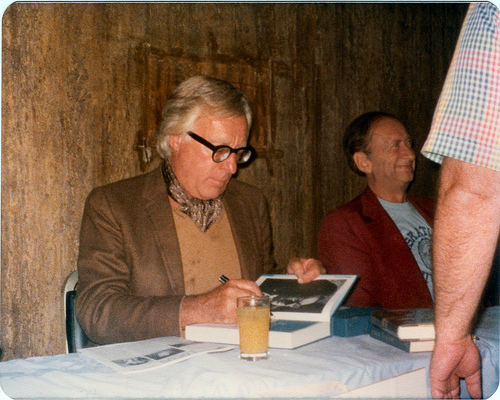
Photo taken by Will Hart, used with permission under Creative Commons licensing
by Jenna | Apr 20, 2011 | Science Fiction
I was reminded of a novel I read recently called Agent to the Stars by John Scalzi.
The book is a fun, lighthearted romp about a film agent who ends up being the P.R. guy for a group of ugly aliens wanting to be accepted by the earthlings despite their extremely off-putting appearance and odor. A highly entertaining read and clever story, to say the least.
Practice, Practice, Practice
Beyond the unusual plot line, what particularly endeared me to the book was that it was Scalzi's very first novel and one he wrote as a "practice" novel just so he could say that he had done it (and to impress his classmates at his 10 year high school reunion :) ).
Here's what he has to say about it on his website (where, by the way, you can read the whole novel):
"In sitting down to write the novel, I decided to make it easy on myself. I decided first that I wasn't going to try to write something near and dear to my heart, just a fun story. That way, if I screwed it up (which was a real possibility), it wasn't like I was screwing up the One Story That Mattered To Me. I decided also that the goal of writing the novel was the actual writing of it -- not the selling of it, which is usually the goal of a novelist. I didn't want to worry about whether it was good enough to sell; I just wanted to have the experience of writing a story over the length of a novel, and see what I thought about it. Not every writer is a novelist; I wanted to see if I was.
"Making these two decisions freed me from a lot of the usual angst and pain that comes from writing a first novel. This was in all respects a 'practice' novel -- a setting for me to play with the form to see what worked, and what didn't, and what I'd need to do to make the next novel worth selling."
The genius of this was that it freed him from the zeitgeist of perfectionism (a trap many of us, including me, know only too well) and allowed him to loosen up, have some fun, and get into action with Doing The Writing.
He made some attempts at selling it, but wasn't able to, so he ended up posting it online for donations from people if they liked it on a kind of "shareware" basis. (Love that!) He was later invited to do a limited edition hardcover release of the book in 2005 and then in paperback in 2008.
Build Your Confidence
Magically, he says, "...between the writing of this novel and the publication of [my second novel], five other books slipped out of my brain, due in some measure to my confidence that I could write book-length works, be they fiction or non-fiction."
Love that, too.
Isn't it fascinating how simply doing the writing helps us to build the confidence we think we need "before" we can do it "for real." This clever guy found a way to do both at once.
So.
There's nothing like finding small ways to get started to help build your confidence around new skills.
Image by Reimund Bertrams from Pixabay
by Jenna | Apr 20, 2011 | Science Fiction, Writing Articles
I was reminded of a novel I read called Agent to the Stars by John Scalzi.
The book is a fun, lighthearted romp about a film agent who ends up being the P.R. guy for a group of ugly aliens wanting to be accepted by the earthlings despite their extremely off-putting appearance and odor. A highly entertaining read and clever story, to say the least.
Practice, Practice, Practice
Beyond the unusual plot line, what particularly endeared me to the book was that it was Scalzi's very first novel and one he wrote as a "practice" novel just so he could say that he had done it (and to impress his classmates at his 10 year high school reunion :) ).
Here's what he has to say about it on his website (where, by the way, you can read the whole novel):
"In sitting down to write the novel, I decided to make it easy on myself. I decided first that I wasn't going to try to write something near and dear to my heart, just a fun story. That way, if I screwed it up (which was a real possibility), it wasn't like I was screwing up the One Story That Mattered To Me. I decided also that the goal of writing the novel was the actual writing of it -- not the selling of it, which is usually the goal of a novelist. I didn't want to worry about whether it was good enough to sell; I just wanted to have the experience of writing a story over the length of a novel, and see what I thought about it. Not every writer is a novelist; I wanted to see if I was.
"Making these two decisions freed me from a lot of the usual angst and pain that comes from writing a first novel. This was in all respects a 'practice' novel -- a setting for me to play with the form to see what worked, and what didn't, and what I'd need to do to make the next novel worth selling."
The genius of this was that it freed him from the zeitgeist of perfectionism (a trap many of us, including me, know only too well) and allowed him to loosen up, have some fun, and get into action with Doing The Writing.
He made some attempts at selling it, but wasn't able to, so he ended up posting it online for donations from people if they liked it on a kind of "shareware" basis. (Love that!) He was later invited to do a limited edition hardcover release of the book in 2005 and then in paperback in 2008.
Build Your Confidence
Magically, he says, "...between the writing of this novel and the publication of [my second novel], five other books slipped out of my brain, due in some measure to my confidence that I could write book-length works, be they fiction or non-fiction."
Love that, too.
Isn't it fascinating how simply Doing The Writing (or Doing The Work) helps us to build the confidence we think we need "before" we can do it "for real." This clever guy found a way to do both at once.
(On a similar note, funny how this often comes up for entrepreneurs, coaches, and artists around having enough "credibility" to do what we want to do. So often I hear people talking about getting "certified" first, taking one more training, getting the "right" website designed, or crafting the "right" progam. I make those mistakes too -- my coach just busted me on this very thing this very morning, hello!)
So.
There is nothing like finding small ways to get started to help build your confidence around new skills.
For instance, I took a screenwriting class last summer and then signed myself up for a short screenplay writing competition to put my skills to the test. And my first script came in 3rd place in my group! My two subsequent scripts did not "score" in quite the same way, but simply the act of creating all of them gave me a sense of confidence and comfort around putting the pieces together to make a plausible script.
Since I have never written any fiction before this, I was so pleased with gaining the sense of, "Oh, yes, I can do this!" Even if I have more to learn (there's always more), I'm off to a good start.
Reminds me of what someone told me was one of my lessons to learn in life: "With creativity comes confidence."

by Jenna | Jul 20, 2010 | Science Fiction
One of my all-time favorite science fiction books is The City and The Stars, by Arthur C. Clarke.
This magical story details the life of Alvin, a "Unique," who has never been born before.
In the fully enclosed city of Diaspar, everyone else has lived many lives -- they are reborn cyclically from the city's Central Computer banks -- and their memories of their past lives return to them on their 20th birthdays. Alvin has no prior memories.
Alvin's uniqueness has been deliberately designed. Because the city creators knew that the measures put into place to protect the last of the human race might someday no longer be needed (including behavioral inhibitions to keep everyone safe at home), they knew that a catalyst would be required to test the waters and breakthrough old paradigms when the time was right.
Over the billion years the city existed and of the millions of city inhabitants at any given time, only 14 other Uniques emerged to play this key role in the fate and future of the city.
Unfortunately for Alvin, as someone with such a unique purpose and role to play, he didn't fit in well with his co-inhabitants. None of the other people in his life were interested in seeing what was beyond the walls, or questioning why things were they way they were.
One day, Alvin met another unique character: Khedron the Jester. Although Khedron had lived before, he too was designed to play a key role -- the role of the artist and the saboteur -- with the purpose of shaking things up, stimulating discourse and debate, and catalyzing other catalysts (the Uniques) into action.
The city planners had chosen his role with care: They realized that a billion year old city would get downright boring and complacent without periodical upheaval, crime, disorder, and change.
Although the Jester had lived before, and had his own implanted inhibitions, he operated outside the societal norms and could help Alvin to claim his purpose and to act on it. Khedron became Alvin's muse, in a sense.
Ultimately, Alvin ventured beyond the city walls to discover the self-imposed secret truths that kept the human race cowering on planet Earth and fulfilled his purpose.
I share this story with you for a number of reasons:
- I love the demonstration of purpose — of how a single individual can have a lasting impact -- and how compelling that purpose can be. Alvin could not rest until he had fulfilled his purpose. Khedron fulfilled his purpose as well. Each had a role to play.
- I also love how The Jester —the archetypal fool — demonstrated the powerful role an artist in a society. Often creativity and art are thought of as gratuitous or entertaining, but this story caused me to see creativity as a powerful force for change, learning, growth, healing, and understanding. When I hear people debating or disliking an art piece (particularly a public art piece), I smile to myself, and think, "Good! That artist is fulfilling her purpose -- she's got people talking."
- I love the idea that not fitting the mold is not only "designed" but is the key ingredient for success. The discomfort both characters experienced as "different" parallels the lives of many sensitives and creatives as we navigate this world not well-designed for us. Precisely because of the fear of being different, or rocking the boat, many of us hold back. But as sensitive sages and visionary creatives, when we hold back, we fail to fulfill our purpose. We must recognize that not fitting in is part of our impetus to fulfill our purpose.
- I love the reminder that we require muses and supporters as we breakthrough the limitations imposed on us (self-imposed and otherwise). As my teacher Sonia says, "We cannot do this alone."
Image by Reimund Bertrams from Pixabay