My Sci-Fi Circuit article on ScriptMag originally published on June 16, 2015.
There’s a compelling new sci-fi feature out there right now you won’t want to miss, called Time Lapse. Co-written by Bradley King and B.P. Cooper, it’s a slow-burning thriller that hooks you with just the right touches of mystery, sci-fi technology (with a little steampunk flare), and engrossing complications that draw you forward to a surprising and intriguing climax.
The cast makes the project hum with life and thoroughly delivers on the psychological complexities of knowing what they’re going to be doing next — in snapshot form. That’s the premise of the story: A time machine camera that takes polaroid pictures of the future — 24 hours ahead.
I had the pleasure of recently interviewing Bradley King, who also directed the feature, about the process of creating this award-winning film.
On Making the Writing Happen
I asked Bradley about the writing process he and Cooper went through and about the road he's been on to get here. He mentioned that he's written 16 or so scripts prior to this one, and has worked with Cooper to produce three shorts. Time Lapse is their first feature together.
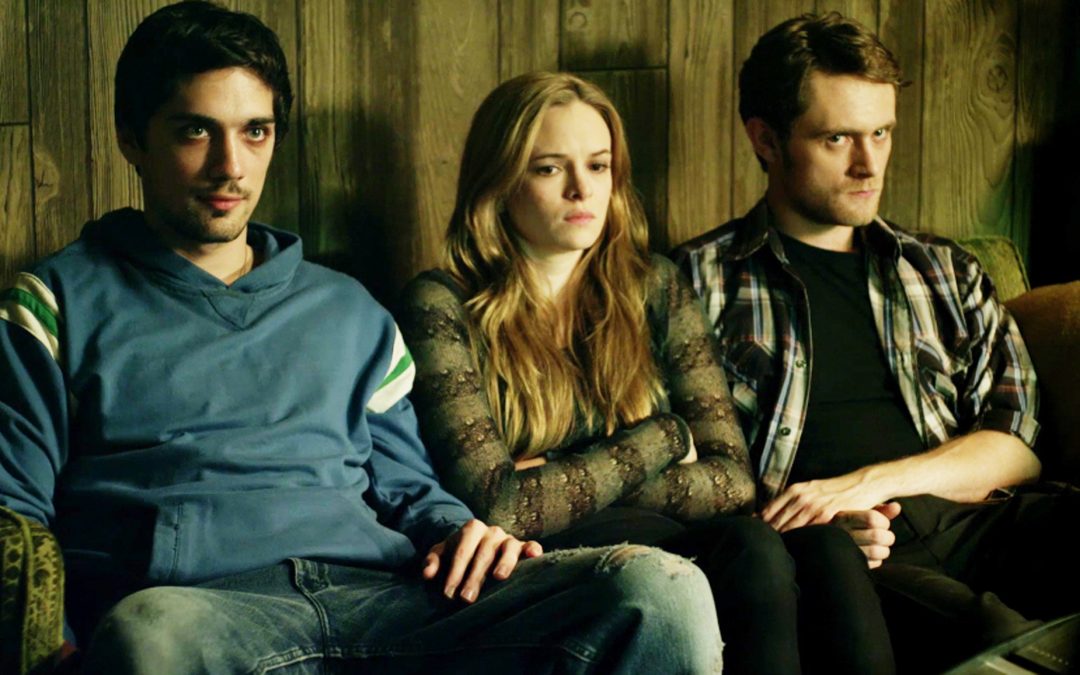
(L to R) George Finn as Jasper, Danielle Panabaker as Callie and Matt O'Leary as Finn in a scene from TIME LAPSE, directed by Bradley King. PHOTO: XLrator Media
Perhaps all the writing experience was part of why he and Cooper were able to whip through this one — or perhaps it was the collaborative nature of the project and their past experience together. On hiatus from their day jobs, they wrote the project in just a few weeks after brainstorming and landing on their inspiration for the story: Two weeks to outline and one week to write. Bradley said then they took notes for a month, “but the script we wrote in those three weeks is pretty much what ended up on the screen”. He hastened to add that his prior script (which he’s in the process of polishing and taking out to the market right now) took about six years to write.
About the writing process, Bradley added, “Writing is never easy, it’s always torture. But this was the easiest I’ve ever had it. We had the conceit, and I pretty quickly landed on the story paradigm of a small group of characters who are close friends and find something valuable, and it tears apart their relationship as they try to exploit it. That provided the big framework and structure. After that it was just fun to get excited about what the next photo would show and how it was going to affect our characters.”
On Keeping the Story Straight
Bradley King and B.P. Cooper in the storyboard room. PHOTO: XLrator Media
Even with a seemingly simple time machine story like this one, a major challenge they faced was keeping the continuity straight, both in the writing of the script as well as on set.
Bradley shared their solution: “Certainly the time elements, the timelines, and the photos presented a unique challenge in the writing. We used yarn and notecards as visuals on the wall to remind us if we got stuck or confused as to the continuity in the story.”
On location, they shot much of the film backward, in order to assure that the polaroid stills of the future story matched the actual footage, and they had the storyboards and timelines mapped out in a special room with yarn, tacks, sketches, and notes.
It looks like a great method for keeping a time travel story organized both on set and in the writing room, something I suspect will come in handy for aspiring time travel writers. :)
On Keeping the Audience Engaged
Matt O'Leary as Finn contemplates a wall of exposed Polaroids in a scene from TIME LAPSE, directed by Bradley King. PHOTO: XLrator Media
The story unfolds polaroid by polaroid, and it’s never quite what you expect will happen, which is part of the brilliance of this story.
Bradley commented on this, saying, “Ang Lee once said that storytelling boils down to showing the audience something and then taking it away and then showing it to them again — but twisted slightly from their anticipation of it. It sounds overly simplistic, but that’s what Time Lapse does, you see a photo of what’s coming, then there’s a gap between now and then, and you don’t know what’s going to happen. So then when it finally arrives, we twist it slightly so that it is what happens in the photo, but still adjusts your expectations.”
On Making "Living Room" Sci-Fi -- on a Budget
(l to r) George Finn as Jasper, Danielle Panabaker as Callie and Matt O'Leary as Finn in a scene from TIME LAPSE, directed by Bradley King. PHOTO: XLrator Media
“When you say science fiction, some people immediately think, ‘Oh, I’m going to see aliens or spaceships exploding or some future slick sci-fi dystopia’,” Bradley says. Time Lapse is a terrific example of what Rod Serling called “living room science fiction” -- and it's been compared to Twilight Zone. It's more of a thriller that has sci-fi elements, and feels like something that could happen in our world, right now.
Although Bradley says he’d someday like to do bigger budget productions, he “loves the smaller style production that hasn’t been done so much because it feels fresh and fun.”
This is the kind of sci-fi that newer writers can afford to make on their own (or sell more easily) than big budget productions laden with special effects. This project came in well under $1 million to make. To keep it at a low-budget, Bradley and Cooper put their focus on keeping the project contained to one location, though they did find that the holy grail of one location did come with some unexpected challenges, like needing to take over an entire apartment complex. Luckily, they found one that was slated for demolition and got to work rehabbing it just enough for the picture.
On Breaking In
Since we were speaking about time machines, when I asked Bradley about tips for writers looking to break into the industry, he said that if he could go back in time to tell his younger self something it would be two pieces of practical advice in regard to fear:
1. “Don’t be afraid of rejection.”
Bradley says, “I spent a lot of my early 20’s being scared of taking my material out into the official marketplace of Hollywood to get feedback or get rejected. What I didn’t realize is that in the process of getting rejected, you also build relationships. They may not like that script but you will become someone in their mind who has written something, and you will probably be able to come back to them with something else down the line.”
Since this is an industry built on relationships, that’s a smart perspective to take. Producers will often like your writing, even if a particular project isn’t for them. So Bradley makes an excellent point that interactions for feedback -- rejection even -- are opportunities to build connections. He says, “I was determined to write the perfect thing before going out into the world, and as a result it took me a lot longer to get better as a writer and to move my career forward to the next square on the chess board.”
2. “A good script can open a lot of doors.”
Bradley also said that when you don’t get rejected, and things actually go well, it can be a bit shocking at how many doors open to you: “I couldn’t have conceived of opening them myself, particularly in regard to cast.” It wasn’t even an amazing script, he said, but a good one, fairly well written, and it led to many meetings and introductions to actors they might not have otherwise have had access to or been able to afford who got excited about the script, including Danielle Panabaker and John Rhys-Davies (whose two scenes ended up being cut from the film).
“Keep in mind that a lot of the scary blockades that seem like they’re there in Hollywood will come down or you’ll find a door through them with material that people are responding to.”
It’s an excellent lesson for a newer writer: Put the focus on interesting roles for actors to play and write a compelling story that people can be drawn into. It doesn’t take a big budget to get a win.
What's Next
Up next for Bradley are two sci-fi projects that he and Cooper are polishing and taking out into the marketplace, plus they’re negotiating rights for overseas distribution to add to their already negotiated deals with Japan, Turkey, the United Kingdom. It's a great success story for two up and coming filmmakers, one that we can learn many lessons from.
I’ll be looking forward to seeing what they do next!
Where to See Time Lapse
Catch Time Lapse on DVD and Blu-Ray on June 16th, already available on VOD.
My Sci-Fi Circuit article on ScriptMag originally published on June 17, 2014.
A sci-fi spec screenwriter in today's market has a number of hurdles to overcome. One of the primary challenges we face is learning not only to master great sci-fi storytelling but also how to do so on a limited budget. Until we're top-of-the-line, A-list writers, any big budget features we're bold enough to write are likely to remain shelf-fodder in the near term.
For now, we're better off focusing on telling compelling, powerful sci-fi stories on a limited budget or "for a price." We can learn a great deal from up-and-coming sci-fi storytellers who are successfully doing exactly this. One such storyteller is writer-director Caradog James of Red and Black Films.
I recently had the pleasure of interviewing Caradog about his award-winning sci-fi feature film The Machine, which he made on a limited budget of just under one million pounds or about 1.7 million in U.S. dollars. I asked for his insights about how he brought the project to fruition and his advice for spec writers looking to break in to the industry.
On Creating Sci-Fi Grounded in the Real World
One aspect to which he attributes the success of his film is the very human story at its core. He discovered the storyline through a year-long research endeavor, which included an off-the-record interview with an artificial intelligence consultant to the British Ministry of Defense. He learned that they had been able to map the brain of a mouse and were planning to move on to mapping a chimpanzee's brain. From there it was a short leap to the film's concept of mapping a human brain.
Caradog also learned that the strategy used for teaching machines to think and feel is similar to the kind of teaching used with disabled children. This notion inspired the storyline for the main character of The Machine – a man seeking to cure his daughter of Rett syndrome using the secret military technology he's developing to create a cybernetic super soldier, known as "Machine."
As a result, The Machine is a startlingly haunting and personal story set in the near-future context of artificial intelligence development and all its potential pitfalls. The music, acting, and storyline, all contribute to a powerful, human experience that asks questions about what we should or shouldn't be doing with the technology at our disposal – as the best sci-fi does – all grounded in what feels like a not-too-distant reality.
On Avoiding Being Heavy-Handed with a Message
A movie like this could be easily overly message-laden, but I found it implied the right questions and possible answers inherent in exploring new technology without being heavy-handed.
When I spoke with Caradog, I asked him how he avoided being overbearing with a “message." He pointed to several practical solutions.
As mentioned, he extensively researched the project before beginning to write, including reading "heavy duty" books from futurists and quantum theorists that led to his conversations in the field about weaponizing machines and creating virtual models of brains. And perhaps most importantly, he met with families of disabled children which allowed him to paint a realistic picture about what they face.
He also held two weeks of rehearsals with the actors prior to beginning the shoot, and through the rehearsals, was able to identify more clearly where the dialogue and storylines were lecturing the audience too much or showing too much of the research.
The team also conducted test screenings, even with their very limited budget, so they could make sure their final edit culled unnecessary information and exposition that wasn't furthering the story. The goal was to give the audience just so much that they could grasp the concepts without the information deadening the emotion of the story.
The producer made a point to provide objective feedback. Producer John Giwa-Amu would take time away from the editing process in order to give feedback from as an objective place as possible. As Caradog noted, objectivity is the first thing to go as a filmmaker, so it was invaluable to have someone with relatively fresh eyes to review each new cut of the film.
Advice for New Screenwriters
Caradog's advice for newer screenwriters is to focus on "elevated genre" as much as possible – genre movies with heart, real characters, a real point of view, all grounded in a well-research reality – much as he did with The Machine.
He recommends avoiding dramas as a new writer, because he says most adults don't go to the cinema anymore for drama without Oscar winning actors or high production values, both of which are hard to attain as newbie writers.
Instead, he suggests that the "holy grail" producers are looking for is great genre scripts that can be made on a budget, and will have a much better chance of getting into production.
Working with a Low Budget
Speaking of which, working on a low budget for The Machine was tough. "Every day was a struggle trying to get the film made," Caradog reported, particularly since he'd never done CGI or stunts before, and keeping with the schedule presented all sorts of unexpected challenges as well. For instance, he didn't expect it to take an entire day out of their tight 4.5 week schedule to film one line in the script: "Suri sets fire to the traitor."
Luckily, due to his background in making short films, Caradog found ways to make do, like catching up with scenes in single shots, doing tons of advanced preparation like storyboarding concepts and working out lighting, sets, and costumes ahead of time, and filming in essentially just one location plus some minor exteriors work.
What's Next for Caradog James
Up next for Caradog is a "first contact" movie – an exciting sci fi thriller set a little further in the future with a bigger canvas – and a hopefully bigger budget. He's also collaborating on a number of other sci-fi projects with other writers in the US and in the UK, in order to bring as many ideas to fruition as possible.
About The Machine
The Machine recently won the Raindance Award at the British Independent Film Awards and took home Best Film at the BAFTA Cymru Award. The film also won Best Sci-Fi Film and Best Actress at last year's Toronto After Dark Film Festival. Watch the trailer here. The Machine is available on video on demand and releases on DVD on June 17th.
My Sci-Fi Circuit article on ScriptMag originally published on March 26, 2014.
One of the challenges with writing good science fiction is introducing not only the world itself, but any story background needed to set the stage for what's to come. In my recent interview with Amazon Studios-optioned Adam Pachter, he mentioned his pet peeve about screenwriters using voiceover to get away with exposition that might otherwise be delivered through story. On the other hand, Carson Reeves, Scriptshadow blogger and Scriptshadow Secrets author, recommends using some kind of introduction for sci-fi scripts to help avoid overly expository dialogue, such as title cards (like in Star Wars or Blade Runner) or voiceover. His reason for this, as he puts it, is that “science fiction is a memory hog,” and if a writer isn't careful, a large percentage of her script can end up being filled with exposition. Like Pachter, I've never been a fan of much in the way of voiceover in general but I thought it was worth exploring the options to blasting our readers and viewers with tons of exposition. I mean, let's face it, Carson's right about sheer volume of page space taken up by story explanation. So are there efficient ways of bringing the audience up to speed that actually work? What's been done before, and what do we think about them? Are there times the standbys such as title cards, flashbacks, and voiceover work? Is there anything else?
Title Cards
As much of a Star Wars fan as I am, I've never been enamored of the opening title cards. I've seen the movies repeatedly but every time, part way through the title card, I realize I've lost the train of thought and oops, guess what, it's already rolling off the screen. I don't know if it's the stiff prose or the speed or what, but it loses meaning for me pretty quickly. And are they necessary? Perhaps. The most relevant part to me has always been, "A long time ago, in a galaxy far, far away." For me, that's enough to say, "This isn't here and now, different rules apply." The rest just has a "Blah, blah, blah, Ginger" vibe to it for me. I found myself having a similar reaction to the opening scrolling backstory in Blade Runner. On the other hand, I found the opening to 2010: The Year We Make Contact much more compelling. It's not much different: words appear in moving animation across the screen. But the distinction for me is that I have the sense that I'm part of the story as opposed to being informed about it. I believe this is because I am reading the mission analysis of the expedition in 2001: A Space Odyssey, and I'm experiencing it as if it is being written in front of me in real time. I'm not being told. I'm being shown.
Flashbacks
And what about flashbacks? Seems like every time I turn around there's someone telling us (and by "us" I mean newer screenwriters working to break into the industry) to never, never, never use evil, bad, horrible flashbacks. But are they so terrible? Haven't we see them used quite successfully in "Mad Men", "Lost", and even The Butterfly Effect? Perhaps this is where the "only once you're an established, successful screenwriter" rule applies? I find that often I enjoy flashbacks, as a way of getting a sense of what has come before. But perhaps that just the lazy spec writer's method of getting the backstory across?
Voiceover
Which brings me to voiceover. I was recently reminded how much I enjoyed the voiceover in The Croods. Perhaps it was because it was not a voiceover telling the backstory, but one setting the tone at the opening of the movie. "Eep" tells us what it's like in her world as the story begins. It's all about how she feels about it. There's another voiceover sequence at the end, where Eep conveys the message of the movie in a simple way -- to change the rules and follow the light. She essentially highlights her father's character arc. And for me, it worked. Perhaps it only works because it is a family movie? Or perhaps you will disagree with me and say that it does not work, period.
But what about voiceover in sci-fi? Where do we see examples of voiceover -- or not -- in the realm of science fiction?
One of my favorite examples of voiceover in science fiction was for the movie Serenity, the follow-up to the much beloved and prematurely cancelled TV series, "Firefly". In Serenity, Joss Whedon was faced with a difficult challenge -- satisfying the existing "Firefly" audience while bringing a new audience up to speed. And quickly. He used an intriguing combination of voiceover and illustration to describe the world of Serenity, but then quickly transitioned into the story -- the voiceover was the voice of a teacher, in an outdoor classroom with a younger version of of the primary characters, "River". (There are later quick flashbacks to that scene and location as well -- that show the feelingand tone to deepen our understanding of what's happening.) Personally, I think the voiceover in this case works. It's not "just" voiceover.
Again, as with The Croods, it's done as part of the story, part of the history, told in a way that illustrates not only the world, but also just barely enough of the backstory to get us caught up. (And I think that's another key -- to give us just enough of a taste that we're willing to jump in to the new world and explore it with the writer, but not enough to feel bludgeoned over the head with meaningless facts, names, and data.)
On the other hand, and I say this as a diehard "Firefly" fan, I didn't love the initial voiceover in "Firefly" that aired in the opening sequences after the pilot, nor do I love it with the newer TV series, "Almost Human". It feels extraneous.
Other Methods
And what about other methods? One of my other favorites is the documentary-style footage shown in District 9. Again, we're given a visceral, feeling-based sense of what's happened, how people feel about it, and the problems in place that bring us to the present day, in a way that we're familiar with as a culture: watching the news. In Avatar, Jake Sulley's video journals provide a unique way for us as the viewers to experience what he's going through. It all feels like part of the story.
Final Thoughts
One of the challenges with using any kind of expository storytelling, in my opinion, is that it feels like it condescends to the audience. As if we are too stupid to figure out what's going on and someone has to explain it to us. My general preference is to demonstrate the backstory through action and dialogue. My favorite example is from the movie Aliens, when Ripley's ship is discovered adrift in space and she is still in cryo-sleep. It doesn't take much in the way of visual illustration, action, and dialogue to quickly understand not only that she's been lost in space for 57 years, but also exactly what that means to her. In the end, it seems to me that taking the pedantic "teaching" route is the core of the problem, rather than there being a problem with a specific methodology. I believe that flashbacks, voiceover, and even animated title cards have their place, when used to immerse the viewer into the story. My personal bias will always be to choose to illustrate as much as possible through action, then through character dialogue. I don't think we need to be so concerned about the intelligence of our viewers to keep up with what we're doing. They are, after all, sci-fi fans.
What's your take?
I'd love to hear your opinion in the comments. Where have you seen exposition through these various methods succeed and fail? Are you vehemently opposed to any and all of these methods?
My Sci-Fi Circuit article on ScriptMag originally published on January 17, 2014.
Besides some of the standard approaches to breaking into the spec market, like querying agents and managers, attending pitch fests, or submitting to contests, what else is there for a sci-fi spec writer looking to get a little industry traction?
Amazon Studios has been relatively new to the industry. They've undergone a number of changes to their approach to developing projects since their inception, and I've been curious to find out more about how it all works -- from someone who's seen it from the inside out.
I reached out to Adam Pachter, who recently landed an option with Amazon studios for his sci-fi script Hiber to find out more about how the Amazon Studios process works and what it's meant for him so far.
Adam, thanks so much for being here with us today to talk about your recent development agreement with Amazon Studios for your sci-fi script Hiber. First, can you tell us what Hiber is about and how you were inspired to write it?
It’s a fun story, and one of those rare times when I can pinpoint the precise moment an idea occurred to me. One late October morning in 2012, I was driving my family down the highway and trying to entertain my two young daughters. We were discussing a recent episode of the PBS kids show “Wild Kratts” that involved animal hibernation, and I was quizzing my then 4-year-old about it: “Does a bat hibernate? Does a bear hibernate?” Stuff like that. Then, as a joke, I said, “Does a person hibernate?” and my 4-year-old said, “Silly dad, people can’t hibernate.” And instantly the creative light bulb flicked on and I thought, “But what if they could?” And then a second later I thought, “What if only rich people could?” And the basics of what became Hiber just fell into place from there; I had the plot outline by the end of that day, and wrote my first draft in a couple weeks.
Although I spent several more months revising it, the Hiber script stayed close to the initial vision I had of a future America in which climate change has made the winters much worse, and the rich get to hibernate while everyone else struggles to survive. And I owe it all to my daughters and the silly conversation we had!
How did the selection process with Amazon Studios unfold and how long did it take from script submission to the development agreement being signed?
When the Hiber idea came to me I’d only been writing scripts for a little more than a year, and I was still a dabbler, which your colleague Lee Jessup will tell you is the kiss of death for a baby writer! I’d written a comedy, a romantic drama, and a contained horror/thriller, and I’d actually submitted a couple of them to Amazon Studios, where they were politely declined.
But Hiber felt different. Everyone got the concept right away, and I think the visual backdrop -- DC buried under ten feet of snow -- captured people’s imaginations. So after doing my revisions, I submitted it to Amazon in late April, and this time I heard back from a development exec just a couple of weeks later. He said he’d read it and wanted to chat, and when we got on the phone, he offered me the option. I was delighted and of course said yes, and I signed the development agreement with Amazon in late May.
Being optioned as a baby writer is always thrilling. I guess the only part that didn’t surprise me was that if any of my scripts got optioned, it would be Hiber. From the get-go, there’s just been something about it, and Hiber also made the semis of 2013’s Scriptapalooza contest, which I think speaks to its appeal.
How would you describe the model that Amazon Studios is using to find and develop projects? What makes it different than standard industry practices?
I think the great advantage of Amazon Studios is that you can submit from anywhere -- you don’t need to be in L.A. (I’m in the Boston area), you don’t need to be represented, etc. With Amazon, all these typical barriers to entry don’t exist. And although I do have some contacts in L.A., I’d be kidding myself if I thought I could have gotten anywhere near this far without the opportunity that Amazon presented. I consider it a more democratic process, based not on who you know, but solely on the quality of your script, and in a way that made getting optioned by Amazon even more exciting.
What can you tell us about the development agreement terms for writers with Amazon Studios versus the way an agreement for a WGA writer might look? I understand that some writers might feel limited by the terms of the agreement. What's your opinion about the value of Amazon Studios deals for new spec writers?
One of the nice things about Amazon Studios is that they don’t hide the ball when it comes to their development agreement -- it’s right on their website -- and in fact you have to agree to it in order to submit. In another life I was an attorney, so I know how to read a contract, and I think that for screenwriters starting out in the business, the Amazon agreement is perfectly fair. Obviously the terms offered to a non-WGA beginning screenwriter are going to be less generous than those for someone who’s established. But that’s hardly limited to Amazon. I read all the time about screenwriters agonizing over taking so-called “free options,” and whether it’s realistic to expect compensation when you’re just starting out. And I have to say, compared to that, Amazon’s payment felt great!
And what does Amazon actually pay for an option?
They pay $10,000 for an option, and then there are other payments depending on how far the project goes ($200,000 to buy all the rights, etc.).
I understand there's some debate about the impact that Amazon Studios is having on the spec market, much as there's been a debate about Amazon's impact on the publishing market. Do you see this impact as having a positive or negative impact on the marketplace?
Of course there’s a debate, as there is when any new business model enters an established field, and I think that’s healthy. In my opinion, Amazon Studios has a positive impact on the spec market because it provides access to those who otherwise would have a hard time getting their scripts read, let alone optioned. Certainly in my case it has opened doors. And other writers with whom I’ve spoken have also had a positive experience.
It’s not going to be the right move for everyone, and I certainly would never advise someone to stop trying to get representation, taking classes, entering contests, etc., and just submit script after script to Amazon. After all, they do receive thousands of submissions! But especially for folks like me who live 3,000 miles from L.A. and won’t be moving there anytime soon, it has provided opportunities that would not have otherwise existed. And in an industry as hard to break into as Hollywood, I applaud anything that expands opportunity.
Where does the project stand now and what are the next steps?
At this point I’m about seven months into an 18-month option; or, if you want to be precise, an 18-month extension of my option, since when you submit to Amazon, you give them a free 45-day evaluation period. Right now Hiber’s in development along with about 30 other projects on Amazon’s movie slate, and while I know the odds of any particular script becoming a movie remain long, I do feel good about Hiber’s chances.
As a screenwriter I’ll be the first to admit that I’m still honing my craft, and I look forward to the improvements that Amazon will make as Hiber moves through development. Right now I’m focused on building my screenwriting “brand” by creating a strong portfolio of sci-fi specs.
How did you come to write sci-fi?
This is a great example of the old saying that hindsight is 20-20. In retrospect, of course I should have become a sci-fi screenwriter; I grew up reading Bradbury, Heinlein, Clarke, and Asimov, and I’ve always enjoyed sci-fi films. In fact, I love both Star Trek and Star Wars – which explains the unhealthy level of jealousy I harbor towards J.J. Abrams!
But when I started as a writer, I tended to follow, rather than try to direct, my story ideas, so they lead me into a number of different genres and places. One of the great things about the Hiber option is that it enabled me to say out loud, “I’m a sci-fi screenwriter,” and ever since then, I’ve focused on keeping my antenna open to that particular type of story, with positive results. I still do get the occasional comedy or drama idea, but I know that following them would dilute, rather than strengthen, my brand. In addition to Hiber, right now I have five sci-fi scripts written and another in progress, so I feel good about the direction I’ve chosen.
Do you have any tips to share with other sci-fi writers looking to break into the sci-fi spec market? Any pet peeves?
Be visual; create something cool and new. It doesn’t need to be an alien planet; any future, including our own, is a brave new world that’s worth exploring. And when you’re exploring, try to do so without my personal pet peeve: the expository voice-over. It’s amazing how many sci-fi films still use that storytelling crutch. And the reason this bugs me is it assumes the future will need explaining. Actually, the future, when it comes, won’t seem different and bizarre -- we’ll experience it as normal, just like we do the present day. And you don’t need voice-overs to understand the present.
One more thing -- please lay off Manhattan. Speaking as a huge Red Sox fan, I still have to say New York’s been blown up enough. Try Sicily, or San Antonio, or Siberia instead. Gotta spread the love!
Thanks, Adam!
Adam Pachter lives near Boston and teaches American Literature at Cambridge College. He is the author of the novella ASH and numerous short stories. Adam also edited the Fenway Fiction series of baseball anthologies. While Adam's Hiberscript is in development at Amazon Studios, he's busy working on a number of other sci-fi specs.
My Sci-Fi Circuit article on ScriptMag originally published on December 20, 2013.
If you've been following this column for a while, you'll have seen the many recommendations about focusing on writing low-budget spec scripts from both screenwriting gurus like Chris Soth and Scott Myers, as well as sci-fi screenwriters who have been successfully breaking into the sci-fi market, like Dan Gordon and Shane Joseph Willis.
Since my personal sci-fi palate has always tended toward the higher budget range (epic spaceship battles and the like), I've been making a point to check out lower budget movies ($5 million or less) like Moon, Sleep Dealer,Another Earth, and Safety Not Guaranteed.
In my opinion, all four delivered well-executed stories -- and definitely on a low budget. Let's take a look at them here, from highest to lowest in terms of budget.
Moon
In Moon, Sam Rockwell stars as "Sam Bell," an isolated helium-3 miner about to complete a three-year tour of duty on the far side of the moon. His only company is a robot GERTY (voiced by Kevin Spacey), and he suffers greatly from faulty communications with Earth which only allow him to send one-way messages to his wife.
As his stint comes to a close, Sam begins hallucinating and having increasingly bizarre experiences, and ultimately discovers unexpected information about the true nature of his assignment.
What makes Moon shine as a sci-fi story is its unusual and isolated setting, compelling acting, and intriguing food-for-thought twist at the end.
Moon was co-written by director Duncan Jones and screenwriter Nathan Parker. They set out to keep the budget limited to $5 million by limiting the cast size and filming in a studio (source: Wikipedia). The movie grossed $9.7 million worldwide and won many awards.
Sleep Dealer
Sleep Dealer is a fascinating study in low-budget sci-fi. Although it didn't perform well in the box office (perhaps because it was only released in 18 theaters), as a sci-fi story I thought it deserved more attention.
It's an intriguing tale of Mexican workers doing grunt work across the border in the United States via remote controlled robots. They're connected to their alter-egos through a network accessed by cables implanted into their backs and arms. Just as Mexican migrant workers perform many of today's heavy labor tasks, so do these workers -- but from a place "safely" across the border, where they are worn out by their late night hours, desperate to make an income.
Of the four films, Sleep Dealer is the one that truly tackles social commentary in the way sci-fi is known for.
Another Earth
Another Earth embodies a simple sci-fi concept that's well-executed: What if there was another Earth, and an identical copy of you was present on that mirror planet?
A young woman, played by actress Brit Marling, struggles to redeem a horrific mistake -- a drama playing out under the glow of this duplicate, mirror Earth. When she realizes there's a chance for redemption tied to the duplicate planet, she enters an essay contest to try to win a civilian ticket to the mirror world.
The budget for Another Earth was a $750,000, brought in $1.7 million in the box office, and won awards.
What made the movie so powerful were the tragic circumstances the character created and her painful path to try to recover from them. The sci-fi element of the story was always present -- the second Earth was a constant backdrop -- but that was the only visual effect necessary. The story felt like science fiction primarily through implication, which I thought worked brilliantly.
Safety Not Guaranteed
In Safety Not Guaranteed, a young magazine intern, Darius, played by Aubrey Plaza, gets picked by one of the magazine writers to go with him and another intern to research the story behind a classified ad that reads:
"Wanted: Somebody to go back in time with me. This is not a joke. P.O. Box 91 Ocean View, WA 99393. You'll get paid after we get back. Must bring your own weapons. Safety not guaranteed. I have only done this once before."
What makes this movie so terrific are the kooky, ever-so-slightly-over-the-top characters and Darius's growth arc from her reluctance to enjoy life to a more go-for-it spirit. As in Another Earth, the actual sci-fi element is there primarily through conversation and implication: Is this time travel guy for real, or not? Delightfully, you don't discover the answer until the very end. (And I'm not going to tell you what it is, either.)
The budget for Safety Not Guaranteed was a mere $200,000 and it grossed over $4 million, making it the most financially successful of the bunch. The movie also won several awards.
Budget-Box Office Comparison
Let's take a look at how the four movies compared in terms of budget and box office. Isn't it fascinating that the lowest budget performed the best at the box office, relative to its budget?
So what can we take away from all this?
Keep the budget low by keeping it simple. One idea, well-executed, can go a long way.As Chris Soth said in one Sci-Fi Circuit column, "Stick to one 'What if?' or change and play out the unexpected consequences of it."
Sci-fi aspects can be minor background elements and still significantly impact the tone and genre. Although Safety isn't even listed in IMDB as "sci-fi" -- and it arguably isn't -- the sci-fi tweak on the story was what hooked me and kept me wondering throughout.
Great roles and great acting still count, even in the low budget market -- and perhaps more so. Every single one of these movies had compelling story lines, stakes, and characters.
A limited cast size can help keep the budget low too. Each of these movies had just a few core characters: One in Moon, three in Sleep Dealer, two in Another Earth, and two to four in Safety (depending on how you count).
Sci-fi is everywhere. I'm struck by how much sci-fi material is out there for the taking with a little creative brainstorming and a willingness to see it through. And it doesn't require complex world-building, alien races, or advanced technology to make the sci-fi magic we know and love. How cool is that?
My Sci-Fi Circuit article on ScriptMag originally published on November 22, 2013.
By now you know how fascinated I am in not only how to write a great sci-fi script, but also in what it takes to break into the market as a sci-fi screenwriter. So when I heard that screenwriter Dan Gordon had recently had a sci-fi screenplay optioned, I reached out to him to get the inside scoop. Dan's a writer that's been around the block a few times and has a solid handle on not only writing amazing sci-fi but also some fascinating insights into what makes the industry tick -- particularly because he's seen it from the inside out working as a reader for a production company.
Dan, thanks for being open to being interviewed about your recent option! Can you tell us about how the deal came to pass? Is this your first?
Actually, this is my second option, but that first one was years ago, so... It’s essentially a first option.
The key was having a timely, well written script. The second part was networking. Here’s how it went down: I’m at a yoga retreat in Santa Barbara where I meet this actress on the retreat and we hit it off. We both like Monty Python, Star Trek, and of course yoga. I share I’m a writer and just finished this script I’m quite jazzed about (I used the ScreenwritingU ProSeries for the rewrite). I pitch the story and she wants to read it.
Well, she loves the story and gives it to a producer friend, and they decide it’s a perfect fit for their slate. After some negotiating on the option, we have a deal.
I understand that the project is "under wraps" right now. Is there anything you CAN tell us about it?
Yes, it's "under wraps," which means I'm not at liberty to discuss ANY of the details of the project, including the title, subject matter and budget except to say that it is a sci-fi project.
What's your background with sci-fi? Do you have a particular passion for it or is this a one-shot deal?
Science fiction is my genre. I have a degree in Marine Biology and also taught science for twenty years. So, writing sci-fi was a natural outgrowth from my interests. when I realized I wasn’t cut out for research – I found it tedious which resulted in a crisis in my 20s -- it finally occurred to me it was because I was always considering “what if?” and then imagining the possibilities.
Science research is quite procedurally intensive and of course you can’t just make up “facts.” I was way more interested in the possibilities and creating outcomes based on that. So, about 15 years ago, I decided to start writing scripts, and most of them have been sci-fi.
What tips or advice do you have for sci-fi writers wanting to break into the marketplace? Is this all about luck? Writing quality? Something else?
First, be patient and learn the craft. I wrote 5 scripts before anyone took me seriously. It took 20 scripts before I got optioned the second time. I don’t consider it luck. You have to know the craft and then you have to know what producers are looking for. You learn a lot from InkTip and IMDb as to what’s marketable now.
If possible, intern at a production company as a reader. I did that when I first came out here to Los Angeles, and it was a fantastic opportunity to learn the business and learn about screenwriting. I was quite fortunate when we moved to Paramount Studios so I could explore the lot and just imagine writing scripts for the next big production. And of course, Star Trek was made there...
More importantly though, I learned how to “not” write a script. I understand now why studio readers and producers get jaded. Here was my breakdown for two years as a reader: I gave a “consider” to 1 script in 50 and a “recommend” to 1 script in 100. That’s right – 1% of the scripts I read felt like a movie. It was easy to give a pass -- 99% of scripts are just not there. Some had good ideas, but they lacked in most areas. The funniest part of giving a recommend though was I had developed a reputation for good analysis and producers took me seriously. Very seriously. So when I gave a recommend, I was immediately called into that “office” and had to face three to five eager producers asking me all sorts of questions as to why I recommended the script!
Finally, I would add that good science fiction is good science. I know that sounds obvious, but I can’t tell you how many countless scripts I read that were “sci-fi” and the writer was either careless with science concepts or facts – here’s one of my favorites, “he (scientist) puts the slide under the microscope and turns the magnification to 100,000x.” Really? The best light microscopes are limited to about 2000x. Remember, I’m a biologist, and of course you might think I’m being anal here, but again, good science fiction is good science, and I was the goto intern when they received a sci-fi script, so... when I read that, my first thought was, “this person doesn’t know how to write sci-fi.” And after reading the script, it was clear -- this person didn’t know how to write sci-fi.
What have you learned about the industry and what the market is looking for in terms of sci- fi, based on the response you’ve received?
Well, you have to be patient with pitching sci-fi. It seems to be a cyclicalgenre. About twelve years ago, I had no problem getting my scripts read. Then I went through a dry spell where no one wanted sci-fi. So I decided to write a romantic comedy. I know, quite a change. But, I consider rom-coms one of the most challenging genres out there –- we all know the outcome, they’re highly structured, dialogue driven -- so how do you write one that’s original? Always liking a challenge, I wrote one and pitched it and was quite astonished at the responses I got – everyone wanted to read it. So, I learned, certain genres are way more market friendly.
Recently at the InkTip Pitchfest, I encountered a lot of requests for sci-fi and horror scripts for under $3 million. Most wanted scripts for under a million. I think with CGI costs down, producers can make low budget horror that looks great. Very few wanted just pure sci-fi, so you have to learn to be patient or adjust your pitch to fit the market. Fortunately for me, I write sci-fi that has broad appeal, usually, and I felt would fit their needs. Then when I got home, I had to do page 1 rewrites to match the request of the producers. Yikes!
The other issue is always cost. Because we imagine so many cool things in this genre, you have to be sensitive to the producer’s needs. Special effects, exotic aliens, unique or futuristic sets are usually expensive. When you’re breaking in, if your script is loaded up like the new Star Trek movies, you’re lowering your chances because it won’t work within today’s low budget requirements.
What recommendations do you have for other writers looking to get traction in the market with sci-fi projects?
As I mentioned, know your craft, which always means a great story with great characters. I know, sounds easy. But if you look at the most successful sci-fi shows, it was always about the characters. Star Trek comes to mind. The X-files. Those characters are wonderful and the stories were fantastic.
And write with low budget in mind. That requires creative solutions to furthering the science fiction narrative without being costly. The first script I optioned was at the time low budget, because I chose to make the alien well, human, or at least indistinguishable from a human. I then built the story around an alien who appears human. I use that script now as a writing sample.
What were your early sci-fi influences? What are your favorites now? What have you learned from them?
I’ll never forget the first time I saw 2001 in the theater as a kid. I was about 8 and remember sitting there thinking, “I’m seeing the future.” I was transported in time. Even though I had no idea what the story was about, I realized then I wanted to make movies. It was an awe-inspiring film and still is my favorite.
I already mentioned Star Trek and my other childhood favorite was The Outer Limits. The Outer Limits is a great example of sci-fi done well on a modest budget. Highly creative stories with aliens or humans who usually develop some kind of special power and the outcome usually scared the hell out of me as a child.
As far as writers: Ray Bradbury, Arthur C. Clarke, and H.G. Wells -- all highly imaginative, great story tellers with boundless originality.
Recently, I like the first Matrix movie, the new Star Trek movies, though I found it sacrilegious how they vaporized Vulcan and mixed Spock with Uhura... illogical, but well done. The Batman trilogy, I know not sci-fi, but it has that fantasy element and cool technology that works for me.
What I’ve learned? Create great characters, invent imaginative stories, know the science, and always remember the coolness factor, whereby the writer asked the question “What if?” and generates a whole universe based on that one question.
What are your next steps with this project?
Getting the movie made. <Grin>
Thanks, Dan!
Dan Gordon is a sci-fi screenwriter based in Santa Monica. He's written over 20 scripts, 3 television pilots, and is currently hard at work on 4 more projects, because he’s obsessive about writing the next sci-fi masterpiece. You can follow Dan online on Facebook, here.