
by Jenna | Feb 15, 2012 | Writing Articles
I’m sharing a free series on “How to Find the Courage to Tell the Stories You Are Longing To Tell.”
Today’s third post in the series continues today with thoughts on “How to Find Your True Stories.”
- To read the first post in the series, “Why It Requires Courage to Write,” click here.
- To read yesterday’s post, “How to Spot the Stealthy Smokescreens that Stop You From Writing,” click here.
 How to find your true stories
While I’ve said that it’s more important to write ANYTHING than not to write at all, it’s also important to be writing the words and telling the stories YOU are here to share. Yet often we aren’t clear on what we want to write about.
Sometimes this is fear masquerading as creative apathy and confusion, as we discussed in the previous post.
It also has to do with not giving ourselves permission to explore what it is we truly love and want to write about.
Permission
Very often the stories we are secretly longing to write are stories we’ve told ourselves that we can’t write for some reason (see the first post in this series for more on this subject). We need to shift into allowing ourselves to discover them.
Here are some ideas about how to get clear on the stories you are secretly longing to tell:
- Remember.
One of my favorite tools for helping people rediscover themselves is to have them look back at their childhoods. So often the things we loved as children are lifelong loves, passions that we invariably give up and forget as life goes on. What did you love as a child? What sparked your imagination and curiosity? What games did you play? What kinds of stories did you love? What were you naturally drawn to engage in?
It took me a long, long time to finally give myself permission to write science fiction stories, but it’s a constant love of my lifetime — and it was right there waiting for me all along.
- Brainstorm.
If you have the seed of an idea — even just the tiniest, littlest, glimmer of an idea — brainstorm about it. How many different ways could you tell that story? What genre would you love to express it in? What could you combine it with to make it even more interesting? Don’t take anything out of the mix too soon — let yourself freely create.
- Engage, LIVE, Look, Explore.
Be engaged with the world. Get out into life and see what’s happening. What catches your eye? What are you intrigued by? What do you always come back to? What pisses you off? Write about it. Brainstorm about it. See what happens. Where does it take you?
- Read, Watch, Listen.
Notice what you are feeding your mind. Have you mixed it up a bit lately, read, listened to, or watched something you don’t usually explore? When you give yourself a chance to break out of your shell, you may see something you haven’t considered before. The sparks of ideas are just waiting to be discovered.
- Daydream, Fantasize.
When it comes to discovering story ideas, one of my favorite questions of all time is, “What if?” What if you combine two seemingly different elements? What if it happened a different way?
Also, give yourself a chance to just BE. In our busy world, we need time to just stop, daydream, and mull over what we’re experiencing. Even if the big ideas don’t “pop” in those exact moments, the act of allowing yourself space will make room for those notions to appear at just the right time, usually when you’re not even expecting them.
- Pray, Ask for Guidance.
When I wanted to start writing my sci fi screenplay, I had no idea what to write about. I knew I wanted a strong, female lead, unlike anyone I’d quite seen on the screen before, but I didn’t know what to do with her. So I started asking for guidance. I said to the Powers That Be, “Please help! I could use a really good idea here.” And one arrived.
- Experiment.
One discovery I’ve made time and again about writing is that very often I figure out what I want to write by doing it. I know my writing voice has strengthened simply through the act of writing regularly. Write to figure out what you want to say and how you want to say it — you’ll discover so much you didn’t know!
Stay tuned for the last post in this series coming your way tomorrow, “How to Make Writing A Whole Lot Easier.” Watch for it on the blog or subscribe here.

by Jenna | Feb 15, 2012 | Writing Articles
In a writer's coaching session with one of my clients the other day, we discovered that she was holding herself back from what she truly wanted with her creative work because she was afraid of being disappointed if it didn't come true.
Does that sound familiar to you?
So many of us, myself included (!), tend to vacillate between wild dreams of incredible success and being afraid to admit to what we truly want for fear that we won't get it.
We even hold ourselves back from knowing what we want, as if staying confused will keep us safe.
Lessons from little tots
The other day on the way to preschool, my son tripped, fell flat on his hands, and dropped his toys. After he stopped crying and we had a good hug, he said to me, "I was running too fast and I threw my toys."
I thought about that for a minute and responded, "I don't think you were running too fast, but sometimes we do trip and fall down."
I wanted him to know that sometimes, things just go wrong, and we don't necessarily want to: 1) blame ourselves, or 2) hold back overly from enjoying life because "something might happen".
Making decisions to protect ourselves
We have all had experiences in our lives where we reach for what we want and don't get it.
In our disappointment, we make decisions to protect ourselves from even wanting it in the first place, so we won't get hurt again. We decide that it's safer to aim low than to proclaim our dreams and be embarrassed when we don't get them.
I've run into this with my creative work and my coaching work -- setting my sights high, only to have it all come crashing down, and then deciding it's not worth pursuing anymore.
In fact, I can't tell you how many times I've given up on my creativity over the years to protect myself, like the time I dropped out after ONE DAY in art school because another student ridiculed my work, or how I decided not to be a writer when I was a kid because my parents told me I couldn't make enough money that way.
What's the right lesson here?
So while it's true that we might be disappointed and sometimes we do aim higher than we achieve, is the right lesson to learn NOT to aim high? Is it truly better to be "realistic"?
I think we have to ask ourselves which risk is bigger. Is it the risk of playing small and holding back, never quite going for what you want most? Or is it the risk of going for it, maybe falling hard, but possibly grasping that star you're reaching for?"
Let's all agree to admit what it is we truly want, and to say to ourselves, "I'm going to give this dream the respect it deserves, and play full out to get it. After all, it's something I truly, deeply want."

by Jenna | Feb 15, 2012 | Writing Articles
I’m sharing a free four-part series on “How to Find the Courage to Share the Stories You Are Longing To Tell.”
Our series continues with Part 2: “How to Spot the Stealthy Smokescreens that Stop You From Writing.”
To read yesterday’s post, “Why It Requires Courage to Write,” click here.
How to spot the stealthy smokescreens that stop you from writing
If you’re longing to write, but not doing it, you’re probably doing a number of other things instead. I think of these as “smokescreens”, because very often we don’t realize that we are fooling ourselves about why we are not writing — our fear. Our smokescreens mask that raw, naked fear and keep us busy thinking something else is going on.
Most people who say they want to write but aren’t doing it are usually instead:
- Retreating into fantasy.
When you’re retreating into fantasy instead of writing, you’ll notice yourself dreaming about the day when you finally have enough time to write.
You’ll usually have a story about needing to deal with something else first, like: Making more money, getting enough childcare, getting the house clean, finishing that other big project, just getting through this one rough patch in life, etc., but the truth is that there is nothing stopping you from writing right now.
- Procrastinating.
If you’re graduated from fantasy land about writing someday, but still not writing, you’ve probably moved on to procrastination or one of the other tricky smokescreens below.
Procrastination turns up when you’ve made the time to write, but when it comes time to do it, your bathroom suddenly looks really dirty or you realize you are massively behind on [your email, your laundry, your sex life, your book keeping, your fill-in-an-excuse-here].
I’ve seen some writers say that procrastination is a good thing — that we’re allowing our creative ideas to build up before they come bursting out of us — but I read procrastination as fear, often wrapped up with perfectionism.
- Feeling apathetic.
Apathy rears it’s ugly head and tells us that we don’t care. It sounds like, “I mean, what’s the point? I don’t even FEEL like writing today. I’d much rather watch Castle or catch up on polishing my silver. Writing isn’t that important.”
ANNNH. Wrong answer.
What’s really going on here is again, you guessed it, fear. This is fear masquerading as apathy, only it’s so tricky it’s got you believing you aren’t even interested. Think again.
- Wandering in a fog of creative confusion.
Creative confusion is the stealthy partner creative apathy. Creative confusion keeps us spinning in circles, telling us that we don’t know what to write. It keeps you vacillating between having too many ideas and not knowing where to start.
The antidote for creative confusion is often brainstorming, putting ANY words on the page, asking yourself a great question (“What do I really want to say here?”) or simply picking a project to start with. Sometimes we just make it too complicated, again because we’re letting our fear get the better of us.
Takeaways
Here’s what I want you to take away from this: When you are fantasizing about writing, procrastinating about writing, or feeling apathetic or creatively confused about writing, you are operating out of fear. It might not LOOK like far, but the odds are high that it’s fear running the show.
But because you know this now, you have the chance to bust that fear wide open and move past it.
“Ah ha! You can’t fool me,” you will say to your fear and self-doubt. “I see you, and I know you are trying to stop me… but it won’t work.”
Then coax yourself to the page, and start writing. ANYTHING. Seriously. Because the antidote to any of these creative smokescreens is ACTION.
Stay tuned for the next post in this series coming your way tomorrow, “How to Find Your True Stories.” Watch for it on the blog or subscribe here.

by Jenna | Feb 14, 2012 | Writing Articles
This is part of a series on “How to Find the Courage to Share the Stories You Are Longing To Tell.”
Today’s post starts the series with thoughts on “Why It Requires Courage to Write.”
Why it requires courage to write
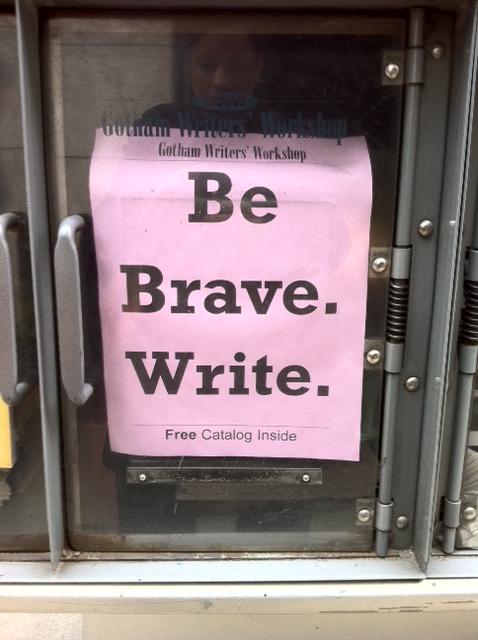
Special thanks to John Klymshyn for this image
I’ve dreamed of writing for years, since I was a child. And I have. Over the last 9 years I’ve written hundreds of articles, blog posts, and newsletters through my coaching business. Before that, I wrote city plans. Before that, my graduate thesis.
But I’ve always dreamed of writing a proper something — a larger writing project with a definitive end, like a book or a screenplay.
Somehow, I never seemed to find the time to write until recently — just in the last year or so. And now I’m writing on a daily basis, soon to finish my first feature length screenplay.
What I didn’t understand, until now, was that my lack of writing WAS NOT tied to all the things I believed about what it would take for me to write, like that I needed more time, better ideas, sudden divine inspiration, the proper writing space, a better computer, or any of the other things I was telling myself.
Instead, I discovered that what was going on at a deeper level was that I was afraid. I was afraid to write.
And this is what I’ve seen with many people who say they want to write but aren’t doing it.
Just like me, they are afraid.
Common fears
If you have fear coming up around writing, you might be experiencing some of these common concerns I hear from writers:
- You’re afraid the writing you’re longing to share isn’t serious, artistic, engaging, funny, clever, dramatic, or fill-in-the-blank enough.
- You’re afraid that you’ll embarrass yourself if you put your words out there for other people to see.
- You’re afraid that you won’t be able to do a good enough job telling your stories — you won’t be able to do them justice and you’ll let your ideas down.
- You’re afraid you won’t be able to come with good ideas.
- You’re afraid that other people will be hurt if you write things they don’t like. You’re afraid they will see themselves in your stories and be offended.
- You’re afraid you don’t know how to write well enough, but you don’t give yourself the chance to learn how because you believe that writing requires innate talent and that if you had it, you’d already be writing.
- You might even be afraid that your best work is already behind you.
What you need to understand is that these fears are ONLY fears. Nothing more, nothing less. They MAY come true, we may fall on our faces and have to pick ourselves up again, just like my son did on his way to school this morning.
You also need to understand that these fears are your ENEMIES. They are the enemies to your dream of writing, and courage is your antidote.
Stay tuned for the next post in this series coming your way tomorrow, “How to Spot the Stealthy Smokescreens that Stop You From Writing.” Watch for it on the blog or subscribe here.
by Jenna | Feb 8, 2012 | Writing Articles
Are you waiting for the right mood to strike before you work on your creative project?
Are you waiting until you have the right room to write or paint in?
Are you waiting until you have the right computer before you can start writing?
Are you waiting until you have the right “voice” or platform before you start sharing your message?
Are you waiting until you’ve picked the right project to start working on?
Are you waiting until you have more money before you do your art?
Are you waiting for big blocks of time before you write songs, start your novel, or get that screenplay off the shelf for a rewrite?
Are you waiting to be divinely inspired before you start your project?
Are you waiting for permission to create?
Wait no longer.
Your art will not happen unless you do it. And sometimes that means showing up and doing it even if you don’t know what you’re doing yet.
Besides, in a study by Robert Boice about academic writers, he found that writers who committed to writing daily were TWICE as likely to have a creative thought as writers who wrote when they “felt like it.”
The key here is consistency. Making the effort to show up every day to your creative passion will foster and spark your creativity, not the other way around.
Warmly,