by Jenna | Dec 22, 2015 | Writing Articles
I waited for years to start writing fiction.
Inside, I felt like I had to get some kind of stamp of approval before I was "allowed" to write. That I needed an expert or agent or mentor or master writer to see my potential and encourage me to pursue writing. That otherwise I was chasing a fool's dream or breaking the rules somehow.
Change Your Mindset
I think many writers or want-to-be-writers do this. It's tied to perfectionism. A belief that we have to be "good enough" before we start. That there's a qualification level we have to reach before we even begin.
But how can we learn how to do anything, until we actually start doing it?
One of my mentors, Hal Croasmun of ScreenwritingU.com, talks about how he makes a point, every two years, to learn a new skill, so that he always remembers what it's like to be a beginner. This helps him develop the programs he runs for new writers because he can put himself in our shoes. I'm willing to bet he doesn't wait for permission to learn karate or poker or horseback riding. I'm betting he picks something that interests him, and goes for it.
Why can't we do the same with writing?
Perfectionism, again. This has to do, in part, with the black and white nature of writing in this digital age. Back when I wrote drafts on paper, I didn't hesitate to scratch things out. I knew I was writing a first draft. (I can even recall telling my father that I didn't think I could ever write without real paper! How times have changed...) There's something about seeing our words looking so final that makes them seem like they should be final draft, publication quality. Which is entirely unfair to our early stream-of-consciousness drafts.
Underneath the perfectionism is also fear, the lurking originator of perfectionism and other writerly issues, which tells us to play it safe and protect ourselves from potential failure, ridicule, and rejection. It's a powerful force that works against us and our writing.
But again, how can we learn, grow, and develop ourselves as writers without actually doing the work?
We cannot.
We have to change our mindsets from a fixed mindset to a growth mindset.
And we have to stop waiting for permission -- for some kind of pre-approval that will guarantee our success -- otherwise, we are really just kidding ourselves.
Don't Wait for Permission
Here's the thing.
You do not have to wait for ANYONE to validate you or tell you that you are good enough or deserving enough or talented enough to write.
No one has to “see” or recognize your writing as “good enough” before you can write. There’s no outside evaluation or assessment of “potential” needed or required.
YOU ARE A WRITER.
You are a writer because you are CALLED TO WRITE.
You know you are called to write because you have been persistently nudged, cajoled, and pestered by your deeper, higher, wiser self to write.
That means, by definition, you have been invited by the Universe to write.
And therefore, you have all the permission you need, right now.

by Jenna | Dec 10, 2015 | Writing Articles
I believe in callings.
I believe that each of us has something that we were put here to do, and when we find what it is, we must do it with all our hearts.
And... it isn't always easy to get clear on what our calling is.
Why?
The noisy, busy world we live in and the noisy, busy minds we are encouraged to cultivate by the mainstream makes it hard to hear ourselves and the deeper whispers of our souls.
And that's often how a calling comes through, as a whisper.
It took me a number of years to come around to realizing that my deepest call is to write. I spent my 20s and 30s sorting myself out in that regard, changing careers, soul-searching, and more (like helping other people get clear on their life callings!), only to come back to the insight that my 6th grade self already had hit upon: I want to write.
Are you called to write?
If you're here, reading a website named "Called to Write", I'm going to assume that you also feel that call. That you have the inner compunction to put words to the page in some form. You may or may not be doing it yet, or maybe not yet quite the way you want to be doing it, but I'm guessing that one way or the other, you've been feeling the call to write for some time.
When I conducted a survey a little while ago, 71% of you said that you felt called to write without a doubt. That's huge. And fantastic!
And, interestingly, 71% of you also said that you struggle with procrastination.
Isn't that fascinating?
The very thing we feel called to do is the very thing we tend to avoid.
And it's entirely normal.
One of my favorite things Steven Pressfield says in The War of Art (aka "Jenna's Bible") is this:
"The more important a call or action is to our soul's evolution, the more Resistance we will feel toward pursuing it."
In other words?
The bigger the dream, the more we fear and avoid it.
by Jenna | Dec 2, 2015 | Writing Articles
It's a busy time. There's a lot going on and a lot expected of us with the next round of holidays looming on the horizon.
It's also a time when we start looking ahead to the new year. Maybe more in the backs of our brains where we don't have to pay too much attention to it, but most of us are starting to think ahead to our writing in the new year and what we want to accomplish.
Some of us are even putting off writing until the new year, thinking we don't have enough time to do it now, with all the busyness.
Don't fall for the big blocks of writing time myth
The truth is, though, that most of us are putting it off because we think we need a lot of time to write. That it isn't worth writing unless we have a big block of time to write, where we can really dig in. And it's true, those long blocks of time to write can be lovely (when they don't scare the bejesus out of us and cause us to procrastinate even more!).
But we don't really need big blocks of time to keep our writing in motion.
We just have to do some writing.
10 Tips to Keep You Writing Through the Holidays
Here's what I suggest to my Called to Write members to keep writing through the holidays:
- Write small. Even if you're accustomed to longer stretches of writing time, it's okay to scale it back to a more manageable amount while you're balancing the busyness of the holidays too. Even just 15 minutes of writing a day (or 5!) is worth doing and will keep you connected to your project.
- Write first. Writing first in the day--even if you have to get up early--will help you bypass most of the challenges the holidays bring. This is because when you put your writing first, everything else comes afterward and fills in the remaining time. It will reduce your stress levels, you’ll feed your soul, and everything else will still miraculously get done.
- Set a rock bottom daily writing goal. If you know what your rock bottom minimum for writing is, it’s easier to know what to do on the really busy days. You might want to aim to write 250 words, or three sentences, or write for 15 minutes as your rock bottom. Then you know what you have to do when you’re in tough. (And it's okay to set your "write small" amount from tip #1 at your rock bottom minimum!)
- Set a holiday season writing goal. Whether you’re targeting completion of a major project or simply determined to keep writing no matter what, knowing what your goal is makes it easier to know if you are on track. This year, for instance, with a young toddler in the house, my goal is super, super simple: just to keep writing. That’s it. For another writer, it might be, to finish the draft of a novel by the end of the year. Once you know your goal, you can reverse engineer what you need to do to accomplish it.
- Know what your specific challenges are and how you will address them. For example, my older son will be off school for two weeks, so I’m thinking about what he’s going to be doing when I want to be writing and making plans to write when my husband is home and/or the kids are otherwise occupied. Maybe you'll be traveling, or having house guests. With some forethought, you can come up with a simple strategy to protect your writing time.
- Be clear about what days you are taking off. I know of writers who ONLY take off Christmas Day every year. I know others who write 365 days per year. I also know of successful writers who write only on weekdays and take weekends and holidays off. If you decide to take days off from writing, be clear with yourself about when, where, and how you will start writing again after the day or days off. You have to be ready to combat the inertia of not writing.
- Assume you will write. On the days you’ve planned to write, make the assumption that writing is happening, one way or the other. Ideally, you’ll have a plan and a schedule to help you stick to that plan, but if all else fails, just assume it’s a question of WHEN not IF. (Don't waste your life energy deciding whether or not you'll be writing. Just decide, and then do it.)
- Create support & accountability. Habit trumps inspiration, discipline, and motivation almost any day of the week, but habit can still get disrupted by changes in our routine, like the holidays, travel, vacations, extra social commitments, and just generally having more to do. You can use the power of accountability to help keep your habit in place even when it’s being disrupted by other things. Whether you’re checking in with your writing buddies, participating in a writer’s group like my Called to Write community, or talking to your writing coach, having people around you who believe in the importance of your writing and support you to keep doing it helps you stay strong when you’re around people who don’t get it.
- Be creative. When the going gets tough, be creative about how and where you write. For example, you might want to arrive at your appointments early so you can sit in the car and write for a few minutes, write on your phone in bed at night (this is one of my favorite tricks), keep a notebook with you at all times for moments of inspiration, or find other clever ways to keep writing even when life is happening.
- Write last. Last but not least, if you can’t write first, write last. Even if you take just a few minutes at the end of every day, write. This is my saving grace these days with a busy life with a little toddler.
I hope this list of ideas will get you thinking about what you can do to keep writing through the holidays so you can feel great about beginning the new year with a strong start.
Happy writing!
by Jenna | Nov 26, 2015 | Writing Articles
It's Thanksgiving here in the U.S., so many of us are thinking about gratitude.
It occurred to me that since here at Called to Write we focus on writing, it might be worth thinking about what we are grateful for that writing has brought to our lives.
So here's a place to share, if you feel so inspired.
Let us know in the comments ... what has writing given you that you're grateful for?
I'll go first:
- The satisfaction of pursuing one of my two most deeply held dreams, alongside my dream of becoming a mother.
- The joy of playing in far off imaginary worlds that I've always loved but never believed I could be responsible for creating.
- Incredible amounts of personal growth, self-discipline, self-confidence, self-trust, new habits, and new beliefs.
- Exciting adventures in learning about writing fiction and screenwriting.
- A tribe of incredible writers I'm grateful to call friends and colleagues.
It's your turn. :)
What has writing given you that you're grateful for?
by Jenna | Nov 25, 2015 | Reflections, Science Fiction
I wrote recently getting a handle on online distractions that keep you from writing, and prior to that, about cutting back on the online distractions that were cluttering my head.
I've been highly interested in this topic because I could feel my life-energy being sapped by these distractions and it's been really bothering me, despite the many changes I've already made. I do a good job of protecting my actual writing time from email and other online stuff, but the rest of my life? Not so much.
And it was mostly because of my phone. My computer use feels manageable. My TV consumption is minimal (though I have been watching lots of Prison Break and Breakout Kings as I'm prepping a sci-fi prison movie right now!). Having said that, I like being able to use my phone to read ebooks in the dark late at night without waking the baby (who sleeps in the same room) and being able to write on it when I want to.
But I don't like feeling like I can't be without it. Ever. YUCK.
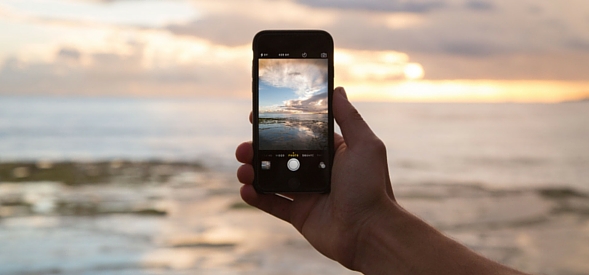
(And honestly, the picture I've chosen to accompany this post keeps freaking me out -- it seems entirely emblematic of how so many of us are viewing our world through the filter of a device... constantly.)
My email trap
It was email that was really my last "hook" — I rationalized that as a business owner, I need to stay on top of things and make sure nothing was falling through the cracks. But that notion kept me constantly checking to see if I had any new messages.
And not only did I feel guilty for oh so frequently "checking" my phone when I was around my kids, I didn't like the way my brain felt always cluttered by all the checking, even after I'd taken Facebook off my phone, turned off almost all the notifications in the lock screen and more. It was like being tied into other people's energy and needs was keeping me on edge, in a hyper vigilant state of awareness and constant readiness. Again, YUCK.
Finding the courage and support to make a change
So I decided to participate in a "Look Up" two week online use "detox" program and see what shifts I could make.
We worked through a four-step process of first defining what we want, noticing what impulses were driving the behavior to check in online, accepting that those feelings and impulses (often discomfort) would not necessarily change but that we could learn new ways to deal with them, and finally choosing what we wanted instead. Then, every day, we answered simple journal prompts every morning to set our intentions for the day about our online use and how we wanted our days to go, and every evening, about how it went and what we learned.
I deleted Gmail from my phone
Initially I found myself sort of skirting the edges of changing my phone use, testing the water, seeing how it felt just to consider cutting back. (Which just shows how powerful an addiction it can be!)
Even before the program started, I installed the app called "Moment" so I could see how much time I was actually spending on my phone, and how many times I was picking it up. So in some ways it was good that I wasn't changing anything initially, but just observing. And it was kind of scary. There was one day, prior to the program, where I picked up my phone FORTY-NINE times. 49!! It's embarrassing even to put that in print.
On about Day 3 of the 14-day program I decided to take Gmail off my phone entirely. For good measure, I took off Chrome too, so my second-biggest, "let me just look that up real quick" excuse was gone too. I still have Safari there but since it wasn't my go-to program it just doesn't have the same attraction. While I was at it, I turned off every other kind of lock screen, pop up, and banner notification I could find on my phone (except iMessage and Reminders, which I do use) and on my computer.
It was so worth it.
I felt sort of jittery for about 24 to 48 hours, still on that automatic "must-check-now" auto-alert. It was mildly frightening to feel so much like Pavlov's Dog. Again, YUCK.
What changed for me
After that, everything got a lot more calm.
I found myself feeling much more present in my life and to my family.
My brain felt quieter, calmer, more alert.
I had more energy.
I started reading REAL BOOKS and putting my hands on REAL THINGS like baking food, drawing, collaging. I noticed that when I felt the urge to "check" I could make tea, or snuggle with my boys, or GO OUTSIDE and look up at the beautiful amazing sky that helps make life on this planet possible.
I also found that I could still use my devices for certain things: Kindle, Netflix, the timer, the calculator, iMessages, writing, and other apps I love and find incredibly useful without it taking over my time and energy. My phone became a tool again, instead of a constant companion or savior or whatever it was actually doing for me. It's been interesting to walk the line of finding what online use works for me and what doesn't, at least for right now.
I found myself being crystal clear about times when I absolutely did NOT want to be consuming any online stuff at all and have had a few spans of totally unplugged time (something I used to do weekly) and LOVED it.
It's started to feel kind of gross to be looking at my phone.
So I just don't do it much anymore. It mostly stays in my office, on the charger, except when I need it when I'm out and want it for emergency phone calls, or if I need it for another purpose, like the calculator or timer. Again, it's gone back to being a tool, and I like that.
I also found that the days have gotten So Much Longer! All those "little" checks and moments of time that were getting sucked into online use are suddenly mine again. My mind is clearer. My intentions are clearer each day. I feel more focused.
How my writing has changed
And as far as my writing goes, I have not noticed a huge change in my writing time, but I'm not surprised by that, since I've already been writing regularly and protecting my writing time well.
What I have noticed is that I feel readier to write when I sit down to do it. Now what swirls around in my brain when I'm out in the world is what I'm going to be writing about next, whether it's a blog post, my current script, or the next big project that's coming down the pipeline. It might sound like a small shift, but it's huge. It feels like I've reclaimed my own territory again. And it's such a relief.