In this month’s “Ask the Coach” article, I’m addressing a collection of shorter questions from writers wondering about getting started with screenwriting, writing and learning screenwriting in another country, getting an MFA, and finding other screenwriters.
My responses include:
Steps to begin exploring and learning screenwriting
Tips for finding writing mentors
How to evaluate whether an MFA program could be a good fit
The challenge of the term thick skinned
Where to find writing groups online, especially for screenwriters
There really are no “shoulds” with writing. There are so many paths forward, and it’s about choosing what resonates with you the most.
Want the full scoop? Get all the details in the full article on Script Mag:
In this month’s “Ask the Coach” article, I’m addressing a set of questions from a reader about managing self-doubt in writing.
“[My] fear of failure has several prongs for me:
1. What if no one likes my writing? I’m trying to make it as truthful as it is filled with emotion and colorful descriptions, but maybe it’s just me because I relate to it all.
2. I’m currently writing a memoir that involves some memories of my parents and their failures — but good memories also. I feel guilty/disloyal for writing about their failures, but to some extent that’s where the strength of the story lies.
3. What I create in my head as I’m falling asleep never seems to be as great when I put it into my computer.
4. I suffer off and on with imposter syndrome, but I usually like what I write in the end.”
This is a set of challenging questions so many writers wrestle with. It reads to me like issues of self-doubt more than a fear of failure, though the two are intertwined.
First let me say this: In working with writers all over the world, being a writer myself, and reading first-hand accounts of seasoned, professional writers, so many if not all writers deal with self-doubt and fear much of the time (including me).
Here are the 6 antidotes I discuss in my response:
Use self-doubt as a clue that what you’re working on is important.
Trust that truth transcends differences.
Ask yourself empowering questions.
With memoir, write for yourself first.
Embrace the vision while also welcoming imperfection.
Trust the process.
The real key to all of this is learning to manage the doubts and the fears so they don’t stop you from writing, and so that they don’t make the experience of writing miserable along the way, by triggering overwhelming negative self-talk, habitual procrastination, perfectionism, and even shame.
Want the full scoop? Get all the details in the full article on Script Mag:
With the start of school and fall on the horizon, there’s this energy many of us naturally connect to that feels motivating and inspiring to start new things, take action, get organized, and make things happen. Lean into this energy and let it buoy you toward the momentum and progress you’re wanting.
In this month’s “Ask the Coach” article, I’m addressing a question regarding getting back to writing after summertime.
“My kids are starting school again. (Whew! Ack!) Truth be told, it’s been hard to write this summer with so much going on between family vacations and organizing summer camps. How can I regain my momentum after a rocky summer, writing-wise?”
Hey, good question! Many screenwriter-parent types are asking ourselves similar questions right now. Whether you’ve been writing intermittently, or not at all, the good news is that as your kids head to their classrooms, you can tap into the “back-to-school” energy they’ll be experiencing too.
And this is true whether or not you’re a parent. There’s a natural activation energy that arises in the fall and spring in particular, so this is a smart time to revisit your writing practice and give it a refresh if needed.
Here are the 7 steps I discuss in my response:
Remind yourself to treat writing like a pro.
At the same time, allow writing to be fun and joyful.
Lean into the back-to-school activation energy.
Revisit your writing practice.
Remember, you can ramp up gradually.
Keep going to keep going.
Be ready to adapt.
Want the full scoop? Get all the details in the full article on Script Mag:
My Sci-Fi Circuit article on Script Mag originally published on March 15, 2023.
“The important thing to focus on is preserving how the source material made you feel when you read it, and to hold on to that feeling and making sure it’s preserved in your adaptation.” -Eric Heisserer
Shadow and Bone magnificently expands its rich world-building and heart-capturing characters in Season 2, releasing Thursday, March 16th on Netflix.
If Season 1 was a strong takeoff for the show based on two of Leigh Bardugo’s bestselling YA book series — The Shadow and Bone trilogy and the Six of Crows duology — Season 2 soars even higher.
For those not already in the know, Season 1 begins with Alina Starkov (“newcomer” Jessie Mei Li) transforming from a lowly orphaned cartographer on a military assignment with her childhood friend, Malyen ‘Mal’ Orestsev (Archie Renaux), into a newly discovered and developing “Sun Summoner,” believed to have the rare power to destroy a shadowy and dangerous “Fold” that has divided the country of Ravka for hundreds of years, created by an ancient, dark magician experimenting with power beyond his control. Alina aligns with General Kirigan (the inimitable Ben Barnes), attracted to his power, and hoping to learn from him to control her own power, and together destroy the Fold that killed her parents.
Their story collides with a band of thieves — the “Crows” — featuring Inej (Amita Suman), a beautiful and stealthy knife fighter, Jesper (Kit Young), a gunslinger extraordinaire, and Kaz (Freddy Carter), their surly and mysterious boss, who are hired to capture the Sun Summoner. When their plans go awry, and nothing turns out quite as expected, Alina is on the run by the end of the season.
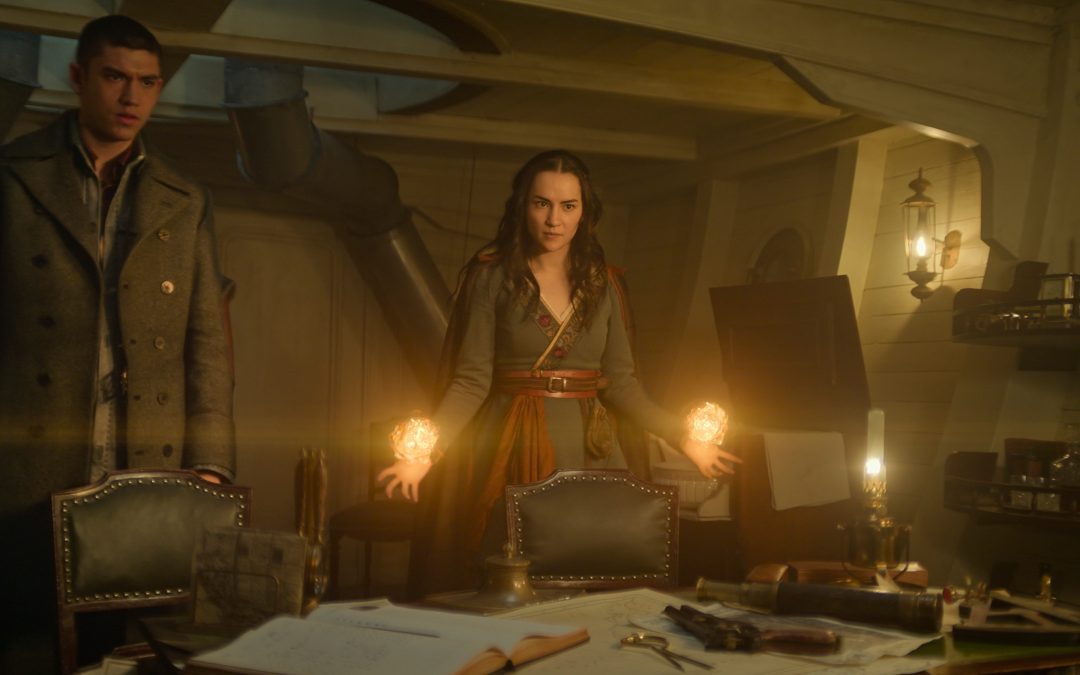
As Season 2 opens, Alina is still on the run, now with allies and reunited with Mal, and determined to seek two mythical creatures to amplify her power so she can destroy the Fold once and for all. She’s opposed by forces who’d prefer to use the Fold to leverage it as a weapon and keep the balance of power in their favor. Alina and Mal, aided by some excellent new characters, including Sturhmond, a privateer with uncertain interests, a pair of twin sibling fighters (Tolya and Tamar, pictured above), and Wylan, a charming demolitions expert.
With the diversity and excellence of the cast, well-drawn characters breaking tropes (sharing power instead of constantly competing), unique “tsarpunk” costuming and settings, intriguing magical abilities and methods, and beautiful world-building, Shadow and Bone is fresh, intriguing, and delightful. And it truly takes off in Season 2.
I had the pleasure of speaking with Eric Heisserer, the series creator and showrunner, and the screenwriter behind Arrival and Bird Box,about how he came to work on the show, his approach to the adaptation, and how he runs the show.
Heisserer originally read the books for pleasure, starting with Six of Crows. He fell in love with the story with the chapter titled, “Inej,” after being introduced to the world and to Grisha abilities, with a characters who “came alive on the page,” saying, “I’m still in awe of Leigh’s writing ability to do that.”
Series author Leigh Bardugo attends Netflix’s Shadow & Bone Season 2 Premiere at Netflix Tudum Theater on March 09, 2023 in Los Angeles, California. (Photo by Rodin Eckenroth/Getty Images for Netflix)
He so enjoyed the read, he tweeted about it to author Leigh Bardugo. He had made a resolution that year “to reach out to authors of anything I love to give them joyous praise,” in counterpoint to “the other side” (negative critiques).
A little over a year later, Netflix reached out, surprising Heisserer, who’d forgotten entirely about his tweet. He was in the middle of developing a pilot project at another network based on another story by Ted Chiang (Arrival is based on the short story “Story of Your Life” by Chiang), when Netflix approached him about becoming involved in the adaptation of the Shadow and Bone trilogy. Heisserer related how he turned the project down because they didn’t also have the rights for the Crows duology, feeling confident that the pilot project was a sure thing. He laughed about it ruefully, saying, “I definitely had the Charlie Brown voice of, ‘I’m absolutely kicking the ball this time.’ And Lucy yanked it from me.”
Luckily, Netflix was interested in his take to integrate the two series and picked up the rights to both, bringing him on board as showrunner and lead writer.
Because the Shadow and Bone series is a prequel to the Six of Crows duology, Heisserer had a unique challenge — essentially inventing a prequel story for the Crows to play during the Shadow and Bone timeline — and which ended up being “just as difficult as adapting something, but also just as rewarding.”
Heisserer described the work as something akin to a Back to the Future Part IIeffort, in that they were integrating characters into the main storyline that “could have absolutely been in the first book,” but weren’t. The writers had to do some of this in Season 2 too, particularly because they hadn’t yet reached the point where the Six of Crows duology begins (and had to navigate a hard and fast rule from author Leigh Bardugo to not have a certain something show up before that point). They compressed the remaining two books of the trilogy for Season 2, in part to get to that point in the timeline, as well as to navigate around some of the “palace intrigue” that otherwise would have kept too many of the large (and excellent) cast off-screen for too long.
Although the writers began writing the Season 2 scripts in January 2021, well before Season 1 aired and before Netflix renewed for Season 2, they haven’t followed the same approach this time around with a third season. Happily, however, they’ve written a season’s worth of scripts for certain characters that can “live alongside a Season 3, should we be so lucky as to get a Season 3,” per Heisserer, who added, “Book fans will know what I’m talking about.” (I’m hoping this means an adaptation of King of Scars, featuring Patrick Gibson (The OA), who was fantastic in Season 2 as Sturhmond, but since I haven’t read the books yet, that’s pure speculation on my part.)
Heisserer worked as the solo showrunner for Season 1, but “when [Netflix] green-lit the production of Season 2, they also green-lit the writer’s room for this side project, and I made it very clear I could not do both at the same time, and live. And we all agreed that Daegan Fryklind, who was my EP and right hand in Season 1, should absolutely ascend to be co-showrunner for Season 2. And I’m grateful that she said yes — great boots on the ground for so much of that on the production, and I joined her as soon as I could.”
Eight writers comprised the writer’s room for Season 2, including Heisserer and Fryklind, plus other “fresh voices” working on the mysterious side project (Heisserer mentioned an Inej-focused episode which immediately caught my attention). The writer’s room included two assistants who moved up in the ranks, one from show assistant to writer’s assistant, and another from writer’s assistant to staff writer. Heisserer said, “[This] is part of the process — looking to bring people up in the business and have them ascend to greater positions of writing — the way it used to work.” (We love him for this, right, writers?)
He added, “I have clung to this creative team and stuck with them as much as I could throughout. They’re a good group of people and know the material so well. There’s a genre fluency and a fluency to the world, and they know how to write for our actors. So we kept a lot of that same team throughout.”
On the subject of adaptation, Heisserer had this brilliant piece of wisdom to offer, “The important thing to focus on is preserving how the source material made you feel when you read it, and to hold on to that feeling and making sure it’s preserved in your adaptation. There will be a lot in the aesthetic fidelity of the project that you’ll try to preserve, but discover that does not translate in the adaptation.”
As an example, he shared that “one of the most frustrating elements in Shadow and Bone was that in the books [a character] was called ‘the Darkling’ constantly and had no other name. And we struggled with that. We tried to make it work for so long and it got frustrating for two reasons. One was that we found in so many early auditions that if there’s a slight enunciation problem with an actor, it sounded like ‘darling.’ It worked so well in that source material and it fell apart for us in the show. [Second], we didn’t want to divulge his first name until early in Season 1, when he’s making a gesture of closeness and intimacy to Alina. When we thought about having him give a fake first name, we realized it would seem like he was lying to her about everything and wasn’t being emotionally honest with her, which was a betrayal of his character at that moment. So we knew that was going to be too troublesome for people to understand. We only hope they can empathize and understand that it came out of us holding on as hard as we could to what worked in the books that didn’t work in the adaptation.”
With world-building in fantasy, Heisserer fought a battle for all writers: “On adapting fantasy or creating fantasy — particularly second world fantasy where you don’t have the portal of the real world that someone can ground it in — there is so much world-building that needs to happen. The fight I had — that I hope will make it easier for other fantasy writers — is in how much you have to define and explain, particularly for the executive who doesn’t read and doesn’t necessarily care about fantasy, and wants a text crawl or a 10-minute voiceover describing all the hierarchies, caste systems, currencies, and histories so that it turns into a BBC documentary about a show versus an actual fictional narrative.
“And the fight I had was this, ‘If this were a medical show and our character — our lead — was a neurosurgeon who threw around a ton of jargon about the brain, about surgical tools, medicines, and whatnot, that you didn’t know about, you wouldn’t care. You wouldn’t bat an eye. You would be happy with it because you understood the stakes are life and death. If I can get you to the place where you believe the stakes are life and death, then let us have this use of foreign terms, and trust the audience, because today’s audience has such a genre fluency that we wouldn’t have 30 years ago. We’ve been weaned on Game of Thrones and Lord of the Rings and all these other shows that have paved the way for us, and we think viewers will give us that faith and hang in there until it clicks.’”
Amen.
Season 2 of Shadow and Bone is out on Netflix on Thursday, March 16th. I hope you enjoy it as much as I have.
Note: I screened Seasons 1 and 2 for review.
About the Series
Co-Showrunners / Executive Producers / Writers: Eric Heisserer (Chronology) and Daegan Fryklind
Author and Executive Producer: Leigh Bardugo
Executive Producers: Shawn Levy, Josh Barry, Dan Levine, and Dan Cohen for 21 Laps Entertainment, Pouya Shahbazian (Loom Studios) and Shelley Meals
Directors: Bola Ogun (Episodes 1 & 2), Laura Belsey (Episodes 3 & 4), Karen Gaviola (Episodes 5 & 6) and Mairzee Almas (Episodes 7 & 8)
Cast: Jessie Mei Li (Alina Starkov), Archie Renaux (Malyen Oretsev), Freddy Carter (Kaz Brekker), Amita Suman (Inej Ghafa), Kit Young (Jesper Fahey), Danielle Galligan (Nina Zenik), Daisy Head (Genya Safin), Calahan Skogman (Matthias Helvar), Lewis Tan (Tolya Yul-Bataar), Anna Leong Brophy (Tamar Kir-Bataar), Jack Wolfe (Wylan Hendriks), Patrick Gibson (Nikolai Lantsov) and Ben Barnes (General Kirigan)
In this month’s “Ask the Coach” article, I’m addressing two questions regarding finding representation and connecting with producers (and some notes about navigating these appropriately during the Writer’s Guild strike).
Here are some of the action steps I discuss in my response:
Do the research to find the companies and individuals that are a good fit. (With recommended resources.)
Look for ways to connect.
Nurture relationships over time.
Build your own overall network of industry contacts that may naturally lead to an introduction at some point.
Focus on genuinely connecting with managers you think could be a good fit for you and your work. Follow them. Read what they post. Respond authentically when appropriate. Help out with something they’re looking for. Relationships evolve organically when nurtured over time. Keep an eye out for an opportunity to work together to arise, naturally.
In this month’s “Ask the Coach” article, I’m responding to two questions about writing scene descriptions, including seeing it as an opportunity for your voice to shine, and where to draw the line with what to include and what to leave out.
Here are the main points I discuss in my response:
Scene descriptions can be a delightful way to design your pages.
Scene descriptions are a place where your voice gets to shine.
Include thoughts and emotions in scene descriptions sparingly.
Focus on what’s truly important to the story when writing descriptions.
Writing scene descriptions offers a unique opportunity for screenwriters to feature their voice, style, and creativity. Allow it to come through with all the choices you make, while striking the balance between creating the blueprint for the visual, cinematic world of your story, keeping your writing open and flowing on the page, and giving your readers and audience insights into the depths of your characters and the critical information they need to follow the story.