by Jenna | Nov 14, 2012 | Writing Articles
In my last post, I wrote about the cycle of creative burnout and how our creative inspiration becomes depleted when we push ourselves too hard and for too long.
I'm well acquainted with burnout; it's a cultural norm in the field of urban design, my last "real" J.O.B. The writing profession has its own set of deadline-driven, high-stress work.
In the creative realms, including writing, artists are often seen as people who work in fits and starts, pulling all-nighters when they suddenly become inspired (or finally stop procrastinating).
I've allowed myself to enjoy the feeling of heroism that comes when I swoop in and save the day, meeting the deadline with just seconds to spare, but I've paid high prices for every single one of those dramatic experiences: apathy, resistance, confusion, grief, exhaustion, and lifelessness.
And truthfully, I STILL feel like I'm recovering from the bad choices I made working 60 and 70 hours a week more than 10 years ago.
Balance is a myth? I don't think so.
It's been said that balance is a myth and that passion should reign supreme.
I disagree.
Imbalance is an amateur's gig.
Balance -- an ongoing cycle of work and renewal without resorting to extremes -- is part of not hitting bottom in the first place.
Balance is about staying sane.
It doesn't mean that we don't work hard and play hard at different times.
But it does mean keeping an eye on the greater whole and not bingeing on any one thing at any given time.
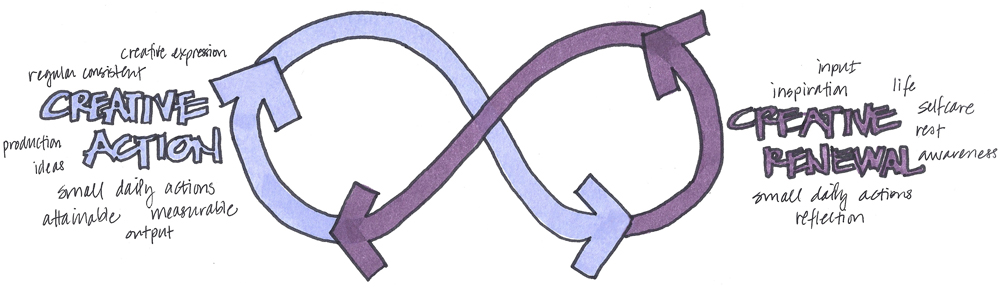
So what DOES a cycle of creative renewal look like?
The cycle of creative renewal
It looks like this:
by Jenna | Nov 7, 2012 | Writing Articles
In my writing community we periodically talk about creative burnout.
In our Western culture we work hard, driven by puritanical work ethics, cultural programming, keeping up with the Joneses, guilt, etc. It's no wonder we're exhausted.
We push and push ourselves, expecting our wells of creativity, resourcefulness, and inspiration never to run dry.
And then one day, we turn to the well and find it empty. No ideas. Maybe even a sense of dread and apathy.
The only way out is through
In a recent blog post, Mark Sanderson talks about his experience with this kind of creative depletion and how he recovered from it. Interestingly, his solution had to do with carrying on and doing the work no matter what.
He said:
"Some call it 'writer’s block.' I call it sheer terror. When this happens you need to relax and continue to work at your process. I know this too well from experience, but it still proves true every time – the only way to solve specific problems is to sit down and focus on the work."
It seems the only way out is through.
It takes courage
Writing -- for that matter doing anything that calls us to step out of our comfort zone -- requires a great deal of courage. A willingness to be uncomfortable often. To sit in it, do the work, and get to the other side.
No wonder we tend to procrastinate rather than facing that terror and doing it anyway.
Procrastination and burnout are close cousins
I've observed that procrastination plays a key role in creative burnout -- part of a vicious, intertwined cycle:
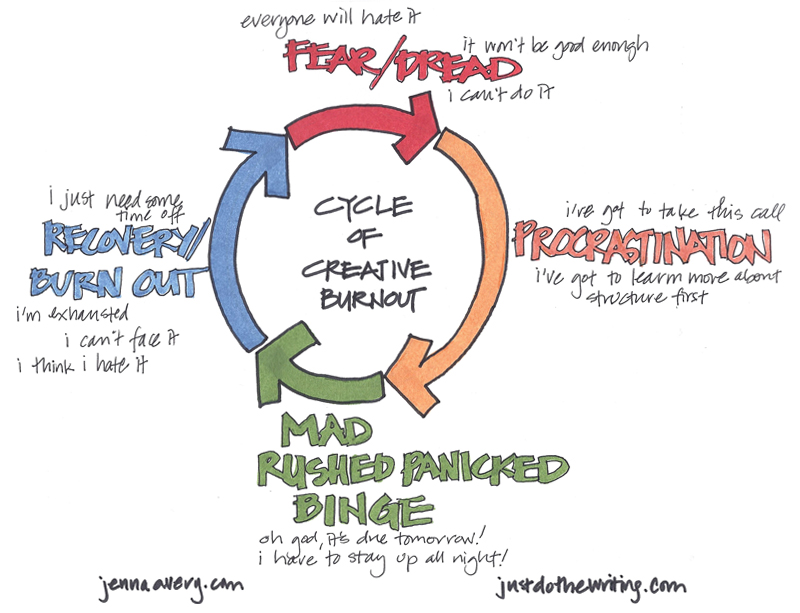
The reason we work past the point of endurance and exhaust ourselves is that we have procrastinated for so long that we are forced to push ourselves. And the reason we procrastinate that we are afraid.
I love what Steven Pressfield says about fear in his book Turning Pro:
"The professional, by the way, is just as terrified as the amateur. In fact the professional may be more terrified because she is more acutely conscious of herself and her interior universe. The difference lies in the way the professional acts in the face of fear."

by Jenna | Oct 31, 2012 | Writing Articles
Something that often comes up for writers, who are often introverts, empaths, and sensitives, is a feeling of not belonging.
I’ve noticed that this feeling of not belonging often comes up in higher stakes social situations, like conferences (whether for work or for pleasure) and parties.
I suspect that this feeling of not belonging is primarily triggered by feeling overstimulated and overwhelmed by the energy of all the different people in the room, as well as by the intensity of our own hopes and expectations about the event.
Not belonging is a kind of rejection
Of particular interest to me is that most sensitives (including me) will go through some kind of rejection process as part of dealing with their belonging issues.
Often this looks like telling ourselves, “I don’t belong here. There’s something wrong with me, I don’t fit in, I’m not as good as so-and-so at this, what was I even thinking to be here in the first place?”
But it can also look like this, “These people are horrible, what are they doing/thinking/saying that for? I can’t believe how [fill in the blank] they are being. I don’t have these problems, I don’t belong here, I’m better than they are.”
It’s a clear pattern of rejection.
In the first case, we reject ourselves.
In the second case, we reject “them.”
Rejection like this is a form of judging
Inherent in this way of thinking is judgment.
We’re either judging ourselves or judging other people.
And why?
I notice that I’m much more likely to get into this kind of pattern when I’m feeling insecure about something.
“Compare and despair”
(Martha Beck’s phrase)
It also feels a lot like comparison.
Remember what we say about comparison? Someone always loses.
I think the same thing goes for judging.
I lose when I judge, whether I’m judging myself, which is so painful, or when I’m judging someone else, because I rob myself of the opportunity to see someone as human, flawed, and imperfect, just like I am.
Judgment versus discernment
As a counterpoint to my own argument, I feel compelled to add that judgment can be a useful tool when applied as discernment. We can and should be discerning about how we invest our time, energy, and money in the world, and who we spend it with. It strikes me that judgment (at least the kind of judgment we’re talking about here) is healthy discernment run amok.
Judgment makes it personal. Discernment makes choices.
Connecting at the level of humanity
A few weeks ago, I talked about how looking from the outside in never gives us the full story about other people, so we need to be careful not to make assumptions about things like how successful other people are or not, what they really think or believe or feel about something, or what their businesses, habits, homes, or relationships are actually like.
I’ve also been observing how much pain and struggle so many of us are experiencing right now, and while I don’t like to focus on the struggle, it’s real and true.
At conferences and parties everyone tries so hard to “BE SOMEONE” they are not, it’s much more difficult to connect to the truth of their humanity, just like it’s harder to connect to our own humanity when we’re focused on the image of who we are trying to be.
The painful beauty of events like Hurricane Sandy is that they connect us together through the simple truth of being alive, something I remember all too well from the 1989 Loma Prieta Earthquake and the 1991 Oakland Hills firestorm.
When we can find that place of connection, by staying grounded and connected with our own bodies and looking to see the deeper souls through the eyes of the people around us, we are always safe, we always belong, and there is no need to judge.
Warmly,

by Jenna | Oct 24, 2012 | Writing Articles
I had a lovely chat with a friend recently about applying to a school program she's interested in. She confessed that even though she very much wanted to attend the school, she hadn't yet completed the application.
Ah!
That familiar friend: Procrastination.
Why do we procrastinate about things that are important to us?
Why is that when it comes time to do the hard work, whether it's taking action on our businesses, filing important paperwork, writing that longed for novel or script, or making time for our art, we stall?
I mean, sure, it's hard, but we've also said how important it is to us. We've spent money on classes, books, training, and support. We've written it into our schedules. It's clearly a priority for us, right?
So why so much talk and not so much action?
It's the size of the dream that matters.
I'll say that again: It's the size of the dream that matters.
The more important something is to you, the more fear, procrastination, and resistance you experience. In fact, the level of fear you feel seems to be directly proportional to the size of the dream.
Perhaps even a little bigger, just for good measure.
"The more we care about something, the more we dream, the more fear shows up."
~ Robert Maurer, author of One Small Step Can Change Your Life: The Kaizen Way
The problem: We're wired to shut down in the face of fear.
The fact that our brains are wired to shut down in the face of fear is what creates the entire conundrum in the first place.
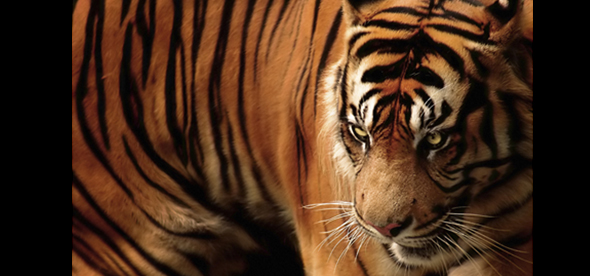
As Robert Maurer describes in One Small Step Can Change Your Life: The Kaizen Way, when our brains go into fight-or-flight mode, our frontal cortex -- our thinking, rational brain -- is automatically shut off so that we can respond appropriately and quickly to the threat at hand. This is a natural response to fear. Unfortunately, our mid-brains, home to the amygdala that governs the fight-or-flight response, can't differentiate between the fear that comes up when we're confronted with a tiger or when we're contemplating completing the next great opus.
And so suddenly your thinking, rational and creative brain is completely turned off . . . which when you're attempting to create and design new business ideas or a screenplay, isn't so helpful.
The good news
The good news is that when you can learn to expect the fear to show up, you can normalize it and make it okay. Then it's easier to be compassionate with yourself and coax yourself through the tasks at hand.
I've learned to recognize my own resistance routine and treat it like a familiar visitor I know how to handle.
I tell myself, "It's okay, I know you're scared, you can do this anyway." And I do.
It helps that I make a point to tackle things in small pieces, just the way Maurer recommends: "Small, easily achievable goals -- such as picking up and storing just one paper clip on a chronically messy desk -- let you tiptoe right past the amygdala, keeping it asleep and unable to set off alarm bells."
This is why, even on really tough days, you'll still find me writing at least 15 minutes a day on my screenplay, six days a week, no matter what.
The really good news?
The more work you do in small steps, the more your brain gets rewired with new neural pathways and new habits, making resistance so much easier to overcome.
Warmly,
You may also be interested in:
by Jenna | Oct 17, 2012 | Writing Articles
I’ve been writing a lot about staying on course and listening to our own inner guidance about what we’re passionate about and called to take action on. Today’s post ventures a little father afield into a broader context I’m noticing for so many people right now: radically changing circumstances. Enjoy.
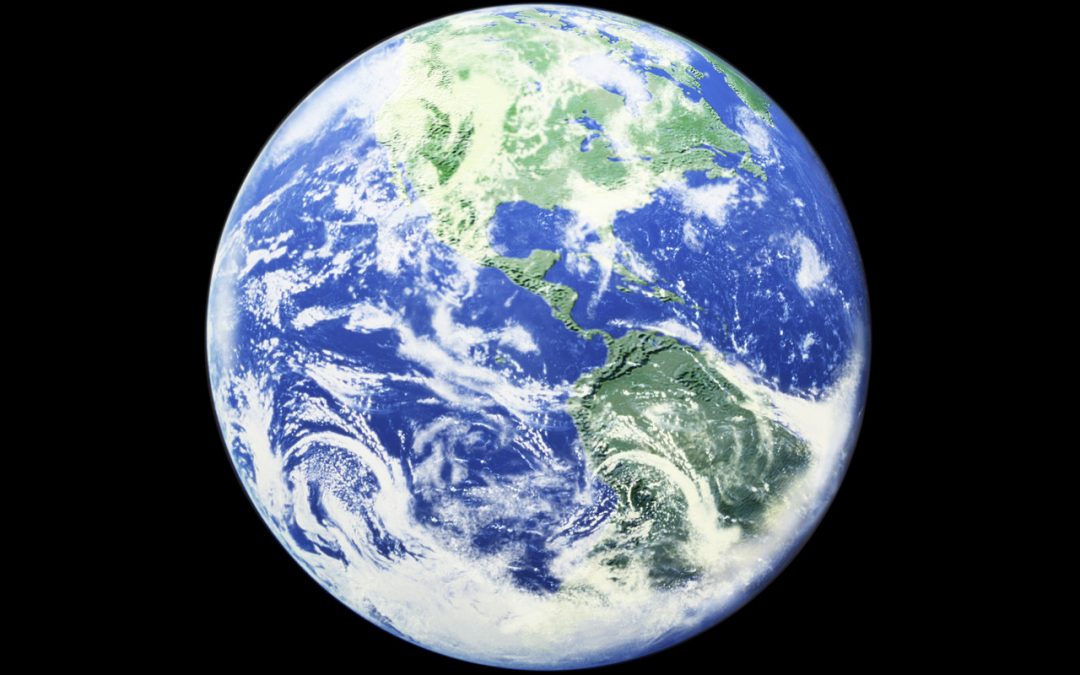
I’ve been interested in the idea of the world “ending” in 2012. Curious, waiting to see what will really happen, and anticipating something along the lines of Y2K.
In other words, not much.
My sense has always been that if December 2012 truly is the “end of the world,” that it would more likely be “The end of the world as we know it,” meaning that things will change radically and significantly as we pass through the final months of 2012… perhaps even being so lucky as to emerge into a new state of higher consciousness as some of the spiritual leaders suggest due to some kind of major world-wide changes or events.
That seems like a good thing. I’m down with it.
As I’ve observed this year unfolding however, I’ve been caught off guard by the way this massive change is playing out. I’d expected to see it on global scale, but instead (at least so far) I’m seeing big shifts on a very personal scale.
So many people around me are experiencing sudden, sweeping change. Their loved ones are dying or being diagnosed with major illnesses. Relationships are crumbling apart and unexpected truths are being revealed. So much is happening and so many people are affected and in crisis. Even people who seem “immune” because their lives appear fairly stable are getting unexpected phone calls that send their lives spiraling in entirely new directions.
It has happened for me too: Over the last 2 months, my personal life has been changed in an entirely unexpected way. I believe it will ultimately be all to the good — and — it’s been darn hard going through it.
It feels like the world is being adjusted — everything that doesn’t support us is being changed or let go of — in a radical, unalterable way.
I think I’m seeing “the end of the world as we know it” unfolding before my very eyes.
My world has certainly been irrevocably changed.
So has my best friend’s life. So has my cousin’s, my sister’s, and my friend’s life. So many changes are happening every day and everywhere.
Surprisingly, I feel 100 times stronger than I ever have before.
My resolve to keep writing no matter what has been astounding, and gratifying.
My sense of commitment to myself has been deeply reaffirmed.
It isn’t easy.
There are hard days and easier days.
But I have this sense that we’ll ALL get to the other side of this challenging time stronger, more connected, and more whole.
Warmly,