by Jenna | May 3, 2011 | Reflections
I’ve been giving a lot of thought lately to enjoying my life more.
I’m kind of an all work and no play kind of girl. I easily fall into a more “masculine” approach to my life and my business: I’ve inherited a strong delayed gratification mentality. I push myself hard to get to the outcome I want, delaying rewards. I’m better (there’s always more) at not neglecting the self-care the way I used to, but I don’t get around to the really fun, delicious, Life Savoring that I want to be enjoying. At least not until recently.
In part because of my own calling in this direction, I’ve been paying close attention to spending my precious time wisely in work or at play.
Here’s what I’ve been putting my focus on, and I’d love to hear how you’re inspired by this and how you decide to use your precious time:
1. Enjoying what I’m actually doing, no matter how simple or mundane.
As an Enneagram Four, it’s all too easy for me to get all dramatic about doing “special” things (you know, grand sweeping gestures and the like) and to poo-poo the ordinary and the mundane.
But those seemingly “little” moments are what add up to the beauty of life — watching my son run around with other kids on the lawn. Folding laundry while listening to my husband read to our little guy. Snuggling up watching a movie together. You know.
2. Prioritizing “real life” activities.
As a creative entrepreneur who operates largely in the virtual world (blogging and writing on my computer, speaking with clients by phone or Skype), I’m making a point to emphasize more real life experiences too, like spending time in the garden with my hands in the rich soil, creating community experiences in our neighborhood like the fabulous progressive dinner we had over the weekend, or simply sitting in the sunshine on my front porch while holding coaching calls.
3. Turning off the virtual world.
I’m also making a point to unplug more from the iTouch, Twitter, Facebook, and my computer. They are seductively engaging, but I find my time swirling away from me into a vortex of web searches and information indulgences.
4. Taking small daily steps to move me towards my big dream rather than looking for single massive actions.
This is a big pitfall for me — I look for giant blocks of time to do one project, but then never QUITE get around to it. I’m learning to take “turtle steps,” as Martha Beck trained coach Jill Winski calls them, consistently. And consistently again.
I received a reminder of this on Twitter via @AdviceToWriters over the weekend from Anthony Trollope (a 19th century novelist):
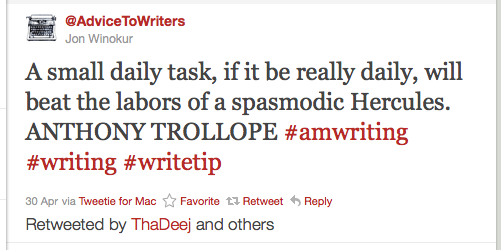
For me, this includes taking small steps to take care of the business of living, like keeping up with my book keeping and paperwork, as well as the business of living my Life Purpose. That way, I don’t get overwhelmed and feel unable to keep moving ahead with my Big Dream.
5. Choosing a grounded approach.
There’s a lot of conversation around integrating the masculine with the feminine. About being goddesses in our own lives. I agree.
I think it’s also about being grounded in remembering what really matters. For me, that is my inner sense of well-being, my connection with my son, my relationship with my husband, my connections with the communities of people I care about, and fulfilling my big dreams.
Despite what my mind and ego like to say to the contrary about achieving my big dreams, it’s not ONLY about “making it happen” or “getting it done.” I want to ENJOY my life along the way, have FUN while I’m doing it, no matter what my current circumstances are — no matter how much money I have or don’t have, no matter how much sleep I’m getting or not getting, no matter how many clients I have or don’t have, etc., etc., ad nauseum.
by Jenna | Mar 26, 2011 | Reflections
My dad apparently started a topic about me and my old job flipping hot dogs on his Cal Sports website last year and I thought it was funny enough to warrant sharing with you.
It’s true: I used to run a top dog in Montclair (Oakland, California).
It was pretty much the antithesis of the textbook job for a sensitive soul — loud, busy, rushed, etc — but I have to say, I loved it. Plus it was so good for me — it helped me find my voice and learn how to manage a crowd. The job consisted of taking hot dog and soda orders from a busy crowd of customers, yelling at the top of my lungs to coordinate all their requests and money and everything, and trying to keep a jam-packed grill of orders straight in my head. Crazy fun. :)
(N.B. The names listed here are the user names they all use on the sports forums. My dad is GreyBear. I’ve edited the thread a bit for relevance.)
“My daughter – Top Dog Manager”
GreyBea: Years ago – [she] ran the whole store, managed employees, cooked dogs, etc. Could we maybe start a draft movement to get her to run a concession at Cal/Memorial? That’s the one sure way I know to get the kind of dogs we all want to have available there.
(Investors needed.)
(She won’t do it.)
KoreAmBear: I’d be interested in investing. Congrats GB. Someone who can run a food business is someone who can make things happen. [Editor’s note: so true!] So you’re talking about after the remodel? That would be stinkin’ cool.
OneTopOneChickenApple: Will it still be $3 a dog?
Calumnus: I’d love to be involved. Great dogs and the best non-alcoholic beer we can find.
OneTopOneChickenApple: Greybear is The Man. Direct Hotline to Athletic Department and Top Dog and BearInsider boss. Count me in too, although I may only be able to invest in napkin and ketchup packet supplies.
sctawndawg: I wont invest any money but ill buy a few hot dogs every other year when SC goes up north to beat you guys.
GB54: Your daughter must have developed a lot of skills you don’t learn in books. I’ve always wondered how they hire these guys who can remember and have 58 orders going.
FremontBear: If your daughter ran Top Dog, then sight unseen, she’s better than the outfit running Memorial concessions. Ten bucks for a Polish and a drink??? Costco sells that combo for $1.50! I don’t mind Cal sports make good prfits, but at least give me the illusion my $10 is actually not that bad a ripoff. What kinds of numbers are we talking about as investment…?
GB54: Hell, if she was a top dog manager she’d be wasted in Memorial. I’d put her in charge of the Afghanistan war.
FremontBear: And the Federal Reserve too!
by Jenna | Mar 8, 2011 | Reflections
Yesterday I went to an art store on an Artist’s Way-style Artist Date.
I found myself in tears over a 28″ x something stretched canvas that made me remember how much I’ve always wanted to try oil painting. I walked away from it quickly and then turned to go back to see what else there was to “see.”
I remembered my old boyfriend who was a “real” artist (Julia Cameron says shadow artists like to hang out with real artists and project their creativity onto their partners. Um. Here!).
I remembered how he had painted a picture of the girl he was cheating on me with and tried to pretend that it was just a gift for a friend.
On a similar piece of canvas.
I remembered how he had made me a painting a long time before I and I hadn’t liked it and didn’t know what to do about it. He never did give it to me, and I never did know how to handle it.
Double ouch.
And then the tears spiked again over a beautiful “artist’s marker pad” that was a perfect vehicle for the diagrams I’ve been wanting to do. (I brought it home.)
As I walked through the aisles of the art store, I was reminded of all the delicious art tools I already own, but that have been untouched for so long.
I wondered why I stopped doing the watercolors that delighted me so much once upon a time. Did I stop simply because I stopped traveling overseas so often? Had I lost the connection because I’d given up urban design work? Did it just start to feel too much like work?
All around the store I found reminders of my past creative endeavors (fabric dyeing, rug making, drafting and tracing, portfolios, yummy art supply containers) and so many possible future adventures. I thought about how I couldn’t afford to buy all the supplies so there was no point in learning a new craft.
But I also considered how much I love learning the tools of my craft — whatever it is — designing, drafting, drawing, coaching, website making — I am such the perpetual student. A true renaissance soul (or “scanner”). And how I wished I could just simply be a perpetual student (oh, wait a minute, I kind of already am) with a patron who wanted to sponsor all my wild ideas and wonderful projects (well, not so much that part, at least not yet).
Whilst all this transpired, I continued a conversation I’ve been having with myself for the past few days.
If I love what I do, will I love it ALL the time?
Will it ALWAYS feel easy and like I can’t wait to leap out of bed in the morning?
My screenwriting teacher often spoke of the pain of writing, the loneliness of it. That it would feel like swimming in a vast sea, just trying to get to the next “tent pole” in a script as if it were a buoy you could grab hold of to save you from drowning.
There are days when writing feels like a wretched chore. When it feels like I’ll never (ever) succeed at it, that my work will never be any good, and my ideas are not clever or brilliant enough.
But if they are my ideas, are they not enough? Isn’t it enough to write what I’ve been given, unleash my creativity as far as I can and hope for the best?
I look for where my fear comes up biggest and loudest, and go there. Is that always going to feel easy and flowing and delightful? I doubt it.
At the same time, there are days when writing feels like the most precious gift I’ve ever experienced.
A freedom to put words on the page and become one with them in the most amazing discovery of story and flow and ideas and energy that I’ve ever seen.
I figure there are good days and there are hard days.

by Jenna | Oct 26, 2010 | Reflections, Writing Articles
Artists, visionaries, and healers face the intense darkness of creativity on a daily basis.
Robert Johnson, author of Owning Your Own Shadow, writes about “why so many creative people have such a miserable time of it. . . . Narrow creativity always brings a narrow shadow with it, while broader talents call up a greater portion of the dark.
“While those with the largest talent seems to suffer most, we all must be aware of how we use our creativity — and of the dark side that accompanies our gifts…. all these [creative] acts will have an equal weight on theopposite side of the scale and lead us into [destructive behaviors].”
So when we create, we face the necessity of destruction to balance our creativity. Our “positive” behavior must be balance by “negative” behavior.
“There is, however,” Johnson writes, “a broader kind of creativity that folds the darkness into the finished product and finds fulfillment in the shadow.”
Creativity is essentially a birthing process, but it evokes death as well.
Here’s what I mean: One of my colleagues reminded me recently that creating anything requires a metaphorical death. Your ego has to die in order to let go enough to bring your creative vision into theworld. You have to embrace an attitude of reverent surrender and to shift into an internal space that’s connected with the divine, rather than the ego, in order to create. Fear and all. No guts, no glory.
In other words, in order to birth our ideas and visions, we have to die. DIE! No wonder it’s so incredibly terrifying to create.
It requires a huge leap into the unknown, a leap of courage, even just to begin.
And no wonder we have so many excuses not to create: Too busy, too tired, too stuck. Don’t care anymore. You know the drill.
But at end of the day, our excuses not to create are manifestations of your fears about birthing our creative work into the world.
Since birthing isn’t pretty or easy, that’s no surprise.
We have to be able to walk into the darkness, transcend the huge void between the light and thedarkness, get down on our knees in abject surrender, and give it everything we’ve got in order to bring what we’ve been given back into this earthly plane.
If you’re not doing that, you’re probably playing too small. A lot to live up to, right?
Interestingly, in our culture, you’re trained to hide from your darkness, to put a pretty face on it, and not to mention it. Not to appreciate it. But that’s where the true jewels lie. All that tension, that angst, that creative frustration is actually a huge untapped energy source, just waiting to be released in a glorious explosion of full, whole-bodied creative expression.
As Johnson says, “We are … talking about sainthood in the original meaning of the word — a full-blooded embracing of our own humanity, not a one-sided goodness that has no vitality or life.”
How can we bring our darkness — shadow — into our creative expression and thereby find our own true “sainthood”?
How can we release being “good” to find our true self-expression?
Worth thinking about.