Welcome to the first installment of my new “Ask the Coach” column on Script Mag!
This month’s question is specifically about the three-act structure in screenwriting:
“What I’m running into is the common criticism that my stories are not strongly three-act. They have a beginning setup, mounting problem, and ending resolution — good stories, I’m told — but tension doesn’t build in common cinematic form. Yet, I watch produced movies even less three-act structured. What am I missing?”
As your coach-of-the-moment, here’s how I’ll approach this question with you. Let’s look at the core components inherent in the question: how films get made (to address your comment about the produced movies), the source of the feedback, the value and strength of the three-act structure overall, and the impact of your own work.
“Remember: when people tell you something’s wrong or doesn’t work for them, they are almost always right. When they tell you exactly what they think is wrong and how to fix it, they are almost always wrong.”
— Neil Gaiman
For my full answer on three-act structure, how to look for a note beneath a note, and digging deeper into improving your next draft
My new “Ask the Coach”column on Script Mag launched this week!
As a writing coach, I answer a lot of questions for writers about how to make the work of writing actually happen. As you may already know, I specialize in helping writers get out of their own way and back on track with what they were put here to do.
In this monthly column, I’ll be answering your questions, anonymously, about navigating the ups and downs of writing, being a writer, and living a writer’s life, specific to your unique circumstances.
This is a judgment-free, guilt-free zone. It doesn’t matter what you have or haven’t done, so far.
What matters is what comes next. Ask me your most pressing questions, and my goal will be to help find a solution that works for you.
My Sci-Fi Circuit article on ScriptMag originally published on August 21, 2017.
There's a new low-budget sci-fi feature from the executive producer of Cloud Atlas called Stasis headed to iTunes and VOD on August 29th in the U.S. – and a lot we can learn from it as sci-fi writers.
I haven't seen the film yet (though it's already been released in over 30 countries), so this isn't a review.
But here's why I'm interested in the story of Stasis: When a screenwriter goes from writing on spec, to writing on assignment, to directing her own first short, to getting hired to write and direct a feature film, I'm interested.
I want to know how that happened, and how she got there.
Let's find out.
Lessons Learned from Writing and Making Stasis
Nicole Jones-Dion, image courtesy of IMDB.com
I sat down with Nicole Jones-Dion, who both wrote and directed Stasis – in record breaking time, mind you – to see what lessons we up-and-coming sci-fi writers might glean from her experience.
Nicole and I are friends and colleagues from our days studying at ScreenwritingU together, so it was a treat to get to chat with her.
Nicole's first directorial project was Devil's Deal, a short she co-directed with a colleague, and also wrote.
Her second was Debris, a short horror film about an ancient and cursed samurai blade, a passion project she crowdfunded on Indiegogo.
(Full disclosure: I contributed to both projects.)
How Stasis Came to Be
Nicole was on the festival circuit with Debris, which was up for several awards, when she reconnected with Pearry Teo, a colleague of hers and an executive producer on the movie Cloud Atlas. Nicole and Pearry co-wrote Dracula: The Dark Prince, which he also directed, and Nicole wrote Tekken: Kazuya's Revenge on which he was an executive producer.
When he saw her directorial work with Debris, he asked if she'd be interested in directing a feature. "Sure," she said, "What'd you have in mind?" (This is consummate Nicole.)
Image courtesy of XLrator Media
He pitched her a YA concept he had about a young woman who sneaks out at night to party with her friends, OD's but recovers, and goes back home only to find someone who looks exactly like her sleeping in her own bed. That was it. From there, it'd be up to Nicole to write the rest of the story. She agreed to take on the project.
Three lessons to live by:
Put yourself out there. Nicole took on a project she was determined to get out into the world by writing, directing, and producing her own short, Debris, and was noticed for it.
The relationships we build over time created the opportunities for us in the future.
When opportunity knocks, say "Yes!"
Putting Together the Financing with a Poster and a Script
Image courtesy of Compound B
Since horror is where Nicole and Pearry tend to hang out, she first conceived the concept as a demonic possession but then their investors asked for a time travel take on the story, which they settled on in January of 2016.
Once they had their concept nailed down, to get the ball rolling, the investors quickly put together a conceptual poster (left, and much different than the official theatrical poster, shown above) to take to the Berlin Film Market in February to build a fan base and secure financing for the project... and Nicole had to put together a script in two weeks to meet that deadline.
As a writer, Nicole said she was struck by how "all you need is a concept and a poster – that’s how films are bought and sold."
Two lessons to live by:
Because viewers often decide whether or not to watch a film on the basis on a poster and a concept (and trailer), it's not surprising that films are sold on that basis, not as much on the basis of the script. And though that can be disconcerting for a writer, it's an invaluable lesson when it comes to understanding the marketplace.
Be ready to write... fast!
Image courtesy of XLrator Media
A Breakneck Timeline
Then, once the financing was in place, Nicole started planning the shoot. She was told originally she'd have 24 days. Then 18. Then 12.
The timeline was short both for budget reasons and to be ready to preview a teaser trailer in May at the Cannes Film Festival. Their first three days of shooting were used to compile that teaser.
As a first-time director, she "didn’t realize how ridiculous that was." She says, "Most movies get three to four weeks. People who make films in this budget range keeping asking how I pulled it off."
Her answer? "An amazing cast and crew."
Nicole is proud of what they accomplished with this film, particularly given the incredibly tight time frames she was given to work with.
Two lessons to live by:
Marketing and budget drive a lot of how a film gets put together, shot, and produced and can have a big impact on a film.
Look at what you ARE able to accomplish with the resources you have, not at what you can't or didn't do.
Image courtesy of XLrator Media
Shooting the Film
Nicole and crew shot the film in May of 2016 in the Arizona desert.
They were plagued with a variety of challenges, haunted sets with shadow people, LED costume batteries dying far too rapidly, injuries, proximity to favored locations for drug runners near the Mexico border, and more, but at the end of it all, Nicole has a positive attitude about the crew and the project as a whole, focusing on learning from what went wrong, understanding the process, and making the most of the opportunity.
A lesson to live by:
No matter what happens, have a good attitude and learn from your experiences.
Image courtesy of XLrator Media
On Matching Up the Marketing
Image courtesy of Compound B
Although a typical convention in YA is to have a love triangle between girl and two guys, Nicole comments that the marketing campaign made some interesting choices, “focusing on the sci-fi elements rather than the YA love story.”
The international poster (to the right) emphasizes "the metaphysical / supernatural aspect where one of the characters is essentially a ghost,” whereas the U.S. poster, marketing, and trailer make it look "a lot more like a big action film," she says.
Despite the differences in the marketing, the film seems to be "finding an audience," as Nicole says, and it's ranking well in IMDb. "It was #317 last week on IMDb," she said at the time of our interview, "...still in top 500. I'm interested in how that's happening, so I can recreate it next time."
Anna Harr, image courtesy of IMDB.com
And so far, the film has fans. Nicole is being messaged privately by people saying they how much liked it. The actors are "getting flooded with fan mail," especially Anna Harr, who plays two lead roles in the feature film and is in practically every scene.
Nicole suspects a lot of the interest is the connection with Pearry as an executive producer on Cloud Atlas, as well as Anna's resonance with and appeal to teens, which is film's the target demographic.
A lesson to live by:
Learn everything you can from what's working.
Image courtesy of XLrator Media
Walking Both Sides of the Fence
After working on this project, Nicole says she's now even more aware than before of the critical business decisions that go into writing a script.
This means being conscious of writing trailer moments, writing roles for A-list actors (no matter who is ultimately cast), giving the protagonist zingy one-liners, and imagining the marketing as she writes.
"As writers," she says, "we tend to ignore and take it for granted, but filmmaking is both an art and a business. All those elements that go into place and make it more salable. It's our job to walk both sides of fence. To make art, tell creative compelling stories, and make money back for our investors."
A lesson to live by:
Filmmaking is both an art and a business.
Image courtesy of XLrator Media
Wide Open Spaces for Sci-Fi Screenwriters
Since sci-fi tends to be realm for big budget, Nicole sees a "pent up demand for films like Ex Machina and Moon." She sees the low budget space as being a "wide open," underserved market for sci-fi.
She also notes that while comparisons between Stasis and The Terminator are inevitable because there's a time traveling character in the story much like The Terminator, she sees it as a loving homage to sci-fi classic that brings in a supernatural element too. It's more like "Terminator meets Ghost" for teens.
Her advice for sci-fi writers, is to "know your genre, be aware of things that have been done before, and try to bring something original to it. Make it your own somehow. Make the most of it."
Lessons to live by:
Look for the opportunities in the marketplace and be the one to jump in and fill them.
Bring your originality to your work, even if there are echoes and homages to other stories.
Image courtesy of XLrator Media
What’s Next for Nicole
For Nicole, horror is her bread and butter. She's just optioned The Elevator Game, and is working on other horror scripts, and possibly other low-budget sci-fi scripts as well.
My Sci-Fi Circuit article on ScriptMag originally published May 31, 2016.
In my ongoing quest to make my sci-fi scripts the best they can possibly be—and help you do the same—I reached out to Scott Myers to get his take on the best way to break into the sci-fi market as well as his perspective on places where he commonly sees sci-fi specs falling flat.
Scott Myers (K-9, Alaska, Trojan War)
As an experienced screenwriter, screenwriting instructor, and the writer and curator of The Black List's official screenwriting blog, Scott has a finger on the pulse of what's happening in the world of screenwriting. He was kind enough to do this interview with me on the subject.
Scott, thanks for being here. First tell us, in today's spec market, what would you say is the best bet for sci-fi spec scripts, and why?
My advice: Think high-concept, low-budget. Can you write a sci-fi script with distant immersive worlds, scads of spaceships, complex battle sequences and hordes of aliens? Sure. But it will have to be incredibly special for two reasons:
Cost. The studios will have a hard time justifying acquiring a spec that could cost $100-$200M to produce, especially from a writer who has not proven they can handle all the unique issues related to the genre, such as world-building.
Studio preference. The studios, for better or worse, are more comfortable working with preexisting material than original material, a situation I doubt is going to change anytime soon.
So the line of least resistance in terms of writing a spec script that can sell is to think of something along the lines of Moon, the 2009 movie from writer-director Duncan Jones, a strong high-concept in a contained environment, and therefore lower budget.
Is there anything particular a writer should keep in mind when trying to write low budget sci-fi? Does low budget still hold a B-movie connotation?
I’d say two things. First, it all depends on the quality of the story concept and the ability to execute it in a simple, but elegant way.
Second, after a decade or more of found footage projects which in effect embrace B-movie production values, audiences are probably well prepared for certain types of sci-fi movies with less special effects and a, shall we say, cruder approach to the filmmaking process.
What would you say is one of the major places sci-fi scripts tend to fall short, and how can we remedy that?
I read a lot of scripts and one recurring issue I find, regardless of genre, is a lack of emotional resonance. There can be all this huge stuff going on in the plot, literally in a sci-fi story at the scale of blowing up an entire planet, but if there aren’t points of connection for a script reader to the story’s characters, where we actually feel something authentic for them, then the effect can be so much noise.
That’s why I have this writing mantra: Substantial Saga / Small Story. That is whatever the big story is, what I call the Plotline, there have to be some intimate subplots and dynamics going on which engender a human connection between the reader and the characters.
Fortunately Hollywood has some top-drawer screenwriters who write sci-fi nowadays who really get that, writers like Joss Whedon (Firefly, Serenity, The Avengers), Damon Lindelof (Prometheus), Alex Kurtzman and Roberto Orci (Star Trek 2009, Star Trek Into Darkness, Fringe), Jon Spaihts (Prometheus), and Neill Blomkamp (District 9).
Advice: Get hold of their scripts, read them, analyze them, read them again, repeat as needed.
How important is world-building in sci-fi and how do you recommend writers go about tackling it?
My own two cents—and this relates to all genres—is to think of the story universe as its own character. It should have a feel, an atmosphere, a unique sense of place, perhaps even an attitude toward the characters, for example, "hospitable" or "dangerous". I believe in character-based screenwriting and I think that can extend to how we approach crafting a story universe.
What's the most important piece of advice you'd give to a sci-fi screenwriter?
In my view, every good movie posits an existential question of key characters, most notably the Protagonist, and that question is this: Who am I?Throughout the narrative, there is a battle, metaphorical and/or literal, over the dispensation of that question that is only answered in the final act.
One considerable benefit of science fiction is to transplant characters into radically different environments and what that can do is really drive home that existential question. Thrust into extreme circumstances as strangers in a strange land, a Protagonist in a science fiction story can confront the question of self-identity not only in a philosophical way, but in a visceral sense of physical survival.
Putting a central character under that much pressure in a world with significantly different cultural values, behaviors and beliefs is a terrific way to confront what is arguably the greatest single question of our existence.
So I would say make your science fiction story about something, delve into the question of who am I. That’s the foundation of a small story set against a substantial saga that is rife with opportunities to create a genuine connection with a script reader.
About Scott Myers
Since selling his spec script K-9 in 1987, Scott has written nearly 30 projects for every major Hollywood studio and broadcast network. His film writing credits include K-9 starring Jim Belushi, Alaska starring Vincent Kartheisher, and Trojan War starring Jennifer Love Hewitt. In 2002, he began teaching screenwriting in his spare time. He won the UCLA Extension Writers’ Program Outstanding Instructor Award in 2005 and currently teaches at the University of North Carolina in Chapel Hill. From 2002-2010, Scott was an executive producer at Trailblazer Studios, a television production company. He is co-founder of Screenwriting Master Class, a unique online resource for writers. Scott is a member of the Writers’ Guild of America, west, and a graduate of the University of Virginia and Yale University Divinity School.
My Sci-Fi Circuit article on ScriptMag originally published on June 16, 2015.
There’s a compelling new sci-fi feature out there right now you won’t want to miss, called Time Lapse. Co-written by Bradley King and B.P. Cooper, it’s a slow-burning thriller that hooks you with just the right touches of mystery, sci-fi technology (with a little steampunk flare), and engrossing complications that draw you forward to a surprising and intriguing climax.
The cast makes the project hum with life and thoroughly delivers on the psychological complexities of knowing what they’re going to be doing next — in snapshot form. That’s the premise of the story: A time machine camera that takes polaroid pictures of the future — 24 hours ahead.
I had the pleasure of recently interviewing Bradley King, who also directed the feature, about the process of creating this award-winning film.
On Making the Writing Happen
I asked Bradley about the writing process he and Cooper went through and about the road he's been on to get here. He mentioned that he's written 16 or so scripts prior to this one, and has worked with Cooper to produce three shorts. Time Lapse is their first feature together.
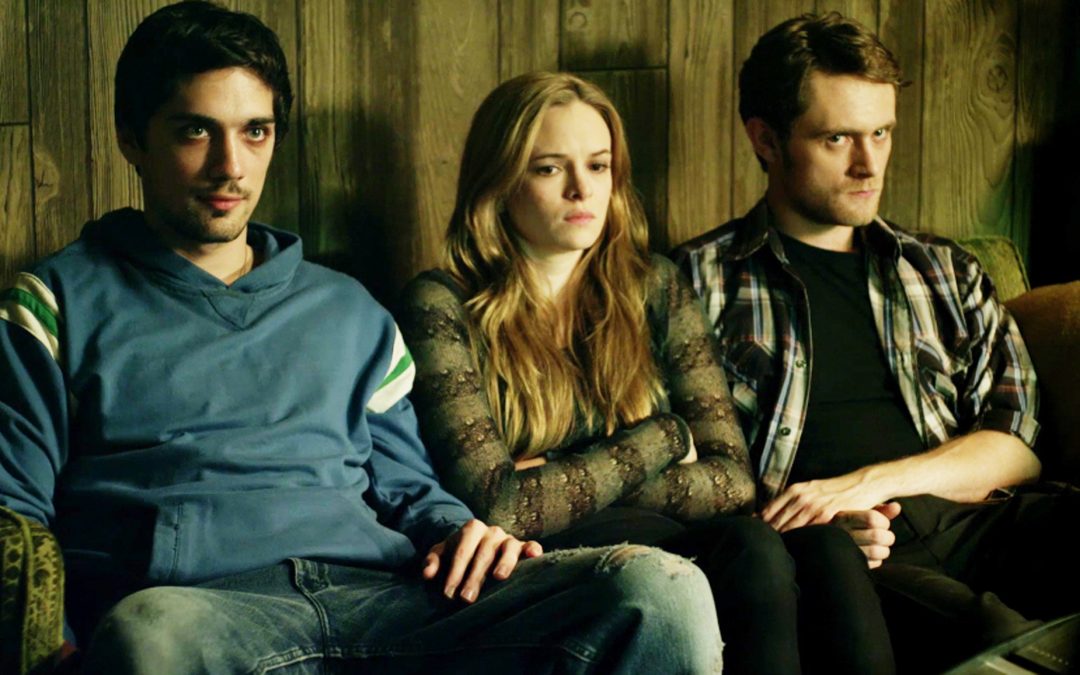
(L to R) George Finn as Jasper, Danielle Panabaker as Callie and Matt O'Leary as Finn in a scene from TIME LAPSE, directed by Bradley King. PHOTO: XLrator Media
Perhaps all the writing experience was part of why he and Cooper were able to whip through this one — or perhaps it was the collaborative nature of the project and their past experience together. On hiatus from their day jobs, they wrote the project in just a few weeks after brainstorming and landing on their inspiration for the story: Two weeks to outline and one week to write. Bradley said then they took notes for a month, “but the script we wrote in those three weeks is pretty much what ended up on the screen”. He hastened to add that his prior script (which he’s in the process of polishing and taking out to the market right now) took about six years to write.
About the writing process, Bradley added, “Writing is never easy, it’s always torture. But this was the easiest I’ve ever had it. We had the conceit, and I pretty quickly landed on the story paradigm of a small group of characters who are close friends and find something valuable, and it tears apart their relationship as they try to exploit it. That provided the big framework and structure. After that it was just fun to get excited about what the next photo would show and how it was going to affect our characters.”
On Keeping the Story Straight
Bradley King and B.P. Cooper in the storyboard room. PHOTO: XLrator Media
Even with a seemingly simple time machine story like this one, a major challenge they faced was keeping the continuity straight, both in the writing of the script as well as on set.
Bradley shared their solution: “Certainly the time elements, the timelines, and the photos presented a unique challenge in the writing. We used yarn and notecards as visuals on the wall to remind us if we got stuck or confused as to the continuity in the story.”
On location, they shot much of the film backward, in order to assure that the polaroid stills of the future story matched the actual footage, and they had the storyboards and timelines mapped out in a special room with yarn, tacks, sketches, and notes.
It looks like a great method for keeping a time travel story organized both on set and in the writing room, something I suspect will come in handy for aspiring time travel writers. :)
On Keeping the Audience Engaged
Matt O'Leary as Finn contemplates a wall of exposed Polaroids in a scene from TIME LAPSE, directed by Bradley King. PHOTO: XLrator Media
The story unfolds polaroid by polaroid, and it’s never quite what you expect will happen, which is part of the brilliance of this story.
Bradley commented on this, saying, “Ang Lee once said that storytelling boils down to showing the audience something and then taking it away and then showing it to them again — but twisted slightly from their anticipation of it. It sounds overly simplistic, but that’s what Time Lapse does, you see a photo of what’s coming, then there’s a gap between now and then, and you don’t know what’s going to happen. So then when it finally arrives, we twist it slightly so that it is what happens in the photo, but still adjusts your expectations.”
On Making "Living Room" Sci-Fi -- on a Budget
(l to r) George Finn as Jasper, Danielle Panabaker as Callie and Matt O'Leary as Finn in a scene from TIME LAPSE, directed by Bradley King. PHOTO: XLrator Media
“When you say science fiction, some people immediately think, ‘Oh, I’m going to see aliens or spaceships exploding or some future slick sci-fi dystopia’,” Bradley says. Time Lapse is a terrific example of what Rod Serling called “living room science fiction” -- and it's been compared to Twilight Zone. It's more of a thriller that has sci-fi elements, and feels like something that could happen in our world, right now.
Although Bradley says he’d someday like to do bigger budget productions, he “loves the smaller style production that hasn’t been done so much because it feels fresh and fun.”
This is the kind of sci-fi that newer writers can afford to make on their own (or sell more easily) than big budget productions laden with special effects. This project came in well under $1 million to make. To keep it at a low-budget, Bradley and Cooper put their focus on keeping the project contained to one location, though they did find that the holy grail of one location did come with some unexpected challenges, like needing to take over an entire apartment complex. Luckily, they found one that was slated for demolition and got to work rehabbing it just enough for the picture.
On Breaking In
Since we were speaking about time machines, when I asked Bradley about tips for writers looking to break into the industry, he said that if he could go back in time to tell his younger self something it would be two pieces of practical advice in regard to fear:
1. “Don’t be afraid of rejection.”
Bradley says, “I spent a lot of my early 20’s being scared of taking my material out into the official marketplace of Hollywood to get feedback or get rejected. What I didn’t realize is that in the process of getting rejected, you also build relationships. They may not like that script but you will become someone in their mind who has written something, and you will probably be able to come back to them with something else down the line.”
Since this is an industry built on relationships, that’s a smart perspective to take. Producers will often like your writing, even if a particular project isn’t for them. So Bradley makes an excellent point that interactions for feedback -- rejection even -- are opportunities to build connections. He says, “I was determined to write the perfect thing before going out into the world, and as a result it took me a lot longer to get better as a writer and to move my career forward to the next square on the chess board.”
2. “A good script can open a lot of doors.”
Bradley also said that when you don’t get rejected, and things actually go well, it can be a bit shocking at how many doors open to you: “I couldn’t have conceived of opening them myself, particularly in regard to cast.” It wasn’t even an amazing script, he said, but a good one, fairly well written, and it led to many meetings and introductions to actors they might not have otherwise have had access to or been able to afford who got excited about the script, including Danielle Panabaker and John Rhys-Davies (whose two scenes ended up being cut from the film).
“Keep in mind that a lot of the scary blockades that seem like they’re there in Hollywood will come down or you’ll find a door through them with material that people are responding to.”
It’s an excellent lesson for a newer writer: Put the focus on interesting roles for actors to play and write a compelling story that people can be drawn into. It doesn’t take a big budget to get a win.
What's Next
Up next for Bradley are two sci-fi projects that he and Cooper are polishing and taking out into the marketplace, plus they’re negotiating rights for overseas distribution to add to their already negotiated deals with Japan, Turkey, the United Kingdom. It's a great success story for two up and coming filmmakers, one that we can learn many lessons from.
I’ll be looking forward to seeing what they do next!
Where to See Time Lapse
Catch Time Lapse on DVD and Blu-Ray on June 16th, already available on VOD.
My Sci-Fi Circuit article on ScriptMag originally published on June 17, 2014.
A sci-fi spec screenwriter in today's market has a number of hurdles to overcome. One of the primary challenges we face is learning not only to master great sci-fi storytelling but also how to do so on a limited budget. Until we're top-of-the-line, A-list writers, any big budget features we're bold enough to write are likely to remain shelf-fodder in the near term.
For now, we're better off focusing on telling compelling, powerful sci-fi stories on a limited budget or "for a price." We can learn a great deal from up-and-coming sci-fi storytellers who are successfully doing exactly this. One such storyteller is writer-director Caradog James of Red and Black Films.
I recently had the pleasure of interviewing Caradog about his award-winning sci-fi feature film The Machine, which he made on a limited budget of just under one million pounds or about 1.7 million in U.S. dollars. I asked for his insights about how he brought the project to fruition and his advice for spec writers looking to break in to the industry.
On Creating Sci-Fi Grounded in the Real World
One aspect to which he attributes the success of his film is the very human story at its core. He discovered the storyline through a year-long research endeavor, which included an off-the-record interview with an artificial intelligence consultant to the British Ministry of Defense. He learned that they had been able to map the brain of a mouse and were planning to move on to mapping a chimpanzee's brain. From there it was a short leap to the film's concept of mapping a human brain.
Caradog also learned that the strategy used for teaching machines to think and feel is similar to the kind of teaching used with disabled children. This notion inspired the storyline for the main character of The Machine – a man seeking to cure his daughter of Rett syndrome using the secret military technology he's developing to create a cybernetic super soldier, known as "Machine."
As a result, The Machine is a startlingly haunting and personal story set in the near-future context of artificial intelligence development and all its potential pitfalls. The music, acting, and storyline, all contribute to a powerful, human experience that asks questions about what we should or shouldn't be doing with the technology at our disposal – as the best sci-fi does – all grounded in what feels like a not-too-distant reality.
On Avoiding Being Heavy-Handed with a Message
A movie like this could be easily overly message-laden, but I found it implied the right questions and possible answers inherent in exploring new technology without being heavy-handed.
When I spoke with Caradog, I asked him how he avoided being overbearing with a “message." He pointed to several practical solutions.
As mentioned, he extensively researched the project before beginning to write, including reading "heavy duty" books from futurists and quantum theorists that led to his conversations in the field about weaponizing machines and creating virtual models of brains. And perhaps most importantly, he met with families of disabled children which allowed him to paint a realistic picture about what they face.
He also held two weeks of rehearsals with the actors prior to beginning the shoot, and through the rehearsals, was able to identify more clearly where the dialogue and storylines were lecturing the audience too much or showing too much of the research.
The team also conducted test screenings, even with their very limited budget, so they could make sure their final edit culled unnecessary information and exposition that wasn't furthering the story. The goal was to give the audience just so much that they could grasp the concepts without the information deadening the emotion of the story.
The producer made a point to provide objective feedback. Producer John Giwa-Amu would take time away from the editing process in order to give feedback from as an objective place as possible. As Caradog noted, objectivity is the first thing to go as a filmmaker, so it was invaluable to have someone with relatively fresh eyes to review each new cut of the film.
Advice for New Screenwriters
Caradog's advice for newer screenwriters is to focus on "elevated genre" as much as possible – genre movies with heart, real characters, a real point of view, all grounded in a well-research reality – much as he did with The Machine.
He recommends avoiding dramas as a new writer, because he says most adults don't go to the cinema anymore for drama without Oscar winning actors or high production values, both of which are hard to attain as newbie writers.
Instead, he suggests that the "holy grail" producers are looking for is great genre scripts that can be made on a budget, and will have a much better chance of getting into production.
Working with a Low Budget
Speaking of which, working on a low budget for The Machine was tough. "Every day was a struggle trying to get the film made," Caradog reported, particularly since he'd never done CGI or stunts before, and keeping with the schedule presented all sorts of unexpected challenges as well. For instance, he didn't expect it to take an entire day out of their tight 4.5 week schedule to film one line in the script: "Suri sets fire to the traitor."
Luckily, due to his background in making short films, Caradog found ways to make do, like catching up with scenes in single shots, doing tons of advanced preparation like storyboarding concepts and working out lighting, sets, and costumes ahead of time, and filming in essentially just one location plus some minor exteriors work.
What's Next for Caradog James
Up next for Caradog is a "first contact" movie – an exciting sci fi thriller set a little further in the future with a bigger canvas – and a hopefully bigger budget. He's also collaborating on a number of other sci-fi projects with other writers in the US and in the UK, in order to bring as many ideas to fruition as possible.
About The Machine
The Machine recently won the Raindance Award at the British Independent Film Awards and took home Best Film at the BAFTA Cymru Award. The film also won Best Sci-Fi Film and Best Actress at last year's Toronto After Dark Film Festival. Watch the trailer here. The Machine is available on video on demand and releases on DVD on June 17th.