by Jenna | May 8, 2013 | Writing Articles
While technically it’s still spring until the solstice, I’m anticipating the changes summer will bring to my writing habits and my life.
My husband will be home more (he works at the University), and my son will have time off from school. We have our two annual camping trips already planned to savor the beauty of the outdoors. The outdoor light shimmering in my garden is calling to me.
It’s an expansive time.
And perhaps because of our cultural pattern of having summers “off” from our school years, I often find myself wanting to ease up on whatever I’m doing, work a little less, and play a little more.
At the same time, I think those of us who write also have this idea that we’ll get so much writing done because we have more time off (whether we literally do have more time or not). In fact, it’s a common pitfall for many writers and creatives. We set high expectations around “getting so much done” but simultaneously are pulled by a very real desire (and need) to take time off and play.
And of course we want do to both really — and that’s what I recommend, of course.
But all too often it ends up being neither one. Most people, when faced with “lots of time to write” end up doing nothing. And then they feel guilty and don’t enjoy their downtime either. Sad face.
What’s a thoughtful writer to do?
Here are three very simple steps to get you started thinking about how you want to see your summer writing play out:
Step 1. Check in with your writing goals for 2013 so far.
As summer approaches, it’s a great idea to think a bit about where you wanted to be right now. Are you on track with your goals? Ahead? Behind? Do they need recalibrating? Where are you right now and where do you want to be by the end of the year?
Step 2. Think about where you want to be in the fall.
At the same time, you’ll also want to think about where you want to be when fall rolls around and summer is over, so you can actually meet that end of year goal.
Are you hoping to be finished with your novel draft by the end of summer so you can move on to revisions? Have a new script polished up and ready to go? Be sending your self-help book off with query letters? Have your blog posting schedule humming like a well-oiled machine so you can start promoting something new?
Check in and see where you are now, and what you’ll want to do to meet that goal.
Step 3. Now, adjust for reality.
Keeping in mind that you may well feel pulled to play outside this summer, adjust your summer writing goals to realistically match the other things that will be going on in your life, like the kids being home, or going on the vacations you have planned, or the time off you desperately need.
Then, design in a reasonable, well-paced daily writing schedule you can actually accomplish. Put it early in the day, get it done, and then go out to play, guilt-free!

by Jenna | Apr 17, 2013 | Guest Posts
It’s always thrilling for me to see someone finish a writing project, particularly when I’ve been on the journey with them, from within the trenches of our writing community. We cheer each other on, during the hard days and the easier days, so it feels like a success for all of us when we see someone finish a project and reach their goal.
Of course, there are various milestones for “finishing” too — finishing the outline, finishing the first draft, revising the first draft, working on the second draft, submitting it for publication, etc. etc. In the writing community, we make a point to celebrate all the milestones we can. It’s a must on a long-haul project like a book or screenplay.
In this case, we’re celebrating the success of one of our writers who has finished the first draft of her novel at age 74!

Fredrica Parlett
I was particularly excited when Fredrica Parlett joined the writing community. I know and have worked with her talented daughter, Isabel, and I’ve had the pleasure of meeting Fredrica on occasion here in Berkeley as a result. What excited me about Fredrica’s project was her passion and commitment to her novel — even when the self-doubts would creep in, Fredrica kept up a steady stream of writing with the support of our writing community.
It’s been thrilling to see her return to and build on the first chapter she wrote of her novel four years ago in a class and had then set aside, first writing 20,000 words in her first three sessions in the writing community, and climbing steadily over time, bit by bit, day by day, to the milestone of completing her first draft this March after 18 months of work.
A self-described “writer, searcher, and hyperactive senior,” Fredrica has dreamed of writing a novel for a long time, and with the support of the writing community, has made it a reality. We’ve applauded her and encourged her to keep going, even as she’s said in her dry, witty tone, “I just hope I can finish it before I die.” As someone with long-lived relatives (the women in her family tend to live into their hundreds), we never doubted she would manage it, but we’ve been so happy to see her get there nonetheless.
I thought you might enjoy reading a little bit more about her project and her journey up to this point — as well as what comes next — in her own words:
Fredrica, thanks for being here. Would you first tell us about your writing project — what’s it about?
I am writing a “literary” novel, which follows the lives of two protagonists in 1950’s America: a 16-year-old dyslexic boy, who is misdiagnosed as mentally retarded and psychotic, and the 36-year-old psychoanalyst who tries to save him from a lobotomy.
Tell us about yourself and your dream of writing — how long has this been a dream for you?
As a child I used to lie in bed and make up stories, mainly to do with the Lone Ranger as my father, who misunderstood me, but then I would vindicate myself by rescuing him from horrible bandits or some other dire situation. I wrote short stories from about the age of 9, mostly about talking animals, such as duckbill platypuses. I also wrote poems, also about animals. I’ve always been interested in language and writing clearly. Only after my second child left home for college, did I start thinking about writing a novel. I had one underway, which wasn’t going well, when my house and all its contents burned down in the Oakland Hills Fire in 1991. After the fire I abandoned hopes of writing a novel and devoted myself to studying classical piano.
In 2009, I saw an advertisement for an online writing course given through Stanford University (my alma mater) entitled “Beginning a Novel.” I took the course, the aim of which was to write the first chapter of a novel. That was the beginning of this story, but it lay fallow until I joined the writing community at the suggestion of my daughter, who works with Jenna. I have always been drawn to novels rather than short stories.
How does it feel to have completed the first draft of your novel at age 74?
It feels wonderful. I have had to deal with all kinds of self-doubt and to learn to really prioritize my time, because I am easily pulled into duties and obligations. I had several medical issues last year also — amongst which were foot surgery and an appendicitis, as well as deaths in the family. It seems incredible that I actually wrote 170,000 words telling this story.
What have you learned about your writing process from participating in the writing community?
I was surprised to find that the support of the writing community made all the difference between writing and not writing. Reporting in to the site every evening has been, I think, the most important influence. If a day is slipping away with no writing, I get more determined to do some in order to be able to report progress.
But the other tools of the writing community have helped me as well — reading about others’ difficulties and successes, commenting on them (which is recognizing I have the same difficulties), attending the coaching calls where we have in-depth discussions about all our questions, and certainly participating in the group writing sprints — knowing the others are devoting that same hour to writing is a great boost. Sharing information about books and websites addressing the craft of writing and publishing is invaluable. The fact that the other members are much younger doesn’t seem to be a problem, even if I roll my eyes occasionally at their new age jargon. They are a serious and dedicated group. All these contacts keep me motivated and focused.
What were the biggest challenges you faced before joining the writing community?
I was always subject to the tyranny of the “urgent.” A large house, family, friends — and piano lessons — all of which were rewarding but did not fulfill the dream to write a novel.
You left the writing community for a time and came back to join us again. What did you notice about your writing habit while you were away and what have you noticed since you’ve come back? What difference has participating in the writing community made for you?
When I was not in the writing community, I noticed that the habit of putting everything else first began creeping back in. I missed the pressure of being accountable — stating my writing goal for the next day and trying to honor that. And I’m very prone to discouragement or negative self-statements such as, “I’m much too old to be undertaking this huge endeavor.”
Coming back, I immediately felt the power of the support. My total writing time increased dramatically, almost without my noticing it. (I have always set doable goals and then been surprised when I exceeded them — another trick learned in the writing community.)
What would you say to others who dream of writing a novel in their later years, and what advice do you have for other writers?
If you dream of writing a novel, don’t put it off any longer. The quality of my life has greatly improved from this undertaking, so I have profited, whether it ever is published or not. How has it improved? I look around and within myself for inspiration. I channel my tendency to worry about the world and the scratches on my hardwood floor into worrying about the fate of my dear protagonists, about whom I could talk to you for hours, without you realizing they aren’t alive right now. We all know how hard it is to establish a new habit, especially one that supports our inherent creativity. That is what the writing community can do.
What’s next for the novel and for your writing?
I am now in the revision process, which demands an entirely new set of skills. Fortunately, many of the writing community’s writers are in the revision process also. One of them recommended a book, which is helping me raise the stakes, increase the tension, and make ruthless cuts. I do Julia Cameron’s morning pages every day so that the words keep flowing. I am attempting to rewrite certain scenes in a much more dramatic, intuitive tone. Very exciting. I have the “soft” goal of having the novel ready to send to a publisher or to self-publish on Amazon by the end of this year. I am planning a road trip to Southern California in the Fall to experience directly the places in my novel, even Highland Mental Hospital in San Bernadino, which is still operating. Beyond that, who knows?
Is there anything else you’d like to tell us?
I want to stress that setting a realistic daily goal, even 15 minutes a day, and reporting in every day, so that one really begins to believe one is a writer, is really invaluable.
Thank you, Fredrica!

by Jenna | Apr 12, 2013 | Science Fiction, ScriptMag Articles
My latest Sci-Fi Circuit article on ScriptMag:
What does it take to make a sci-fi world real? As a science fiction fan, I love to be transported into new and fantastical worlds. As a sci-fi screenwriter, I’m fascinated by understanding what it takes to make that happen, and happen well? It’s not just a pretty gadget Part of the appeal as... [read more at ScriptMag]
Image by Reimund Bertrams from Pixabay

by Jenna | Apr 10, 2013 | Writing Articles
Can we write when we’re surrounded by clutter?
Craving the relief from chaos
For a sensitive person, clutter is an energy drain because it’s overstimulating (one of the biggest challenges for a sensitive person). It affects your energy to work in a messy room because there’s so much more to pay attention to.
Mind you, that doesn’t stop me from doing it when push comes to shove, and in fact, my office is messier than I’d like it to be right now. At least on the surface. Underneath though, it’s fairly well-organized, so it’ll be a quick trick to whip it into shape.
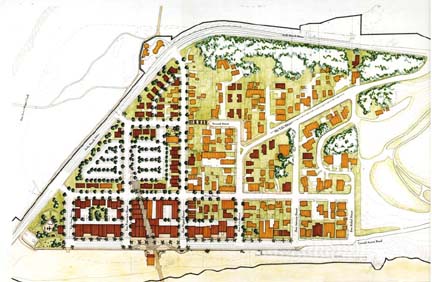
One of my “huge” drawings from back in the day. :)
When I create in chaos, I’m reminded of my old urban design days, where I used shuffle piles of huge drawings late into the night, struggling to meet whatever deadline I was targeting. My office mate used to say she loved to watch me “clean up” when I finished a project, because no matter what was coming down the pike (even if there was another deadline looming), I had to stop and put everything away before I could continue.
And I do find that I can work in a cluttered space for a time, but then I crave a certain kind of relief for it, a spaciousness that leaves room for my brain and my creativity to operate more optimally.
The energy of clutter
On an energetic level, sensitive people are more tuned into the stuff around them. I’ve always felt that we “carry” the stuff that’s around us, and as it stacks up, we begin to feel more and more burdened by it. And why wouldn’t we, if we’re carrying such a heavy load?
The cool thing about dealing with clutter is that we can work with it on a couple of different levels — both the practical mundane level and the energetic level. For instance, on the practical level, you can sweep it into a box and hide it temporarily (you’re only allowed to do this if you schedule time on your calendar to deal with it :) ) or you can stop what you’re doing and take the time to put it away.
Or you can approach your clutter on an energetic level and use energy clearing techniques to get the stuck energy broken up around the stuff so that it becomes easier to put it away. Someday I may teach my “space clearing energy skills” class again, but for now, try clapping your hands over the piles of clutter and see if you can dissipate the stuck energy that way.
Are you writing or speaking enough?
There’s a fun system I used to play with called hand analysis. It identifies a “Lines of Genius” gift marking, which means being called to be a “gifted author and speaker with a special message for a large audience,” or having a “Messenger” life purpose. The idea of a gift marking is that if you don’t use it, you suffer the consequences of it. In this case, lines of genius gift marking holders will be “cursed” with piles of paper and endlessly shuffling them around, feeling like they’re spinning in circles.
The solution? Write and speak.
Put the clutter away, clear the decks, and start writing. Schedule the time on your calendar to deal with the clutter incrementally, but don’t let it stop you from writing, or it’ll just get worse. :)

by Jenna | Apr 3, 2013 | Writing Articles
Seems like every time I turn around, someone I know is going through something big:
… Friends with cancer.
… My father facing health challenges.
… A neighbor’s house catching on fire.
… My cousin’s husband dying.
… Even my own roll-over car accident a few years back now.
The circle of those affected feels like it’s getting closer to me, like a tightening loop.
And it’s got me to thinking…
…Is there anything I’m not paying attention to that I want to be?
Am I going to wait for my next wake-up call, or what if I just paid attention now?
Change the rules that keep you in the dark.
Last night, we saw The Croods. I loved the message at the end: “We changed the rules that kept us in the dark.” (I love that they really spelled it out; it’s a kid’s movie after all.)
And that got me to thinking even more.
How am I keeping myself in the dark, operating out of fear rather than reaching out for tomorrow? Or living for today for that matter?
As writers and creatives, one of the biggest challenges we face every day is our fear. No wonder we act like we’re confronting our own mortality. On some level we are.
But I don’t like this question.
I’ve never liked how people say, “If you knew were going to die tomorrow, what would you do today?”
Maybe there’s something too cynical about me to fully appreciate that question, but there are things I commit to doing on a regular basis that I’m darn sure I wouldn’t do if I knew I’d be dying tomorrow, but I can’t live like that on an ongoing basis. Things like exercising and flossing and making sure my kid’s lunch is made, that yeah, I don’t think I’d pay attention to if the world was going to end.
On the other hand, I’m okay with it in the big picture.
But what about the big picture of our lives? I’m down with looking at that and making sure that what we’re doing matches with where we want to be now and where we want to end up.
Writing.
It wasn’t too long ago that I got the message, “Write like your life depends on it.”
And I’m writing every day now, which is a heck of a lot more than I was doing at the time. Which was rarely, if at all.
But am I writing like my life depends on it?
Not yet.
So am I going to wait for the next cosmic two-by-four, or am I going to do something about it?
Well, you already know the answer, right?
Do something.
Saturday I got out a pad of paper and started redesigning my schedule to put the focus on more writing. It’s not quite where I want it to be, so I’m going to do some more work on it today. And then I’m going to begin the process of shifting my schedule more and more in that direction. It’s okay with me if it takes a little while to shift; it’s a kind of gradual herding things into the right corrals. But it works.
Having fun.
The other persistent message that I simply have to do something about is FUN.
I’m good at working hard, you probably know that about me by now.
And I’m fairly good at really luxuriating when I give myself the chance. (I just love taking days off and putting my feet up and watching movies and eating great food and treats.)
But I just don’t give myself the chance very often.
I come from a long line of self-sacrificers and workaholics and the buck is going to have to stop here, now.
The funny thing is, I’m still not sure what I truly want it to look like, this fun thing. Writing is fun, but it’s also work.
I think it’s more about lightness of spirit and regular adventures. I hesitate to schedule time for fun. But I also used to hesitate to schedule time for writing, and look where that got me!
What if fun was worth making time for?
That sounds like a ridiculous question even as I write it.
But sometimes my brain needs an excuse to think of things in a new way.
Being appreciative and being present.
And last, I think my perhaps my biggest one, is about appreciation and presence. I’m so good at appreciating things in other people, but not so good at appreciating them in my own life. This is huge, and hard to admit. I’ve got more work to do here.
My recent tech shabbats have shown me about the power of being present and not checked out into my own little world. So I’m getting there. And there’s more. There always is.
What about you?
If this was your wake-up call, what would it be?
What is the voice of your spirit asking you to pay attention to right now?
What have you been neglecting but you know, deep down, you want to attend to?
If the Universe was going to give you a whack upside the head with a cosmic two-by-four, what would it be trying to tell you?
* Affiliate link