by Jenna | Aug 28, 2013 | Writing Articles
In my writing community, one of the things writers commonly bring up as a question is how to reward themselves for meeting their writing goals.
We have a list of questions we answer on our site, once we’ve completed our writing for the day (or not, as the case may be). This is one of the stickiest questions for many of us:
- How will you acknowledge or celebrate what you’ve accomplished today?
The question tends to trigger a lot of resistance and debate and discussion. Sometimes writers even avoid answering it or fulfilling it. I know it’s a hard one for me to remember too!
But here’s the thing, it’s incredibly important to both celebrate and acknowledge the work you do as a writer both on an ongoing daily basis and at the end of a significant project phase, like finishing a first draft or a rewrite.
Here’s why:
- You’ve fought resistance to show up, put your butt in your seat, and do the writing. As small as that may seem from the outside, you know deep down that every day it is an accomplishment. We’re talking about a daily battle that you’re winning.
- By creating a positive association with your writing, you are more likely to show up and do it again the next day. Bottom line? It reinforces your writing habit.
- Writing is a long term endeavor. It’s all too easy to walk around feeling like you’ve never done enough when the draft isn’t finished. Stop that right now. Instead, celebrate what you have done. It’ll make it easier to keep going all the way through to the end.
- Too many writers significantly undervalue themselves and their writing, especially if the day’s writing session was particularly hard. Stop that too. Take the time to recognize the value and importance of what you’re doing. It’s important to you, right? For most of us, writing is a true calling. If that isn’t important to feed, honor, and sustain, I don’t know what is.
Ideas for rewards
Here are some super simple ideas to get you started with rewards, celebrations, and acknowledgments:
- Do a happy dance.
- Dance to music for a minute.
- Shout, “I did it!”
- Throw your fists up in the air and say, “YES!”
- Say, “I declare myself satisfied!”
- Hug yourself.
- Pat yourself on the back.
- Play an inspiring song.
- Make yourself a cup of tea.
- Take a moment to stretch.
- Stand in the sunshine for a moment, look at the sky and appreciate the world and the gift of writing.
- Do the things you’d normally be doing while procrastinating about your writing (like checking in on Facebook or Twitter, or playing games on your iPad).
- Tell your writing community about your progress and be proud of yourself.
Two tips for getting the most out of rewards
- Tip #1: B.J.Fogg of https://tinyhabits.com recommends celebrating within a second of completing the task as being critical for reinforcing small successes. So even if you give yourself a bigger reward at the end of the day’s work, do mini-celebrations each time you hit a milestone (e.g. a page done, a hour of writing, 15 minutes of writing, whatever you’re aiming for). I have a sound effect for a cheering crowd set up on my iPhone that goes off whenever I finish an hour-long writing sprint. It always reminds me to notice and acknowledge what I’ve accomplished.
- Tip #2: Don’t “pre-celebrate.” Pre-celebrating means doing something fun — celebrating or rewarding yourself — BEFORE you do the writing. That doesn’t work, because it only perpetuates procrastination AND triggers a guilty conscience. The whole idea here is to eliminate your guilt and anxiety around your writing.
But what about the major milestones?
What happens when you finish your draft, put the final polish on your rewrite, turn in your script to a contest, or your box of books arrives in the mail — in other words, hit a major writing milestone?
Please — and you may take this as a request from your writing coach if you like — REALLY celebrate!
Do something like this:
- Take yourself out to a fantastic lunch or dinner.
- Go to the spa for the day.
- Take a day off and watch movies and eat your favorite foods.
- Open a bottle of something yummy.
- Tell your friends.
- Have a party!
This is a MAJOR accomplishment and deserves to be celebrated.
Particularly if you’re someone who tends to undervalue and underrate and always have more to do and feel like you have to move on to the next thing, STOP, and congratulate yourself on finishing.
Then dive back in the next day. :)
You may also be interested in:
Image by © Royalty-Free/Corbis

by Jenna | Aug 7, 2013 | Guest Posts
Writers who tend to join my writing community — and get the most out of it — often have both a deep call to write (whether they’re doing it consistently or not) and a specific project they want to work on, perhaps one half-completed, languishing on a shelf for a couple of years. And when they find out about the writing community, they’re eager to move past the dreaming or stuck stage into action.
This is the story of a man who has done just that.
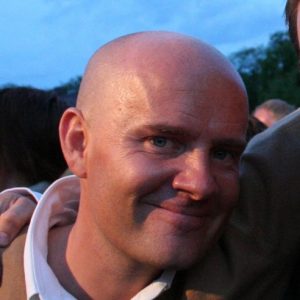 When he joined the writing community all the way from Sweden, Rikard Bergquist had been working on his novel intermittently, struggling to find enough time to write and to move past the outlining and preparation stage into writing actual New Words. And he had a little two-year-old daughter at the time too! (She’s three now.)
After being in the writing community for a session or two, continuing to write intermittently, and listening to me (harp on about :) ) advocate for early morning writing and small writing sessions as a powerful way to jump-start a writing habit, one of our other members “threw down the gauntlet” and challenged him to try writing for 5 minutes every day and logging in every day on the site to report about how it went for him. He took her up on the challenge. It changed his life.
In less than four months, after building from 5 minutes a day to a solid writing habit of 60 minutes a day, he knocked out 75,000 words and completed his first draft. He’s still with us in the writing community now, working on revisions. He is one of our most dedicated and consistent members, showing up to write and log in on the site even while traveling — he even met me for coffee in Berkeley here the other day to talk shop while on a trip to the U.S. from Sweden. It was great fun. :)
I asked “Rick” (as we affectionately call him in the writing community) to talk to us today about his experience with finishing his novel, how he got there, and what’s he’s learned about his writing process along the way. You may be surprised to find some ideas and inspiration you can adopt for yourself.
1. Rick, first, welcome and thanks for being here. Let’s start off by having you tell about your recent major milestone — finishing the first draft of your first novel. What was that like for you?
It was one of the most empowering and surprising experiences I’ve had. Empowering because finally this dream of a novel I’ve had for a couple of years was becoming a reality. I escaped the terror of the first draft and actually produced 75,000 words. Instead of laboring and trying to make early parts of the story perfect, writing and rewriting, outlining and rearranging the order of scenes, as well as reading the latest book on craft and thinking I finally got it, I did the work and now have a substantial number of written pages to show for it.
It was surprising because I did it by writing for about an hour every morning during four months — I never thought an hour a day would amount to anything. I surprised myself weekly when I saw what I had accomplished with just an hour every morning. I surrendered to the process, allowing myself to write badly, knowing that it was only the first stage in a big adventure. Overcoming that editor inside of me, who kept telling me it was crap, was a big victory. And my first draft is the result. Now I know that first drafts aren’t supposed to be outstanding perfect novels, they’re just supposed to be written.
2. Can you give us a soundbite about what the story is about and about who you are?
The story is set in the 1570s of Stockholm, Sweden. In a power struggle for the crown our hero supports a new queen for the throne, who turns out to be a murderer, poisoning her competition. When his secret love interest is surprisingly accused and imprisoned for the murder, without any hope of pardon, our hero has to choose between his career or saving her. And what price will he pay for the choice he makes?
I work in the financial industry, for a private equity company, with business development. It’s hands-on management in selected individual companies in a wide range of industries. Writing is for me a creative outlet and a possibility to follow a totally different path.
3. What have you learned about your writing process from participating in the writing community?
Consistent daily work is key to my process. Being consistent means that I stay in touch with my writing, even though I might be working and doing other things during the day. The story evolves and develops in my subconscious, waiting to be served up during the next writing session. Setting goals and being accountable within the writing community, giving and receiving feedback on each others’ processes — in short, knowing that my efforts are noticed by others is a big motivator for me.
Focusing on the process rather than the craft, is a very important difference from other writing groups I’ve participated in. For me, this group is about focusing on getting the writing done, every day. What you write, how you write, and when you write is up to you. But do it every day. The accountability and support of the writing community is key to making that happen.
4. What were the biggest challenges you faced before joining the writing community? Have they changed?
My biggest challenge was finding time to write. I kept telling myself I needed chunks of at least 3-4 hours of undisturbed concentrated time to get anything done. I used to laugh at friends telling me how someone they knew had finished a novel by coming in 15 minutes early to the office and using that time to write. “It just isn’t possible,” I used to say, but now I know better. I kept on trying to find my big chunks of time, getting them here and there. It was a constant struggle. Looking back, I feel like I wasted a lot of time thinking about how to find time to write, but never doing the actual writing, and instead ending up feeling frustrated and lost. I knew I wanted to write, but why didn’t I just do it? I wrestled a lot with that question. With the help of the writing community I established a habit of rising early and writing for an hour every morning. Consistently.
5. When you first joined the writing community in May 2012, what was your writing habit like and how did it evolve? Were there any key moments where you shifted your habit? Was there a particular trigger or did it build over time for you?
At first my writing consisted of sporadic big chunks of time, where I spent the first part of each writing session reconnecting with my story and the latter part coming up with some new tweaks to my outline, synopsis, and characters. I always felt happy and satisfied afterwards, but not continuing to work on it over time always made me question my earlier work when I got back to it. And I was never moving into writing actual words, paragraphs, and chapters of the book, just staying at the outline stage.
There were two key moments for me — One: I followed the advice from you, Jenna, and fellow members of the writing community to adjust my target amount of writing time downward until I found a suitable amount that I could do consistently every day. For me that was five minutes. How amazed and surprised I was of the power of those five minutes. It changed my world — I connected on a deep level with my story and gradually increased the five minutes to sixty minutes per day. At first outlining scenes and then actually writing the first draft.
And this is where my second key moment occurred — Two: I could not get myself writing. I stalled. I reworked. I was stuck. Again following advice from the writing community I gave myself permission to write badly. I told myself “I am writing crap,” and suddenly I was writing about 750 words during that hour every morning. And surprise, it wasn’t all crap.
6. What advice do you have for other writers?
The only way to do it, is to do it. Complete the journey from the first page to the last page. If you can’t do this, it’s game over. Because without the first draft, you have nothing. You need a lot of faith to do it, faith in your unproven ability to write a novel. But give yourself permission to fail, to write crap, to make mistakes, to forget your outline and synopsis and before you know it, you will have your first draft.
7. What’s next for the novel and for your writing?
Right now I am revising the draft. Aiming at having a first rewrite done in a couple of months. There are times when I feel like giving up, but I now know that that’s only part of the writing life. It’s a constant flow of ups and downs, you just have to trust the process and keep putting one foot in front of the other. Finishing this first draft, I will turn it into my second and then my third, or as many as I need to finally hold an amazing novel in my hands.
8. Is there anything else you’d like to tell us?
Have faith, never give up, and know that in the end you’ll succeed. Once you’re in the habit of writing, trust the process to bring you to the finish line. If you feel down and lost during the journey, just tread water and wait for the next creative wave to come. It always does, have faith.
Thanks, Rikard!
You may also be interested in:

by Jenna | Jul 31, 2013 | Writing Articles
Something that’s helped me when taking on a longer writing project is understanding the natural ups and downs of the writing process. Now when I know I’m in an “up” or a “down”, I don’t take either one too seriously and just forge ahead.
But in the past, I’ve made the mistake of thinking that if I’m having a hard time or if I’ve “lost interest” in a project, that it means something about the project, like:
- It’s not the right project for me.
- I’ve blown it and I don’t know how to fix it.
- It’s time to ditch the project and move on to another one.
- I’m not capable of solving a particular problem or of finishing.
- The idea I started with wasn’t actually good enough.
Now that I’ve been through this process a few times, and I’ve worked with more than a few writers and observed them going through their own stages with their writing projects, I’ve come to see the experiences we have as natural patterns that are part of any project. And “getting” that I’m having a normal experience helps me make the decision not to take it too seriously and to continue on, even if I’m having a hard time with it.
The stages of a writing project
So let’s talk about these stages we go through, shall we?
Here’s what I’ve observed about the natural stages of a writing project. I’m sure they apply to ANY kind of creative or other resistance-triggering endeavor. If you have other stages you’ve recognized, please post them in the comments.
- The idea! — “Ooh! I have an idea for a project, this is great! I can’t wait to get started!”
- The joyful beginning — “Yay, I’m starting today, this is so exciting, this project is going to be amazing! It’ll be my best project yet!”
- The crash of reality — “Oh, wait, I really actually have to show up and do this now for real? Like every day? I don’t even know where to start or what happens next!”
- The commitment phase — “Okay, bit by bit, I can do this. I’ll figure it out. I can make this happen.”
- The dreaded middle — “Wait, what’s supposed to happen here? Where am I? What’s this about again? Why am I doing this?”
- The downhill side — “Okay, I’m past the midpoint, it’s all downhill from here, I can see the ending from here, I can make it!”
- The 80% mark — “This is so boring, I’ve lost interest in this project, I’m over it. I don’t even know why I was interesting in this idea in the first place. That other project sounds like so much more fun.”
- The recommitment moment — “I’m not falling for that, I can do this, it’s not that much longer, I’m not falling for that Bright Shiny Object (the other project), I’m going to keep going.”
- The almost to the bitter end stage — “This is terrible. What was I thinking?”
- The last push — “I just gotta get to the end, then I can see what I have.”
- The end — “I made it! This was so worth it.”
And then, of course, we start all over again.
Notice the creative blocks
What’s particularly useful about this is noticing how creative blocks like perfectionsim (“This’ll be my best project yet!”) and apathy (“I’m over it.”) can show up. They are resistance in disguise. The key is not to fall for them, but to keep going until you get to the end. THAT is the time to evaluate what you have and decide what happens next with it.
An epidemic of incompletion?
I see an epidemic of not finishing all around me. Perhaps it has to do with the short-term gratification culture we’re raised in these days (a favorite quote from Carrie Fisher, “Instant gratification takes too long!”).
What I know is that personal strength, self-confidence, and self-worth is deeply grounded in commitment, doing the work, and making the hard choices.
Warmly,

You may also be interested in:

by Jenna | Jul 17, 2013 | Writing Articles
So many writers I’ve spoken to recently are talking about finishing; many at that point of having just finished a major draft or putting the finishing touches on one.
It got me to thinking about the ingredients that go into the mix to make that happen.
It strikes me that there are both internal and external aspects to these success stories. What I see on the internal side is:
- Vision — having an idea or a calling to see something come to fruition.
- Passion — having a love or interest or fierce desire for a specific project or idea.
- Decision — making the decision to tackle the project.
- Courage — having the courage to dive in to the unknown.
- Perseverance — having the wherewithal to stick with something.
- Intuition — knowing when something is right for you, or not.
Hopefully we have all these skills. If we don’t, we can strengthen them within ourselves. (And there are good coaches and therapists who can help us do just that.)
So yes, completing any project requires a tremendous amount of drive, determination, and courage. But even the strongest of strong-hearted among us get tripped up by a laundry list of obstacles, like:
- Doubt — what if I can’t do it?
- Fears — of success, failure, rejection, disapproval, shame
- Resistance — the force that repels us from our dreams
- Procrastination — our tendency to put off anything that moves us toward completion of our dreams
- Perfectionism — the belief that perfection is attainable and that if we’re not hitting it, we’re failing.
- Bad habits — putting vices before taking action on our dreams.
- Poor self- management — struggles with discipline, decision-making, commitment, time choices.
- Poor self-care — not taking care of our bodies, minds, hearts, and spirits.
- Comparison with others — thinking other people are doing better than we are.
- Obsessing about our chances of success — focusing on the big questions rather than doing our work.
- Approval-seeking — looking outside ourselves for validation of our talent or ability.
- Life challenges — stopping when life gets hard.
Many of these things can be solved with self-awareness and determination, and yet what I see time and again is that we can draw on resources outside ourselves to help us make it through the rough patches. Things like:
- Support — there’s nothing quite like having other people believe in you, especially when you’ve temporarily forgotten your own skill and ability.
- Daily accountability — having support to see it through, to keep showing up and do the daily work is deeply motivating.
- Community — being a part of a community where you are with other people who truly “get” what you’re experiencing helps end the sense of isolation we can all experience at times.
- Energy — the shared energy of working together, whether side by side or as a team, can move us into action when we’re otherwise flagging.
- Inspiration — a shared spirit of energy and enthusiasm can reignite us when the going gets tough.
Warmly,
You may also be interested in: