by Jenna | Jul 2, 2014 | Writing Articles
 Note from Jenna: This guest post is from one of our wonderful writing community members, Janis Brams.
Janis held a life-long dream of writing regularly and has made it happen now that she’s retired from her education career and her two daughters are grown.
One of the fascinating aspects about finally having the time to write when one retires is that having big blocks of time to write can actually be somewhat paralyzing. Janis uses the writing community and worked with my Design Your Writing Life course along with other online writing classes to create structure for her writing time.
Read on to find out more about what Janis learned to make writing while retired work for her.
Retired and Writing
by Janis Brams
Although I’ve wanted to be a writer since submitting a story about a girl and her dog to my eighth grade teacher, my writing record has been spotty. The piece ended with the girl’s dog jumping from a craggy cliff, and I was especially pleased with the final sentence “she ceased to exist,” written vertically down the page.
Unfortunately, for chunks of time, writing fiction and personal nonfiction ceased to exist for me.
While college, jobs, children, and graduate school challenged my attempts to maintain a consistent writing practice, fear played a role as well. What to write about and whether I’d have time to complete a piece were concerns that grew inside my head. They rooted there, fed by other doubts like was I talented enough to hold a reader’s interest and was I brazen to assume I had something to say worth reading.
My internal editor lived a splendid life.
But every once in awhile, I cajoled myself into pulling out a journal or sitting at a keyboard to record what I was thinking. I observed. I experienced. I felt.
And the need to sculpt words so that I could share what I was living continued to grow.
While I managed to produce some writing, the call to do more mushroomed so that even if I wasn’t writing, I was thinking that I should. I craved blocks of time to glue the bits and pieces of my stories into meaningful wholes, but my other passion, teaching children, was an exhausting task. Depleted by the end of day, I was too tired to do my writing justice. Instead, I dreamed about a time when my essays and my stories would assume their rightful place. And then, I retired.
The gift and terror of time to write
I woke up one morning with a huge chunk of time spread out before me. I could write for long hours, produce multitudes of end products; writing was my new priority. I was terrified.
Instead, I exercised, reached out to friends, organized bills, poured over cooking magazines, produced lovely dinners, and then went to bed promising myself that tomorrow would be the day I dedicated to writing.
I realized I was wasting precious time, so I spoke to my daughter, Rebecca, who is also a writer. Thinking I might enjoy an online class, she gave me a link to explore. I registered for a workshop and was hooked. The class held me to a deadline and provided me with a structure that felt familiar: a lecture, a prompt, a submission, and response to a critique. For 10 weeks, the duration of the class, I was a writing dervish. I overcame resistance and wrote, made deadlines, and revised.
I took one class and then another, but as each ended, my censor returned and resistance flourished. After spending hours assembling a cabinet to house unfinished stories, I realized an important piece was missing from my writing life.
The missing piece
I hadn’t thought to separate process from craft until an email appeared in my inbox with the subject line: “Mom, read this”.
Aware that I was floundering, last December my daughter sent me a link to a four-day class that Jenna was teaching, called Design Your Writing Life. The class was in the form of a conference call. “Why not drop in and see what you think?” Rebecca asked. [Note from Jenna: This class is now available as a homestudy course and will be on sale next week.]
Since then, I’ve subscribed to Jenna’s online writing community. The writing community has helped me see the importance of building a writing habit in addition to honing content. My biggest epiphany has to do with managing time. I understand the need to write consistently even if, some days, I can only manage minutes rather than hours. I give myself permission to accept these shorter blocks but feel compelled to intersperse them with longer stretches at the keyboard.
So while completing my progress page on the writing community website one night, I coined the term “Intervention Intention”. When too many days pass with little time for writing, I intervene, rearranging obligations so that composing rises to the top. My intention is to carve out the hours I need to pursue a passion and make a story happen.
My writing life isn’t perfect. I still worry my words are not precise enough or crafted well enough, but combining classes, focused on craft, with the writing community, focused on process, has given me a frame to hang my drywall. I sit at my keyboard and pound the stories out. Good or bad, I get to tell them. I’m retired and I’m writing, finally living out the dream from my childhood.

Janis Brams is a retired educator who formerly taught community college, middle school and elementary school for over 25 years in Pennsylvania, Upstate New York, and California. She now facilitates a small group of senior citizens writing memoirs as family legacies. She holds two graduate degrees, one in Education and one in Writing Composition. While she loves to teach writing, her fiercest passion has always been to write herself. She has published both fiction and personal essays in several small literary journals.
You may also be interested in:

by Jenna | Jun 25, 2014 | Writing Articles
 Note from Jenna: This guest post is from one of my favorite screenwriter pals, Tomm Gillies. Tomm is a writer, director, and lighting designer with a more than full-time business that keeps him on the road a LOT, and a family he loves spending time with. Finding time to write isn't always easy for him, but he makes it happen.
Take a look and see what you can learn from how he does it.
Making Writing Happen
by Tomm Gillies
Trying to kick-start a writing career when you already have a full-time day job or run your own business is like trying to run on two treadmills at the same time. As if that isn’t hard enough, the treadmills are probably running at different speeds. One (the full-time gig) may be chugging along nicely, whereas the writing treadmill is sputtering in fits and starts, or not moving at all.
So, how do you get that one going without allowing the other one to slow down too much or stop? And, perhaps more importantly, when can you transition from one to the other?
What happens when your writing career finally starts to blossom into a full-time gig?
When do you decide to leave the old day job for the new one, writing?
Like it or not, when writing becomes your career, it is your new day job.
Because, like it or not, when writing becomes your career, it is your new day job.
You still have to go to work. Every day.
But before you start to answer those questions, you need to write. And for that, you need time.
So, what’s the secret?
There isn’t one. At least it’s not a secret. All that stuff you’ve heard before? Turns out it’s mostly true.
But the one that rings truest? You have to love writing for it’s own sake.
You have to love the process, the craft, the assembling of letters into words, words into sentences, and sentences into paragraphs.
You have to love the idea that mere words can create an emotional response in someone you may never meet, the idea that mere words can inspire or destroy.
You have to love writing. You have to love writing. Oh, and one more thing: You have to love writing.
But you’re not reading this blog to hear that.
When you don't have time for writing
You already love writing. You want to write. You just feel as though you don’t have the time.
I’ll let you in on the real secret: You have the time. It’s there. You just need to locate it. And then you need to protect it. Protect it like Gollum protecting his “precious”.
As soon as you do that, you will discover more time for writing. You will start to suffer withdrawal when you haven’t written on a particular day or for a few days.
Sure, you’ll still have those moments when you stare at a blank page during your writing time with no words coming. That’s okay. Write about not being able to write.
Step away from the computer and grab a notebook or a journal. Write a To-Do List. Write a grocery list. Write a letter to your mother, your best friend from high school. Compose a Tweet - but not on Twitter. You do tweet, right? That’s writing.
Write something.
Don’t cheat the time just because you don’t know what to write in that particular moment. Even if you’re working on a particular story, novel, or script, if you’re stuck at that moment, write something else.
The point is to use your writing time to write. That’s what makes it a habit.
How I find time to write
I own my own successful business. We have two employees and I am one of them. I travel a lot -- 30,000+ miles a year and growing.
My best writing time? On the plane.
I’m stuck in a metal tube 30,000 feet in the air for 2+ hours. I put on my headphones, open up my laptop and start writing. In fact, I’m composing this post on a trip to Los Angeles.
Sometimes, I set up my laptop beforehand. I shut down any unnecessary programs. Where most people see travel delays as an inconvenience, I count it as more writing time.
It’s also helped me when I’m home. I create my own little airplane-like environment and write.
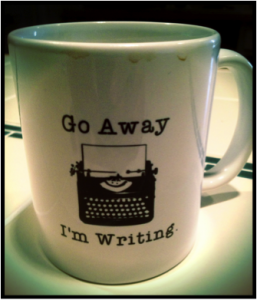 For Father’s Day one year, my wife and kids got me a coffee mug that says “Go Away. I’m Writing.” They know when I’m using that mug it’s writing time.
But in order to get to that juncture, I had to overcome some obstacles. I had to be honest with myself, first. I spent some time answering these kinds of questions:
- How committed am I to making writing my career?
- How busy am I really? How much time do I spend doing “fake work” vs. “real work”?
- How much time do I currently spend on social media or other distracting websites?
- What are all of the things clamoring for my attention on a daily basis? (I made a list, and prioritized it into important, urgent, would be nice, distracting, unimportant.)
- How many time blocks (as little as 5 minutes) do I have during a day when I could be writing?
- And again, How committed am I to making writing my career?
Now it's your turn
Be brutally honest about how much time you spend not writing. Don’t beat yourself up, but be honest. Take your time. What are some things in your life that you see as obstacles that could be removed? Some are easy. Some only seem easy. Some are hard.
Rather than waiting for that “perfect” moment/place/inspiration/etc..., what can you do within your current situation to create time for writing?
In the end, I think you’ll be surprised how much time you do have.
Tomm Gillies is a screenwriter/director who writes on airplanes, in coffee shops, in hotel rooms, and occasionally at home. You can follow him on Twitter: @AbstractChicken
Thanks for reading!
We’d love to read your thoughts in the comments.
Warmly,


by Jenna | Jun 18, 2014 | Guest Posts
 Note from Jenna: This guest post is from one of the many talented writers in my online writing community program, Rebecca Brams. Rebecca knows first-hand about the many challenges of writing while being a mom to two young boys, but it doesn’t stop her from getting her writing done. She shares here some brilliant-yet-simple techniques she uses to jumpstart her writing on a regular basis, even as a busy parent.
As you read these tips, look for ideas you can use for yourself — and let us know in the comments which one you’ll be putting into action.
My personal favorite is #5. :)
11 Tips: How I Get (& Keep) Myself Writing
by Rebecca Brams
We all have days when sitting down to write sounds about as fun as scrubbing the toilet. When the Muse is ignoring my pleas and Resistance is strong as steel, I turn to these tips and tricks to get words on the page.
1. Write longhand and keep my hand moving
It’s classic advice for a reason. When I’m stuck, I break out the old-fashioned tools: paper and pen. I start by describing what’s around me: the room I’m in, the clothes I’m wearing, the way the clouds are moving out my window. I add in some other senses – the smell of the old coffee in my mug, the sound of the washing machine whirring – and presto, I’ve tricked myself into writing!
2. Use a timer
Before joining the writing community with Jenna, I had mainly done timed writing when responding to prompts in writing groups, but now setting a timer is a critical part of my daily writing habit. I love using Freedom, an Internet-blocking software which temporarily disables my computer’s access to the Internet and blocks new emails from coming in. It keeps me away from online distractions while also giving me a clear “time’s up!” message right on my laptop screen.
3. Write before I’m awake
I’m not a morning person, but there’s something about 6:30 a.m. writing that allows me to sneak past that critical “editor” voice that can make each word a struggle. At night before I go to sleep, I set the scene: pen and notebook on the kitchen counter, splayed open to a fresh page. If my husband’s away, I prop my laptop against the wall by my bed, where it charges silently, waiting for morning when I pull it into bed for the indulgence of writing while still snug under the covers.
4. Bribe myself
On days when Resistance is mighty, I give myself a dark chocolate peanut butter cup, but only allow myself to eat it once I’m at my desk, I’ve set my timer, and the document is open. Some of my other favorite rewards are: a walk around the block, People magazine online, or a few minutes rocking in my hammock, thinking about how glad I am that the writing is done.
5. Suffer the consequences
Here’s the idea I keep in my back pocket for days when I feel powerless to stop avoiding my writing. I tell my husband, “Either I write today, or I have to spend those 15 minutes cleaning the toilet.” I’m pretty sure I know how that one will turn out, and it won’t be with a sparkling toilet.
6. Write in an unusual place
I write in my car, parked on a street where I’ve never before driven. I write in crowded cafes. I write in the yard under the Japanese maple. I write in the bathtub. But I do observe the cardinal rule: no laptops hovering over water.
7. Set a teeny tiny goal
10 minutes. 5 minutes. 2.3 minutes. When the timer goes off, I ask myself, “Can I keep going?” If the answer is yes, I set it for another tiny goal. I think in bite-sized pieces.
8. Write a numbered list
It could be a list of “Reasons I Can’t Write Today.” Or something supremely creative like “Things I Remember.” Eventually my timer will go off, or I’ll veer in some new, unexpected direction, perhaps even stumbling upon what I didn’t realize I was meaning to write about all along.
9. Use the phrase “What I really want to say is…”
Courtesy of writing teacher Laurie Wagner, this powerhouse phrase can make a piece of writing fizz and pop like Alka-Seltzer dropped into water.
10. Release the need to know where I’m headed
Sometimes I’m steaming along, words pouring out as fast as my fingers can type, and sometimes I hit dead stop, no idea of how to move forward. That’s when I remind myself that all I need to do is inch the story along. It doesn’t matter which current I tap into; I just need to move into the flow. Once I’m in motion, I can always change course.
11. Change my mindset
Instead of saying “I have to write now,” I tell myself: “Now I get to write.” What felt like suffering a moment ago might turn out to be my favorite part of the day.
Rebecca Brams is a novelist, blogger, grant writer and mama to two young boys in Berkeley, California. You can find Rebecca online at https://rebeccabrams.com.
In her copious spare time, she likes Zumba, nature, and hot tubs.

by Jenna | Jun 17, 2014 | Science Fiction, ScriptMag Articles
A new Sci-Fi Circuit article over at ScriptMag drawing on insights from The Machine.
A sci-fi spec screenwriter in today’s market has a number of hurdles to overcome. One of the primary challenges we face is learning not only to master great sci-fi storytelling but also how to do so on a limited budget. Until we’re top-of-the-line, A-list writers, any big budget features we’re bold enough to write… [read more at ScriptMag]
Photo Courtesy of XLrator Media.
by Jenna | Jun 11, 2014 | Writing Articles
 Note from Jenna: This guest post from one of my screenwriting colleagues and best friends, Isabel Holtreman. Isabel is a talented writer and is one of my most trusted feedback sources, both for my writing itself and for emotional support around the challenges of writing. I’m thrilled she was willing to take the time to talk with us today about navigating the emotional ups and downs of writing, and how she does it.
Be sure and leave a comment at the end of the post and let us know what inspired you.
How to Ride the Emotional Roller Coaster of Being a Writer
by Isabel Holtreman
I’m in marketing mode. I’ve never really taken marketing seriously until now, but it’s that time — the time where you realize that you must push yourself out of the realm of amateur and finally go pro.
Over the past few weeks, I’ve noticed some emotions coming up around where I am in my writing career:
- I miss working on story, something I can’t seem to do while I’m marketing. It engages a different part of my brain.
- I feel like an imposter, like at any moment, someone will find out that I’m not a writer at all, but some big fake who’s trying to fool the world.
- I’m elated when someone asks to read my work, but am devastated when a few days go by without a request.
I experience a similar thing when I’m in writing mode:
- I feel like I should be marketing something, because if I don’t, I’ll never make any money as a writer which will negate my newly acquired professional status.
- I feel like an imposter, like at any moment, someone will find out that I’m not a writer at all, but some big fake who’s trying to fool the world.
- I’m elated when story is flowing and everything is clicking, then devastated when I get stuck or can’t find a way to solve a story problem.
Does any of this sound familiar?
I’m sure it does. Being a writer is hard work. And I’m not just talking about the work itself. It’s difficult to stay even, to function in society, to not allow ourselves to fall into the pit of despair, and keep ourselves from paralyzing.
So, how do we deal with this emotional roller coaster without driving ourselves or our loved ones insane?
And perhaps even more importantly, without giving up on the dream?
Well, once again, we have to be willing to hunker down and do the work. Whether you decide to do the work on paper as I do (or on a computer) and journal, or decide to talk to someone, the fact is, the emotions must be acknowledged, brought to the surface, and observed for all they really are: Feelings.
Feelings are not ultimate truths.
They are simply clues, little alarms that lead us to overcoming our fears, and it’s our job to allow the feeling to flow, jump into our logical minds and say “Oh. Wow. There’s that feeling again. Okay, it’s just a feeling,” then take a step, ANY STEP toward overcoming it and moving forward.
Here are a few tips that have worked for me:
- Cry. I know, I know. It seems counter-intuitive, but it’s a quick way to get the feelings out. Set a timer and cry for 5 minutes, then wipe your eyes and write a sentence. It doesn’t matter whether it’s in a journal or novel or script. The act of writing breeds more writing.
- “It’s just a feeling, it’s not truth.” I repeat this phrase to myself a lot. It helps to help put feelings into perspective and understand that an emotion is just an emotion, a temporary, fleeting thing and that it doesn’t have to stop me.
- Give yourself a break. There’s no use trying to power through if your emotions are overpowering you. For those minutes or hours when you’re feeling at your lowest, step away from the work and connect to your heart, your humanity. Playing with a child, going for a walk, kissing a spouse, getting a hug — all these things put our lives into perspective and help us to realize that writing is what we do and not who we are.
- Journal. This has been the single most effective tool I’ve used for dealing with my emotions, period. Allow your feelings to flow on paper or on your computer for as long as you need, then ask yourself this question: “How can I turn this around?” With a little practice, you’ll find a ray of hope that will pull you out of your fear, anger or sorrow.
All of these tools do one very important thing: they teach us how to step back, observe, and process emotions while we’re still feeling them, which almost immediately reduces their power over us.
The roller coaster of emotions will always be part of the writer’s life, but with a little perspective and a few good tools, we can minimize the ups and downs, find a little peace, and get back to work.
Isabel Holtreman is an optioned screenwriter and consultant with a master’s degree in screenwriting from Cal State.
Thanks for reading!
We’d love to hear your thoughts in the comments.
Warmly,