
by Jenna | May 22, 2013 | Writing Articles
Today's article is on the subject of organizing and simplifying for writers, in a Q&A format with me and with my colleague Miriam Ortiz y Pino. Miriam helped me reorganize my office and design my schedule to help streamline my workflow and it's made a big difference in what I've been able to accomplish.
We pulled together this list of questions from our writing community members and from other frequently asked questions writers often pose to me.
Q: What’s the best way to find extra time in my day?
Miriam: Creating routines, so that you become more masterful over the actions in the routine, allow you to get it done more quickly. You also will be able to do most repeatable things with a lower brain function because you develop muscle memory. That saves effort. Those little bits add up over the course of a day, a week, a month, and by the end of the year can save up to 6 weeks.
Jenna: I learned a ton from Miriam about making sure that I was using my time as effectively as possible, and routines have definitely become a mainstay solution for me. The Four in me (from the Enneagram) rebels against routine and structure (more on this below), but I've found that it makes writing (and other things) possible for me in a way that I hadn't quite seen before. And, at the end of the day, if you're having trouble finding time to write, put it at the beginning of the day. It's an incredible boon to carve out time for you and your writing in the priority spot of your life.
Q: I hate structure. How can I make a regular routine for writing or creating when I rebel against it?
Miriam: If you don't want to create structure or routine for your writing or creating, try making routines out of the other repetitive tasks in your life. Things like grocery shopping, processing the mail, and invoicing clients become easier with repetition, so they take both less time and less effort. That is how you save up to 2 hours a day – a little bit at a time. Just think of all the fun stuff you could do!
Jenna: Even though so many creatives (me included) rebel against structure, I'm amused to find that it's something that truly makes a difference when it comes to writing productively and consistently for me. My take is to try out creating a structure for your creative work. You may actually be surprised to find you like it. And once you are in the habit of creating regularly, then start introducing variations. I've gained a tremendous amount of freedom in most of my life by creating a small amount of structure in part of my life, while in the past, when I had little or no structure at all, my life was much more stressful and chaotic.
Q: I hate systems and I want to rebel against them. How can I find super simple solutions that work without feeling rebellious?
Miriam: You can’t deny feelings. So, I suggest calling your system something else. How about method, or scheme? That way you can feel rebellious and still accomplish something. Then start with the end result you are seeking and reverse engineer the project. That usually provides the simplest solution.
Jenna: I love the idea of calling it something else, especially a scheme! Structure, systems, discipline, focus, goals -- we creative types have learned to think of these as bad things that interfere with our creativity. But do they? Or are they simply useful containers that help us channel our efforts into finished results?
Q: What do I do when I want to write but my office is filled with clutter?
Miriam: Begin removing the clutter. It’s actually better to work on a little at a time so you get the benefit of practicing making decisions. It’s just an editing process with things instead of with words. Once you decide you don’t need something, remove it from the space.
Your creative space needs to be a sacred space where you honor your muse. I recommend starting with your desk. Take everything off of it, and dust it. Then return only the things you need to write with. Perhaps a pen and a pad and a computer is all you really need. You can put the pen in a pen cup. You can add a cup of coffee. Keep enough space to lay out the file with the stuff about the idea you are working on. Everything else needs to live elsewhere.
Jenna: As much as my office can get cluttered, I do feel better and in a higher vibration space for writing when I clear the decks first. Working with Miriam to take everything out and then only bring back what actually belonged was tremendously freeing for me.
Q: What suggestions do you have for tracking, organizing, and saving writing ideas, and writing projects?
Miriam: Keep your ideas in one place – a notebook, a computer file, a box, a bowl – it doesn’t matter what form - it matters that you are consistent in storing your initial ideas there.
Then mine the idea place for your projects. When you begin work on a particular idea, start a file or other place for it to live for the duration of the work. Don’t forget to cross it off, take it out, or delete it from the idea place.
Jenna: I have most of my current project ideas in Evernote, so I can take them with me (and add to them) on the go. I do also have some paper files. Like Miriam says, consistency is the key; there's no one right answer. The beauty of all this consistency, structure, and systematic methodology is that once you decide what your method is, you don't have to keep deciding every time you come up with a new project idea.
Q: What do I do with my project – and the associated mess – once I’m done?
Miriam: The last step of any project is to put away your toys. In other words, file the finished product with flair. Recycle any drafts, they are things you decided against so they need to go. Research gets tossed or returned to a file depending on if you had to footnote it. Clear the desk of any lingering notes about the project.
Now you can pull a new idea from your idea place and start a fresh project.
Jenna: Cleaning up at the end of a project is a lovely way of completing the energy associated with it. It's harder for me to let go of interim drafts but I like the notion of it. :) I tend to keep an "archive" copy of my last draft with my notes in it, and the final one on my computer (with a redundant copy in Dropbox* so it's stored off site).
Q: I’d love to know any tricks for organizing the massive amount of hard-copy printouts of my drafts (when I print them out to read through and edit). They end up in stacks or spread out in various places on my office floor. Seems there has to be a better way than having stacks with bunches of sticky notes attached to them.
Miriam: You have actually described an excellent system for editing. What may be a problem is not sticking to your decisions. Once you print out and mark up a copy, input the changes and toss each page as you do. If you have to leave a pile between writing sessions, use a giant binder clip to keep each version neat.
If you have the space to stack, by project, in a bin, basket, or behind a cabinet door, it can help with the cluttered feeling between sessions.
Jenna: It's tricky to deal with the visual clutter between writing sessions, especially for more sensitive types. I like the idea I learned from a old boss, to have a "staging" area where I can keep works in progress "neatly" stacked (I do have to remind myself to do this!).
Q: What should I do with early drafts?
Miriam: Recycle them, they represent things you decided against.
Jenna: Ditching old drafts is a tougher one for me, but I like the principle behind it, and that's why we've invited Miriam to consult with us! As writers, we do have to keep making choices along the way about our work, and I like the idea of getting in the habit of trusting ourselves and knowing we can revise later if we need to.
Q: How do I quickly refocus if I get interrupted?
Miriam: It is much easier to refocus when there isn’t a lot of clutter, and when you are in the habit of working at a certain time. However, you can quickly refocus by closing your eyes, taking a deep breath and then actually asking yourself “ok, now where was I?”
Jenna: And I do a lot to make sure I don't get interrupted in the first place -- see below.
Q: How do I keep from getting interrupted in the first place?
Miriam: Good communication with potential interrupters is essential. Turn off the ringer, alarms, and close the door. Tell people you expect not to be disturbed – put up a sign if you have to.
Establish good boundaries around your creative and work time. Then enforce them. Boundaries work because they anticipate and accommodate other people’s problems with them. “In half an hour, I’m all yours.”
Don’t think of it as being unavailable for an hour, think of it as being with a client – your muse – right now and that you will be MORE available in an hour for others.
Jenna: We do have to think of our writing as being JUST AS IMPORTANT as most other things (excluding true emergencies of course). Setting great boundaries around our writing time is truly a critical and important part of the process. We have to be willing to tell the people in our lives that we have other priorities too.
Q: How do I decide what to work on?
Miriam: Well, it doesn’t really matter. You can use your intuition, ask the Magic 8 Ball, follow a matrixed schedule, or throw darts at your to do list. None of these will work if you don’t only pick from things that get you to your goals and are in alignment with your values.
A good rule of thumb is to have your routines in place so the stuff that must get done gets done. Then pick 1-3 other things to achieve each day.
Don’t start new projects until you are done with the one you are working on. It is faster in the long run to work on just 3-4 at a time in various stages (outline, draft, final edit) and add in one as each one completes.
Jenna: I have a bunch of those kinds of tricks to help people hone in on picking a project, which is often quite difficult for many creatives. One thing to recognize is that having too many ideas may actually be a commitment issue. In other words, you're afraid to commit, pick the wrong project, fail, etc. So if you don't actually pick a project, you'll never fail, never face the blank page, not have to "give up" on a particular project. But it also keeps everything locked in idea stage. So get some help tuning into the project you want to do first.
On the subject of routines, I agree with Miriam with the clarification that I recommend doing the writing first and making sure the routines don't swallow up potential writing time (or expand to fill it). Be careful. Resistance is sneaky.
Q: What can I do when my excuses are really procrastination?
Miriam: Begin anyway. Play games with your procrastination. Set fake deadlines, use ridiculous associations, throw a tantrum and then do it anyway.
Jenna: Yeah, it's procrastination. I've never met an excuse that isn't truly fear, doubt, anxiety, resistance, etc in disguise. Figure out how to you-proof your writing and then ... do it.

 Miriam Ortiz y Pino is a Certified Professional Organizer, Simplicity Expert and Coach, Entrepreneur, Writer, Blogger, and Creator of The Streamlined System. She works with entrepreneurs and other busy and creative people to eliminate the distractions, simplify systems and create routines so they can get it all done practically effortlessly. You can find Miriam at http://www.morethanorganized.net.
Image by © Helen King/CORBIS

by Jenna | May 15, 2013 | Writing Articles
This week I taught a class called “Get Ready For Summer Writing” with an eye toward looking ahead to the summer and getting a writing plan in place to deal with the various obstacles and opportunities that arise around the summer time, like the kids being home, schedules changing, more traveling and vacations coming, and dealing with weather changes like it being unbearably hot (or suffering through the summer fog here in the Bay Area!).
We walked through a planning exercise to give some thought to where we want to be at the end of the summer and how we’re going to get there in terms of words or pages per day over the specific duration of the summer.
I also shared some tips, tricks, and strategies to keep writing during the summer, deal with the challenges, AND have the summer fun we’re all longing for.
The biggest stumbling block
One of the biggest mistakes I see people making when it comes to summer writing (or writing at any time, for that matter) is taking an all-or-nothing approach. Many people think that if they want to travel or be outside or take care of kids or even deal with major life transitions, that means they can’t write.
Nothing could be further from the truth.
The key is being willing to adjust your writing goals to match to your circumstances, not give up writing altogether.
Binge versus balance
While I know that some writers have a tendency to binge-write (and some people even advocate for it!), I remain highly skeptical of its sustainability in the long term, particularly for more sensitive types. I put in an extra effort a few weeks ago to get my script to my mentor in anticipation of submitting to a contest today (gulp) and even that extra effort set me back a bit.
It’s all a system of checks and balances, and while there are people who will tell you that balance is a myth, to that I say, are they highly sensitive or introverted types who need careful energy management? And are they finding themselves settling into long term burnout? I’ve talked with more than a few writers who feel burned by their own efforts, have started to feel like they hate writing, and even question why they’re doing it in the first place. Why wouldn’t they, when they’ve committed (consciously or unconsciously) to a program of writing aversion therapy?
Try small doses of daily writing instead
Instead, I like to see people writing in a long term sustainable pattern, including taking regular days off (I’m not a fan of “don’t break the chain“). It’s easier to maintain in the long haul, and helps keep your momentum and ideas flowing.
So if you’re looking ahead to the summer and asking yourself how you’ll get your writing done AND do the other things you’ve got your eye on, give some thought to a highly achievable small increment of writing you can commit to on a small scale. Even five to fifteen minutes a day will keep you in touch with your project and keep you moving forward. I’ve seen more than a few writers in my writing community move to completion with projects again and again, using just small increments of time and showing up regularly to do the work.
You can do it too.
by Jenna | May 8, 2013 | Writing Articles
While technically it’s still spring until the solstice, I’m anticipating the changes summer will bring to my writing habits and my life.
My husband will be home more (he works at the University), and my son will have time off from school. We have our two annual camping trips already planned to savor the beauty of the outdoors. The outdoor light shimmering in my garden is calling to me.
It’s an expansive time.
And perhaps because of our cultural pattern of having summers “off” from our school years, I often find myself wanting to ease up on whatever I’m doing, work a little less, and play a little more.
At the same time, I think those of us who write also have this idea that we’ll get so much writing done because we have more time off (whether we literally do have more time or not). In fact, it’s a common pitfall for many writers and creatives. We set high expectations around “getting so much done” but simultaneously are pulled by a very real desire (and need) to take time off and play.
And of course we want do to both really — and that’s what I recommend, of course.
But all too often it ends up being neither one. Most people, when faced with “lots of time to write” end up doing nothing. And then they feel guilty and don’t enjoy their downtime either. Sad face.
What’s a thoughtful writer to do?
Here are three very simple steps to get you started thinking about how you want to see your summer writing play out:
Step 1. Check in with your writing goals for 2013 so far.
As summer approaches, it’s a great idea to think a bit about where you wanted to be right now. Are you on track with your goals? Ahead? Behind? Do they need recalibrating? Where are you right now and where do you want to be by the end of the year?
Step 2. Think about where you want to be in the fall.
At the same time, you’ll also want to think about where you want to be when fall rolls around and summer is over, so you can actually meet that end of year goal.
Are you hoping to be finished with your novel draft by the end of summer so you can move on to revisions? Have a new script polished up and ready to go? Be sending your self-help book off with query letters? Have your blog posting schedule humming like a well-oiled machine so you can start promoting something new?
Check in and see where you are now, and what you’ll want to do to meet that goal.
Step 3. Now, adjust for reality.
Keeping in mind that you may well feel pulled to play outside this summer, adjust your summer writing goals to realistically match the other things that will be going on in your life, like the kids being home, or going on the vacations you have planned, or the time off you desperately need.
Then, design in a reasonable, well-paced daily writing schedule you can actually accomplish. Put it early in the day, get it done, and then go out to play, guilt-free!

by Jenna | Apr 17, 2013 | Guest Posts
It’s always thrilling for me to see someone finish a writing project, particularly when I’ve been on the journey with them, from within the trenches of our writing community. We cheer each other on, during the hard days and the easier days, so it feels like a success for all of us when we see someone finish a project and reach their goal.
Of course, there are various milestones for “finishing” too — finishing the outline, finishing the first draft, revising the first draft, working on the second draft, submitting it for publication, etc. etc. In the writing community, we make a point to celebrate all the milestones we can. It’s a must on a long-haul project like a book or screenplay.
In this case, we’re celebrating the success of one of our writers who has finished the first draft of her novel at age 74!

Fredrica Parlett
I was particularly excited when Fredrica Parlett joined the writing community. I know and have worked with her talented daughter, Isabel, and I’ve had the pleasure of meeting Fredrica on occasion here in Berkeley as a result. What excited me about Fredrica’s project was her passion and commitment to her novel — even when the self-doubts would creep in, Fredrica kept up a steady stream of writing with the support of our writing community.
It’s been thrilling to see her return to and build on the first chapter she wrote of her novel four years ago in a class and had then set aside, first writing 20,000 words in her first three sessions in the writing community, and climbing steadily over time, bit by bit, day by day, to the milestone of completing her first draft this March after 18 months of work.
A self-described “writer, searcher, and hyperactive senior,” Fredrica has dreamed of writing a novel for a long time, and with the support of the writing community, has made it a reality. We’ve applauded her and encourged her to keep going, even as she’s said in her dry, witty tone, “I just hope I can finish it before I die.” As someone with long-lived relatives (the women in her family tend to live into their hundreds), we never doubted she would manage it, but we’ve been so happy to see her get there nonetheless.
I thought you might enjoy reading a little bit more about her project and her journey up to this point — as well as what comes next — in her own words:
Fredrica, thanks for being here. Would you first tell us about your writing project — what’s it about?
I am writing a “literary” novel, which follows the lives of two protagonists in 1950’s America: a 16-year-old dyslexic boy, who is misdiagnosed as mentally retarded and psychotic, and the 36-year-old psychoanalyst who tries to save him from a lobotomy.
Tell us about yourself and your dream of writing — how long has this been a dream for you?
As a child I used to lie in bed and make up stories, mainly to do with the Lone Ranger as my father, who misunderstood me, but then I would vindicate myself by rescuing him from horrible bandits or some other dire situation. I wrote short stories from about the age of 9, mostly about talking animals, such as duckbill platypuses. I also wrote poems, also about animals. I’ve always been interested in language and writing clearly. Only after my second child left home for college, did I start thinking about writing a novel. I had one underway, which wasn’t going well, when my house and all its contents burned down in the Oakland Hills Fire in 1991. After the fire I abandoned hopes of writing a novel and devoted myself to studying classical piano.
In 2009, I saw an advertisement for an online writing course given through Stanford University (my alma mater) entitled “Beginning a Novel.” I took the course, the aim of which was to write the first chapter of a novel. That was the beginning of this story, but it lay fallow until I joined the writing community at the suggestion of my daughter, who works with Jenna. I have always been drawn to novels rather than short stories.
How does it feel to have completed the first draft of your novel at age 74?
It feels wonderful. I have had to deal with all kinds of self-doubt and to learn to really prioritize my time, because I am easily pulled into duties and obligations. I had several medical issues last year also — amongst which were foot surgery and an appendicitis, as well as deaths in the family. It seems incredible that I actually wrote 170,000 words telling this story.
What have you learned about your writing process from participating in the writing community?
I was surprised to find that the support of the writing community made all the difference between writing and not writing. Reporting in to the site every evening has been, I think, the most important influence. If a day is slipping away with no writing, I get more determined to do some in order to be able to report progress.
But the other tools of the writing community have helped me as well — reading about others’ difficulties and successes, commenting on them (which is recognizing I have the same difficulties), attending the coaching calls where we have in-depth discussions about all our questions, and certainly participating in the group writing sprints — knowing the others are devoting that same hour to writing is a great boost. Sharing information about books and websites addressing the craft of writing and publishing is invaluable. The fact that the other members are much younger doesn’t seem to be a problem, even if I roll my eyes occasionally at their new age jargon. They are a serious and dedicated group. All these contacts keep me motivated and focused.
What were the biggest challenges you faced before joining the writing community?
I was always subject to the tyranny of the “urgent.” A large house, family, friends — and piano lessons — all of which were rewarding but did not fulfill the dream to write a novel.
You left the writing community for a time and came back to join us again. What did you notice about your writing habit while you were away and what have you noticed since you’ve come back? What difference has participating in the writing community made for you?
When I was not in the writing community, I noticed that the habit of putting everything else first began creeping back in. I missed the pressure of being accountable — stating my writing goal for the next day and trying to honor that. And I’m very prone to discouragement or negative self-statements such as, “I’m much too old to be undertaking this huge endeavor.”
Coming back, I immediately felt the power of the support. My total writing time increased dramatically, almost without my noticing it. (I have always set doable goals and then been surprised when I exceeded them — another trick learned in the writing community.)
What would you say to others who dream of writing a novel in their later years, and what advice do you have for other writers?
If you dream of writing a novel, don’t put it off any longer. The quality of my life has greatly improved from this undertaking, so I have profited, whether it ever is published or not. How has it improved? I look around and within myself for inspiration. I channel my tendency to worry about the world and the scratches on my hardwood floor into worrying about the fate of my dear protagonists, about whom I could talk to you for hours, without you realizing they aren’t alive right now. We all know how hard it is to establish a new habit, especially one that supports our inherent creativity. That is what the writing community can do.
What’s next for the novel and for your writing?
I am now in the revision process, which demands an entirely new set of skills. Fortunately, many of the writing community’s writers are in the revision process also. One of them recommended a book, which is helping me raise the stakes, increase the tension, and make ruthless cuts. I do Julia Cameron’s morning pages every day so that the words keep flowing. I am attempting to rewrite certain scenes in a much more dramatic, intuitive tone. Very exciting. I have the “soft” goal of having the novel ready to send to a publisher or to self-publish on Amazon by the end of this year. I am planning a road trip to Southern California in the Fall to experience directly the places in my novel, even Highland Mental Hospital in San Bernadino, which is still operating. Beyond that, who knows?
Is there anything else you’d like to tell us?
I want to stress that setting a realistic daily goal, even 15 minutes a day, and reporting in every day, so that one really begins to believe one is a writer, is really invaluable.
Thank you, Fredrica!

by Jenna | Apr 10, 2013 | Writing Articles
Can we write when we’re surrounded by clutter?
Craving the relief from chaos
For a sensitive person, clutter is an energy drain because it’s overstimulating (one of the biggest challenges for a sensitive person). It affects your energy to work in a messy room because there’s so much more to pay attention to.
Mind you, that doesn’t stop me from doing it when push comes to shove, and in fact, my office is messier than I’d like it to be right now. At least on the surface. Underneath though, it’s fairly well-organized, so it’ll be a quick trick to whip it into shape.
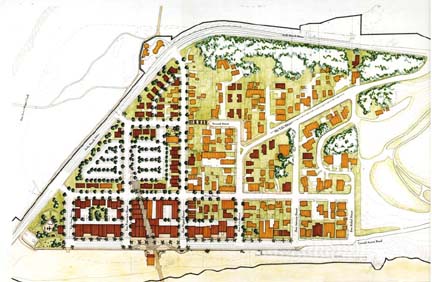
One of my “huge” drawings from back in the day. :)
When I create in chaos, I’m reminded of my old urban design days, where I used shuffle piles of huge drawings late into the night, struggling to meet whatever deadline I was targeting. My office mate used to say she loved to watch me “clean up” when I finished a project, because no matter what was coming down the pike (even if there was another deadline looming), I had to stop and put everything away before I could continue.
And I do find that I can work in a cluttered space for a time, but then I crave a certain kind of relief for it, a spaciousness that leaves room for my brain and my creativity to operate more optimally.
The energy of clutter
On an energetic level, sensitive people are more tuned into the stuff around them. I’ve always felt that we “carry” the stuff that’s around us, and as it stacks up, we begin to feel more and more burdened by it. And why wouldn’t we, if we’re carrying such a heavy load?
The cool thing about dealing with clutter is that we can work with it on a couple of different levels — both the practical mundane level and the energetic level. For instance, on the practical level, you can sweep it into a box and hide it temporarily (you’re only allowed to do this if you schedule time on your calendar to deal with it :) ) or you can stop what you’re doing and take the time to put it away.
Or you can approach your clutter on an energetic level and use energy clearing techniques to get the stuck energy broken up around the stuff so that it becomes easier to put it away. Someday I may teach my “space clearing energy skills” class again, but for now, try clapping your hands over the piles of clutter and see if you can dissipate the stuck energy that way.
Are you writing or speaking enough?
There’s a fun system I used to play with called hand analysis. It identifies a “Lines of Genius” gift marking, which means being called to be a “gifted author and speaker with a special message for a large audience,” or having a “Messenger” life purpose. The idea of a gift marking is that if you don’t use it, you suffer the consequences of it. In this case, lines of genius gift marking holders will be “cursed” with piles of paper and endlessly shuffling them around, feeling like they’re spinning in circles.
The solution? Write and speak.
Put the clutter away, clear the decks, and start writing. Schedule the time on your calendar to deal with the clutter incrementally, but don’t let it stop you from writing, or it’ll just get worse. :)