by Jenna | Nov 13, 2014 | Guest Posts
Note from Jenna: This guest post from one of my favorite writers and colleagues: Jamie Lee Scott.
Jamie is an amazing author, screenwriter, and entrepreneur who has a real handle on the world of independent publishing. I asked her to share her insights about the differences and advantages of self-publishing versus traditional publishing, since I know many of us are considering the indie publishing route.
Enjoy it — I know I learned a ton just from reading her piece.

The (not so) New World of Indie Publishing
by Jamie Lee Scott
It wasn’t long ago that self-publishing was deemed “vanity” publishing and was frowned upon by the traditional establishment.
Fast forward to 2011, and a new landscape.
Vanity is a word no longer in the vocabulary, and writers no longer need the traditional gatekeepers (agents, editors, publishers) to tell them what will sell and what won’t, what’s hot and what’s not. Writers can now write what they love and get it in front of readers in record time. Traditional publishers may take as long as two years to get a book from contract to readers, where an independently published author can do the same in a matter of weeks or months.
My choice to go indie
My decision to publish independently was easy.
I had Let Us Prey finished and I’d been sending out query letters for months. It had been getting some interest when my friend, New York Times bestselling author Jennie Bentley, asked me if I was interested in self-publishing. At the time I wasn’t even sure what self-publishing was, so I did my research. Jennie explained that if I took a contract with a small publisher, with a tiny advance, I’d be lucky to see my book in print by 2013, and even luckier to earn out my advance.
My chances of earning money from my book, and making enough to want to write another would be better if I jumped the traditional ship and waded into the indie publishing waters. Jennie, who herself was wading in those waters with a series of her own, threw me a life vest, and together we swam like our lives depended on it.
If I’d gone the traditional route, I’d be languishing with the mid-list authors, making a few thousand dollars a year if I was lucky, instead I’ve published five novels, one novella, and closed my manufacturing business to concentrate exclusively on my writing.
And I’m not alone.
Two extremely successful, and very generous writers, Liliana Hart and Jana DeLeon, were pioneers in indie publishing, have paved the way for many of us and are part of a collaborative effort to help others in a book called The Naked Truth about Self-Publishing. They’ve been the faces and voices for the masses along with many others who have paid it forward. There are too many to name here, but rest assured you will find them at conferences and talking to authors, generous with their information.
The writer is responsible for all aspects of the publishing process
The biggest difference between traditional and indie publishing is that the writer is responsible for all aspects of the publishing process.
So, if done well, the process is going to cost some money. How much depends on how professional you want your books to look.
Don’t skimp on editors, or cover design. Don’t judge a book by its cover doesn’t apply here, because the cover is the first glimpse and may sometimes be the only thing that makes the reader want to look further. If your cover looks as professional as the New York Times bestseller covers, you have a better chance the browser will look at the book description than if the book has an amateurish cover. Giving the book a fighting chance at the start is a must.
And then don’t turn them off by not having the book professionally edited. This book is going to sell your next book. If it isn’t well-written, and edited, you aren’t going to sell the next one, so why bother?
Spend the money now, and you’ll reap the rewards in the long run.
Whether you are traditionally published or indie, you are your marketing director.
Unless you signed a multi-million dollar traditional contract, no one is going to be running a PR campaign for you. The writing is the easy part.
So, now that the first book is written, great, now get your butt back in the seat and start writing the next one. In between, become a marketing guru, and help others along the way if you can.
Podcast in the making
I’ve been so lucky to have help from so many along the way, including the authors of Mirth, Murder and Mystery, that I decided to start a podcast to help others who are interested in becoming authors, either traditionally published or indie published. The podcast is called Indie Girl’s Guide to Self-Publishing and launches this December. It’s a weekly podcast for authors to help navigate the ins and outs of the crazy but interesting and possibly lucrative world of indie publishing.
This is not a get rich quick scheme
Lest you mistakenly think this is a get rich quick scheme, let me assure you, it’s long hours, hard work, and lots of blood, sweat and tears. The market (and algorithms) change on a dime, and keeping up is part of the game. Not only do indie authors have to keep writing, they have to keep in touch with the markets, changes, and much, much more.
Is it worth it?
I think so.

Jamie Lee Scott is the USA Today bestselling author of the Gotcha Detective Agency Mystery Series, and the founder of Indie Girl Self-Publishing Podcast.
She’s the co-founder of Script Chat #scriptchat and TV Writer Chat #tvwriterchat on Twitter, and writer of the award winning short film No One Knows.
You can find Jamie online on Facebook, Twitter, and at her websites, www.jamieleescott.com and www.indiegirlselfpub.com.
Thanks for reading!
Note: Amazon links in this post are affiliate links and may generate a small amount of referral income for this blog.
by Jenna | Nov 5, 2014 | Writing Articles
As I mentioned in a recent post, as writers --particularly undertaking big writing projects like a book, novel, screenplay, or even NaNoWriMo! -- we need to be mindful about our self-talk and keep it as encouraging and self-supportive as possible.
This is because one of our main tasks (aside from doing the actual writing) is preventing the freaked out voices of fear, self-doubt, and even a little panic (!!!) at times, from stopping us. Those voices may be loud, scary, and intimidating, but it doesn't mean they are right. As writers, we have to learn not to take them seriously and how to kick them to the curb so we can keep doing what we were put here to do.
1. Use the power of yet
I read a powerful post the other day called, “The Power of Yet”.
The core idea is to add the word “yet” to a negative thought.
Like this:
- You might catch yourself saying, “I don’t know how to solve this plot problem.”
- You can quickly add “yet”, to make it, “I don’t know how to solve this plot problem yet.”
Isn’t that interesting?
It takes a defeated “fixed” perspective and cranks it sideways to make room for possibility. And I'm a firm believer in the power of our subconscious minds to help us solve unsolved problems. A "yet" sets the stage for room to solve, grow, learn, discover. You may not know how yet :), but you will!
I love the power of this simple mindset strategy to change how you’re approaching your writing life.
- "I’m not good at plotting."
- "I’m not good at plotting yet."
Or
- "I don’t write characters very well."
- "I don’t write characters very well yet."
It’s an “I’m still learning” stake in the ground against the forces of darkness and negativity.
I love it!
2. See fear and doubt as familiar visitors you know how to handle
We all have a particular conversation that comes up when we're feeling the doubt and facing the fear head on. It sounds different for each person, though there are common threads.
You might hear things like:
- "You're not good enough."
- "This is too hard."
- "You're unoriginal."
- "I'm bored with this."
- "I'm not cut out to handle this."
- "You're doing it wrong."
The thing is, most of these comments come whizzing through our brains at lightning speed and kick us in the gut before we even know what happened.
And then we're feeling bad, not believing in ourselves and our work, and pretty soon we're not writing for the day or even blocked. It's like, BAM, day over.
How to change it up
The way to change this whole pattern is to NOTICE it.
Notice what your particular conversation is.
Write it down.
That's right. Put it on paper in black and white so you can really see it.
You might notice that's not even true!
You might also notice that you've been hearing those same thoughts over and over and over again.
No surprise there. It's your familiar visitor, one you've seen before (and one you will see again).
Why this even happens at all
Here's why this happens: When we take on a big dream through the auspices of a Big Damn Writing Project, the fearful, amygdala-driven part of our brains FREAKS OUT. "What? She's going to put herself out there like that? Is she crazy? We'll be ridiculed and exposed again, just like that time in second grade!! Oh no!!" And then the inner critic kicks into high gear, damage-control mode. "WHOOP WHOOP WHOOP", go the sirens. "RED ALERT! ALL SYSTEMS ON LOCKDOWN!"
That's what's going on behind those mean, horrible things you're saying to yourself.
They are cleverly, evilly, insidiously designed to SHUT YOU DOWN so you don't "get hurt".
But big surprise, inner critic, you actually WANT to do this project. :)
So your job is to say, "Oh, hold on, I see that you're equating this project with that painful experience in high school when you had to speak in front of the entire class and everyone laughed at you in a way that felt like you were going to melt into a giant puddle of liquid shame-goo, but this isn't the same thing. I'm a grown up now, and I actually want to do this project. So I'm going to take care of you, and me, and I promise we'll be okay. We can do this thing."
3. Reframe your negative messages
One of the most powerful things we do on a daily basis in my writing community is to use our online journaling system to reframe the negative messages that show up each day.
The first step is to note what the negative message is.
For example: "I'm not fast enough."
The second step is to take a look at that message in all its black and white glory and ask yourself, "How can I reframe that with a more positive perspective?" You might even want to pretend your best friend came to you saying that about herself. What would you say to her?
It might be something like, "I'm writing as fast as I'm capable of right now, and I'll only get faster over time."
Isn't that a bit kinder?
You might even try "yet" here, though I'd probably change it to something like, "I'm not as fast as I want to be yet."
What's your inner conversation like?
Here's an invitation for you. If you're feeling brave, tell us a self-directed negative thought you're holding about yourself as a writer by posting it in the comments. Then see how you might be able to reframe it or add the word "yet" to change it.
You may also be interested in:
by Jenna | Oct 30, 2014 | Writing Articles
I got off the phone on Tuesday with some of our writing community members and I was left with this question: to NaNo or not to NaNo?
Several writers in my sphere are wrestling with the question of whether to dive in and participate in National Novel Writing Month or not. And even just a few days from "GO!", we're asking things like:
- Will it be too much in my already full life?
- Will it give me the boost I need to get going?
- Can it help me feel like I'm getting a jumpstart on my writing (again)?
- What if I get burnt out doing it?
- What if it's a ton of fun and really inspiring?
Even I'm thinking about it, despite the reality of my current personal life circumstances (A 5 month old baby! A new script to write! A business to run!). I'm especially tempted because we've developed some extra supports on the community site for those who will be participating in both the community and NaNo and want more personal, intimate support than what NaNo itself offers.
As I talked about last week, there are some real pros to participating in NaNo. And what strikes me is that so many of us in the community are thinking about doing both, which speaks to an underlying desire to see rapid progress and to get a jumpstart on a big writing project.
Making the decision
Mary Montanye, one of our community members and author of the recently published memoir, Above Tree Line, and the coach that will be running our special community NaNo support group, approaches NaNo with a delicious spirit of fun and exploration, primarily with the focus on creating a "discovery draft". (More on discovery drafts here.)
About making the decision to NaNo or not to NaNo, Mary says:

"The writing we do in NaNoWriMo can really kick up a writing practice habit, something we are committed to helping writers do in the writing community. And you don't have to write a novel! If you'd rather write a longish piece of non-fiction, it can help you do that, too.
"I have written non-fiction, even journaled extensively during past Novembers. I love the challenge and the camaraderie that occurs when I participate. And through the years I've amassed a bundle of tricks that helped me survive and thrive during this world-wide write-a-thon and on into my writing life after the month of November is over.
"This is the way I look at it. I hold my commitment very loosely. I want it to be fun. And I want to be surprised by the words that make their way from my brain to the page. Fast writing, without thinking about it too much, is how I am surprised. If you look at it as creative play, it might be just what you need right now. And, when we are writing fast, it doesn't take more than about an hour or two to chalk up the words. We can write more on freer days, and less on the others. You may never use much of what you write, but you may, or you may have a breakthrough that might not have come another way. And, if you begin, decide there is absolutely no way you can do this, you can stop. Most do, so there is nothing wrong at all with that.
"But, and this is a very big but, if this is just going to feel like one more draining commitment, don't do it. Or, if you think it would be very hard for you to hold it lightly and have fun with it because that's not your way, then don't do it."
Isn't that useful?
Learning from the NaNo experience
On another front, one of our writers shared some thoughts about the value of participating in NaNo, which really spoke to me:
"I participated in NaNoWriMo last year and finished. It was great, taught me a lot about writing in general and about my own way of writing.
"It taught me the value of writing daily and of aiming high (2000 words a day). It taught me that most of the time the first 300 words were hard, and the first 500 even harder, but that after 700-800 it got easier as I kept going. It also taught me that if I switch off my judging brain I can still write and that how I feel about the writing, while I'm doing it, says nothing about how it turns our or whether I will be able to use it later. Sometimes 'writing blind' like that resulted in pieces of writing that were better than they would have ever been if I would have been consciously trying. I mainly joined to see if I could establish a habit and because I liked the challenge, but I was surprised at how much of what I wrote during that month actually ended up in the novel draft I am working on.
"Being part of the writing community at the same time meant that I had a forum and a group where I could log my progress and reflect on the process, which helped me keep going and helped me notice what I was learning."
What I find most fascinating about this is how she learned that the later words come easier. Isn't that the truth? It's usually the first that come painfully, unless we're totally fired up to write (which by the way, is so much easier when we're writing every day!).
I also noticed that the experience seemed to raise her level of what's "normal" for her in terms of daily writing. So not only could NaNo be a way to crank out one project in particular, it can also be a way to take your writing habit up a notch.
You may also be interested in:
by Jenna | Oct 18, 2014 | Writing Articles
Will you take the NaNo plunge?
In many ways the purpose of NaNo is the same as the writing community's purpose — it’s about making the writing happen. The main difference I see is that in my writing community we focus on writing year round, in a sustainable way. With NaNo, the focus is on writing intensely for a shorter duration of time. Both approaches have pros and cons.
If you're on the fence about doing NaNo, here are some things to consider:
Advantages
- It's inspiring to write alongside other writers, especially with the same goal.
- ... and there’s a very clear focused goal: 50,000 words in 30 days.
- It helps keep you focused on one specific project instead of hopping from project to project and losing your way.
- Meeting a big goal in short amount of time can feel amazing and inspiring.
- It’s a great way to make a concerted push on a big project.
- When you write fast, you bypass your logical left brain and your inner critic. The results can be magical.
- It IS possible to write fast and write well.
Challenges
- Writing 1,667 words every day can be a lot for some writers.
- Not meeting the daily goal increases the number of unwritten words as each day ticks past, which then creates pressure to catch up.
- Writing every day at an intense pace can lead to creative burnout and writing aversion after the big push. Some writers report writing hard during NaNoWriMo and not writing for the rest of the year.
- Not meeting the goal might feel discouraging.
- Writers sometimes report generating a ton of words, but that the quality feels lacking.
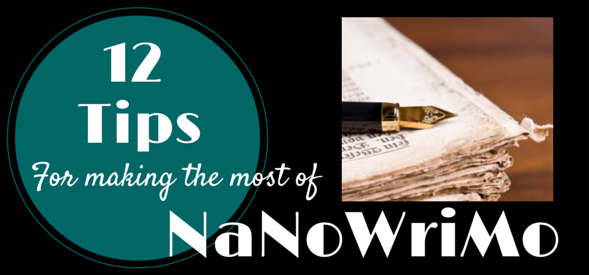
12 tips for making the most of NaNoWriMo
If you do decide to go for it — and I hold no judgment either way, in writing it's all about what works for YOU — here are some ideas that might help you along the way.
Before NaNo
- Design your month around the effort. This could look like cutting back on extra activities, getting extra childcare, taking some time off work, etc. Really think about how you can make it EASY to meet this big goal.
- Be crystal clear about when you’re scheduling your writing time so there’s no doubt about when you’ll do it. Get out your calendar for the entire month and map out when you'll be spending the 1.5 to 2 hours you'll likely need each day.
- If you’re not a “panster”, work on your outline for your project NOW so you can start writing when the clock starts ticking. Even if you just map out the major story beats, you'll have something to swim toward when you're out there in the ocean of words you're about to dive into.
- Up-level your self-care and creative well-filling. Healthy food, lots of water, time in the sunshine, exercise, and lots of great creative inputs will help keep you humming at an optimal level throughout the month. (And keep this up DURING NaNo too.)
- Get lots of non-writing support for the rest of your life like bill-paying, grocery delivery, etc., or work on getting things in order now so you don't have to be distracted by them while you're neck deep in writing.
During NaNo
- Use timed writing sprints to help you write briskly for your daily writing goals. It has the added benefit of teaching you how long it takes you to write a certain number of words as well, so you'll know if you need to adjust how much time you're setting aside for scheduled writing time in #2, above. Plus you can use the sprints to break up the longer chunks of writing so that you get up and stretch between sessions. In my writing community we usually write in 60 minute sprints, but a good sprint can range in length from 15 to 90 minutes. Find what works best for you.
- Be mindful about your self-talk and keeping it as encouraging and self-supportive as possible. Notice any negative self-messages that come up and find a way to reframe them into a more positive perspective.
- Pay attention to how it’s feeling and working for you. There are no rights or wrongs here, no failures. You may want to experiment with challenging your own comfort zone or you may find that this is a method that doesn't work for you. It's ALL useful information that will only help you going forward.
- Have a support system outside NaNo like a writing group, community, or buddy to cheer you on and help keep things in perspective. If you're struggling, get help and support. You don't have to do this alone.
After NaNo
- Celebrate! When the end of NaNo rolls around, one way or another, celebrate. If you met the goal, great! Celebrate it. If you didn't meet the goal, make sure to celebrate the attempt.
- Rest! Once you're done, take one to two days off after NaNo and really enjoy it.
- Write! Then, start writing again. Make a plan for how you’ll keep writing after NaNo. This could look like keeping up the same pace if it worked for you or adjusting it up or down to find your new happy medium of accomplishment, sustainability, and attainability. You may find that you want an extra easy writing goal for the first week after the big NaNo push, which you can then reassess and adjust as needed.
You may also be interested in:
by Jenna | Sep 17, 2014 | Writing Articles
This week I'm reading Chris Guillebeau's freshly published book: The Happiness of Pursuit: Finding the Quest that Will Bring Purpose to Your Life.
I've been a longtime follower of Chris's blog, The Art of Non-Conformity.
What I love about Chris's approach to Life, the Universe, and Everything is his go-get-it attitude about the things that matter to him. He's designed a life and completed a quest that works for him and his personality. This new book is about his quest to visit all the countries in the world by the time he was 35, and about the many people he met along the way that were pursuing quests of their own.
In talking with others and looking at his own experience, Chris gleaned a number of useful lessons and insights about creating and pursuing quests.
And although the focus of the book is generally on more external pursuits, I can't help thinking there's are great lessons to be learned for our writing lives as well. There are certainly some useful parallels to draw between quests and writing, as you'll see below.
Let's talk about some of the lessons that have stood out to me so far in what I'm reading:
1. "When you sense discontent, pay attention." Discontent is a powerful informant about what's not working in your life . . . but it's not enough on its own to spark a quest or change. Chris says, "If you want to get the embers burning, you have to blend dissatisfaction with inspiration, and then you have to connect the dissatisfaction to a greater purpose."
This is his equation for transmuting dissatisfaction:
Dissatisfaction + Big Idea + Willingness to Take Action = New Adventure
I've definitely found discontent to be a great source of information in my own life about what's not working and what I'd like to change, but it was my willingness to do something about it that really made the difference, particularly in my major career shift from urban design to coaching and ultimately to writing.
2. "A true calling involves trade-offs." A dream that calls you -- whether it's creating something or traveling the world -- will require a deeper investment or even sacrifice -- but it will feel worth it to you because you're called to do it.
Making the time to write often involves a sacrifice or trade off for me, but almost always feels worth it. And I'm certainly willing to make hard choices about fulfilling other dreams of mine in order to make them happen (from staying home with the kids to traveling the world).
3. Refuse to give your fear decision-making authority. Making headway into new territory will trigger fear. As Chris says, "Embracing new things often requires us to embrace our fears, however trivial they may seem. You deal with fear not by pretending it doesn't exist, but by refusing to give it decision-making authority."
Any big dream will trigger fear -- and Chris is absolutely right that we cannot allow it to dictate our decisions.
4. Have an emotional awareness of mortality. Chris differentiates between an intellectual awareness of mortality versus an emotional one.
Here's how he breaks it down:
- Intellectual awareness: "I know that no one lives forever."
- Emotional awareness: "I know that I will someday die."
I've always been vaguely annoyed by the notion to "live each day as if it's your last", because I'm pretty sure I wouldn't be emptying the dishwasher if it was my last day on Earth. But Chris's notion here, of having an emotional awareness, points to something more meaningful for me.
It's about having a sense of personal motivation to make the most of the time we are individually given, by adopting greater goals and pursuits that bring a sense of meaning and fulfillment into our lives. That version works for me.
5. Make your personal passions your quest. A quest, as Chris defines it, includes a clear goal, a real challenge, and set of milestones along the way, and something that involves some kind of investment or sacrifice. He doesn't include writing a book as a quest, though he defines that as a "general life improvement" along with other things like getting out of debt, getting in shape, quitting smoking. Those, he says, are not necessarily true quests.
The examples of quests given in the book range from his own (traveling to all the world's countries), a woman's goal of making a meal from every country for her family, a teen earning every Boy Scout merit badge, and a man using walking as an only means of transportation for 17 years (and not speaking either for that length of time as well).
More to come...
The rest of the book contains what looks like more delightful examples of other people's quests, along with some in depth chapters I'm particularly looking forward to reading.
There's one called "The Love of the Craft", which I think will be right up my alley, with some writing examples, including Seth Godin.
Can writing be a quest?
It occurs to me that writing could still be a quest by Chris's definition -- perhaps by setting a goal of some kind around it, like a certain number of books or screenplays written by a certain date, or like Seth Godin, writing 365 days per year. What do you think? Take a look below for an opportunity to submit your answer about how writing might look like a quest for you . . . and get a chance to win a copy of Chris's book!
About Chris
During a lifetime of self-employment that included a four-year commitment as a volunteer executive in West Africa, Chris visited every country in the world (193 in total) before his 35th birthday. Since then he has modeled the proven definition of an entrepreneur: “Someone who will work 24 hours a day for themselves to avoid working one hour a day for someone else.”
Chris’s first book, The Art of Non-Conformity, was translated into more than twenty languages. His second book, The $100 Startup, was a New York Times and Wall Street Journal bestseller, selling more than 300,000 copies worldwide. His latest book, The Happiness of Pursuit, will be published by Crown / Random House in September 2014.
Every summer in Portland, Oregon, Chris hosts the World Domination Summit, a gathering of creative, remarkable people with thousands in attendance. Chris is also the founder of Pioneer Nation, Unconventional Guides, the Travel Hacking Cartel, and numerous other projects.
Read Chris's favorite writing tips here: http://chrisguillebeau.com/good-writing-tips
Meet Chris
You can meet Chris on his tour of 40+ cities in North America. Find out more here: http://chrisguillebeau.com/events
Win a Copy of The Happiness of Pursuit
Pick up your own copy of The Happiness of Pursuit, on Amazon *, Barnes & Noble, and indie bookstores in hardback, paperback, or ebook form.
Thanks for reading!
* Affiliate link