
by Jenna | Jul 16, 2021 | ScriptMag Articles
Welcome to the next installment of my “Ask the Coach” column on Script Mag!
This month’s question is about whether to abandon a current script in favor of a new idea, or not:
“I recently committed to working on a particular script idea, and almost instantly became fascinated by another story entirely. Should I move to the new idea? Or is this a distraction getting in my way?”
Great question. Ultimately, this is a choice no one else can make for you, but here are some possibilities about what’s going on, and some possible strategies to consider. [more…]
When it comes to choosing what to focus on, and possibly letting go of a current idea, there’s a lot to reflect on. Brand, career, preference, genre, instinct, market, and more. And because there’s often a fine line between recognizing resistance versus intuition, pay attention to how and when new ideas come cropping up. The beauty of writing is how it begets new ideas. It’s your job as a creator to corral that surging herd into a manageable strategy that works for you.

by Jenna | Apr 18, 2021 | ScriptMag Articles
Welcome to the next installment of my “Ask the Coach” column on Script Mag!
This month’s question is specifically about finishing, and when — or if — to give up on a project:
“How can I deal with the indecision that comes with looking at what I’m writing and reaching a point at which I say, “I never should have started this in the first place — no one will care about this, this is unoriginal, this has no chance of selling, what was I thinking?” I don’t see a point at continuing and then go on to the next potentially shiny object. Very frustrating and totally within my control. What do you recommend?”
Great question! In order to help you answer it, I have some questions for you.
“The first thing to consider is whether or not this inner voice speaking up is the voice of resistance, or the voice of intuition.”
For my four questions to consider and my full answer,
If you’ve got writing questions, please send them my way!
I’d love to answer them for you in my column.
Image by Gerd Altmann from Pixabay

by Jenna | Apr 10, 2018 | Book Reviews
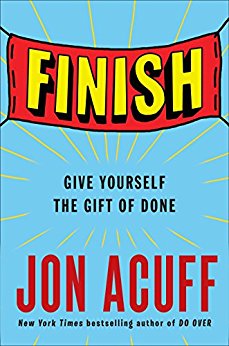 I’ve just finished reading Finish: Give Yourself the Gift of Done* by Jon Acuff. It’s a delightfully irreverent book packed with useful insights — sometimes counterintuitive — about how and why we stop ourselves from finishing (hint: perfectionism is the root cause).
It’s been a particularly fun read right now for three reasons.
First, I’ve been reading it alongside several of my community members and we’ve been discussing it on our online site. I have a feeling we’ll be doing this again. It’s a mini online book club. Yay!
Second, I’m just about to lead the goal setting call for a writing intensive I’m running so I’m looking forward to incorporating some of Acuff’s principles into our goal setting work. And since the intensive is designed to help people finish (or make major progress in that direction), it’s particularly apropos.
Third, I know I’m a recovering perfectionist. Or at least a perfectionist who’s trying to recover. (The first step is admitting you have a problem!) So this book was useful on both professional and personal fronts.
Here are some of my favorite takeaways from the book:
- The “day after perfect” is the make-or-break day. Acuff says the “day after perfect” often turns up as soon as day two of pursuing a goal. I see this happening with writers who put in a big burst of enthusiastic writing for their first day out (sometimes later), then crash and burn the next day by going into massive writing aversion and avoidance the next day… which can lead to despair and giving up. I much prefer to see writers pacing themselves for the long haul. Acuff makes the point that we have to focus on “moving forward imperfectly” and “trying again… today, tomorrow, or next week.” I’ve always been a fan of “starting over tomorrow,” whenever I get off track with my goals so I’m right there with him.
- There’s a difference between commitments and distractions. Acuff makes a useful distinction between the things we’re committed to doing, like our day jobs and our kids, as our commitments, and things like Netflix — and those side projects you turn to when it’s time to write — as distractions. See how simple that is? I found this useful for reinforcing what I do when I write out my Three Big Rocks list, which is to focus on the key things I want to accomplish for my goals that day. I don’t include my standing commitments (taking care of my kids and exercising, for example), because I think of them as “givens,” but prioritize the three major commitments I’m making for the day.
- You can look for your own sweet spot with rewards or penalties (or both) when it comes to goal setting. Acuff says, “make it fun if you want it done,” and recommends establishing a reward or a penalty for your goal. I’m more motivated by rewards than punishment, but his writing had me think more about deciding on really fun rewards, and deciding on them in advance. I’m particularly thinking about how I can do this on the daily and weekly scale (one example he gave was how author Sammy Rhoades would reward himself with a Friday afternoon movie for meeting his writing goals, which sounds right up my alley).
- Pay attention to where you “hide” from your goals. Acuff describes both “hiding places” — where we go to avoid our goals — and “noble obstacles” — the clever schemes we design to make it so we can’t possibly focus on our goals because we’re serving some higher purpose. I’ve seen so many writers over the years come up with the most fascinating and suddenly highly important non-writing or OTHER writing projects than they originally come into our programs with. This is really worth paying attention to and short-circuiting.
- Put your new idea at the finish line for your current one. If you tend to come up with a new idea that’s much more appealing than your current project the minute you start (in the coaching world, we call these Bright Shiny Objects), Acuff recommends making the new idea the project you “get to” work on when you finish your current one. With writing, I recommend what I call a “Project Queue” (tips on how to do this with writing projects are in my free guide, “How to Choose Your (Next) Book“). The core idea is to promise to work on the new idea next. In a sense it even becomes a reward for getting to the end of the current one. Yay!
- Aim a little lower with your goal setting. Acuff recommends cutting our goals in half, either by cutting the quantity or output in two, or by doubling the amount of time we give ourselves. This is because most of us are entirely unrealistic about how we set our goals. I’ve personally been setting fewer and fewer goals over the last few years, after seeing myself being unable to attain the multiple, too-fast-paced goals I was aiming for, and I can see right now from checking my 2018 goals list that I may have a bit more tweaking to do after reading Finish, especially after the hard start to the year I’ve had.
- The “day before done” is another place many of us go astray. I’ve witnessed this in my own writing, suddenly becoming apathetic toward a screenplay, telling myself I’ve just lost interest in the story. Acuff identifies three primary fears triggered by a looming finish, including a fear of what happens next (Amazon reviews!), a fear it won’t be perfect, and a fear of “what now?” The key, he says, is addressing these fears with a combination of trusting yourself to figure it out and being open to seeing what happens.
More my favorites in this book are the “secret rules” we use to sabotage ourselves (“If I lose all this weight, then I’ll have to go dancing/be looked at/feel more vulnerable”), choosing what to “bomb” (where you’re strategically choosing to suck at something in order to prioritize your goal), using data to track your goals and “celebrate your imperfect progress,” and many more.
While there were times I wasn’t 100% sure if I thought Acuff was actually writing about resistance and not so much about perfectionism (which I consider to be a subcategory of resistance), I loved what he shared and he has stirred some useful thinking and insight for all of us who have read it.
Highly recommended.
* This is an Amazon affiliate link, which means Called to Write will earn a small commission if you purchase the book after clicking on this link, for which we are greatly appreciative!

by Jenna | Jan 19, 2017 | Writing Articles
I recently read a blog post by James Clear that suggested we forget about setting goals and focus on systems instead. I appreciated his points about how goal-focused thinking can get us into trouble because it can: 1) keep us dissatisfied with the present moment, 2) cause trouble with long-term progress, and 3) create a sense of control we might not actually have. I agree with all of those points.
But I disliked the implication that therefore goals should be forgotten. Like anything else, they are one possible tool to help us create outcomes that we want, and like any other tool, they need to be used wisely. At the end of the article he even says, "None of this is to say that goals are useless. However, I’ve found that goals are good for planning your progress and systems are good for actually making progress."
So despite the fact that it seems that James and I are in agreement about the value of both goals and systems, since there's usually a lot of debate around this time of year about whether or not goals or resolutions are "right," I thought I'd share some of what I've learned from working with hundreds of writers on goal-setting and creating systems to help them reach those goals (writing habits).
The truth is that goals and systems can work hand-in-hand quite beautifully. Here are eight thoughts about goals, systems, focus, and finishing:
- There's no one right way to do anything. We each have to find what works for us individually. My way of setting goals might not work for you. Your way might not work for me. You don't even have to set goals if you don't want to. But what I've seen is that when we focus on something specific (a goal) and pursue it, we are much more likely to achieve the outcome we're looking for than by hoping it will happen.
- Systems, habits, and routines alone can get us somewhere, but we can get lost along the way when we use them without an intended outcome. I love, love, love systems. And systems in and of themselves are brilliant solutions for consistently problematic issues, like dishes stacking up in the sink and feeling overwhelmed by them (run the dishwasher every night without fail), or laundry taking up writing time or becoming a magnet for resistance (schedule a time for laundry outside your writing schedule and stick to it), or putting off paying your bills (create a routine for how and when you write checks).
But if you're attempting to use a system, routine, or habit to achieve a long-term outcome, like writing a book, you actually have to have an outcome in mind in order to reach it, aka a "goal." You can't just write every day and hope it will happen (though it may eventually, assuming you keep working on the same thing without fail, which perhaps sounds obvious but can be a big assumption in the world of project-hopping writerly types). I've seen too many writers get lost in the weeds of writing without writing toward an end, and lose track of what they set out to do in the first place. Even James actually had an outcome in mind for the system he was using (writing and publishing blog posts twice a week).
- Goals help us focus our efforts. Honestly, there is so much going on in our lives, that unless we are super clear about what we are trying to accomplish, it's easy to get pulled off track. That writing habit can become a pat on the head ("See, I did my writing today!") unless it is focused. Pick something to finish. Finish it. Pick something else. Finish that. Repeat. Setting a goal keeps your eye on the prize.
- Goals set in a vacuum won't get us very far either. Having stated the importance of goals, I see many writers creating unrealistic goals ("A page a day!" ... but what happens when you're in revisions, are you still going to write a page a day in addition to revising?) or using magical thinking to neglect the reality of their daily lives and ending up frustrated at year's end because they don't achieve their goals. Or even worse, they set goals to match what other people are doing, whether or not that's achievable in their lives ("My friends are all writing six scripts a year, so I should be able to do that too, right? Never mind that they don't have kids or that their spouses are independently wealthy."). We have to set goals that work within the context of our lives, even when we're setting stretch goals for ourselves.
- Goals without systems are likely to fail. Goals and systems work hand-in-hand. Want to finish a book, a good one? You can't write it without a writing routine or practice. You have to put in the time, show up, and do the work. It won't happen on its own, and it probably won't happen well if you're binge-writing it at the last possible minute. (And even if it does, the cost on your health, well-being, and future writing energy may be higher than you like.)
- Use systems and milestones to counteract flagging motivation on long-range goals. When we set very long-term goals (such as year-long goals), they can feel so far away that we have a hard time staying motivated and engaged with them. Having a writing system helps us manage that sense of disconnection from our distant goals, particularly when we combine it with milestone goals. A system helps us keep writing -- it's a practice we're accustomed to engaging in every day -- so we can't help moving the project forward, as long as we don't stray to another. We can also hugely benefit from setting shorter term goals (one to three-month goals) that are completion milestones along the way to the finish line. That ultimate finish line can feel really far away, so we can give ourselves something to work the system with in the meantime.
- Taking stock periodically helps maintain momentum. Post your goals where you can see them, check in with them on a regular basis, and take stock of what you've accomplished so far (add up ALL THE THINGS, even if they seem small) to help you see your progress and stay motivated to continue.
- Progress without a finished product isn't particularly satisfying. Yes, as writers we have to be in love with the process and the practice of writing. Yes, we may never be published or produced. There are no guarantees. Yes, yes, yes. But we can still take our books and scripts to their completion points to the best of our abilities and ship them out into the world, and move on to the next project. We can use goals to focus our efforts so we get to the finish line. Working a system and being productive without focusing on an outcome or a finish line can become an endless loop that doesn't feel satisfying otherwise. We have to have both.
The 3 Necessary Ingredients to Finish a Book or Script
From what I've seen, there are three necessary ingredients to finishing a book or a script:
- A specific writing project to work on. Preferably just one long-form project. I rarely see writers completing more than one project at a time successfully. Maybe the true pros can do it. Maybe. My recommendation: Pick one project at a time. And finish it. Then do the next one.
- A writing system. You can also call this a writing habit, practice, or routine. It means showing up daily or near daily to write.
- A goal for completion. Yes, set a goal. I'm a fan of SMART goals (Specific, Measurable, Achievable, Resonant, Time-Bound) because they help us double-check to make sure we're being specific enough about the who, what, where, why, and how. Set a goal for when you'll complete your book or script, and while you're at it, map out the timeline too.
So put those systems and goals to work, and make your writing happen. I'll be right there with you.

by Jenna | Aug 7, 2014 | Guest Posts
 Note from Jenna: This guest post is from Terri Fedonczak, a parenting coach, author, and writing community coach.
I’ve loved working with Terri through the writing community over the last few years, first as a participant, then as a coach. She knocked our socks off by finishing the first draft of her parenting book in just three 28-day sessions of the writing community in 15 minute increments of time – after having had the book “brewing” in her for over 15 years. Amazing!
Just Show Up
by Terri Fedonczak
When I joined the writing community in 2012, I knew that I wanted to finally get my book out of my head and into my computer. I had been “writing” this parenting book for 15 years, as I knew that I needed to get one kid through adolescence before I could have any street cred with other parents. I put writing in quotations, because the book was mostly on tape. The little bit of writing that I did have was on sticky notes and spread across a dozen journals.
In my first session with the community, I thought I would just get organized. My goals were very small: only 15 minutes a day 6 to 7 days a week. Much to my surprise, I finished the rough draft in just three sessions. “Rough” is an understatement as a descriptor for that first draft. It was a 30-page booklet of disjointed ideas. I told myself that I wanted to keep it short, because parents were too busy to read a long book. That was a nice justification for keeping the real story to myself.
When I sent my booklet to my chosen editor, she immediately outed me. She said, “I will edit this book the way it is, but it wants to be so much more. There’s no heart and soul in it. YOU aren’t in your book. There’s nothing about your breast cancer, no struggle, no life coaching journey . . . there’s no mess here. Parenting is messy. You need to show other parents your mess.” She was right. And that started an 18 month journey of re-writes and edits.
Let Go of Expectations
One thing I’ve learned in the writing community is that writing is both infinitely easier and more challenging than I ever expected. It’s more helpful if you flush your expectations of how long it will take or who will like it and just keep showing up to the page every day.
As a coach, I see brilliant writers spending lots of time and energy worrying about what other people will think of their writing, or fretting about how long it will take (or is taking). All this worry keeps us in ours heads. Good writing doesn’t come from the head – it comes from the heart. Meaningful writing grabs the reader with its simplicity and elegance and just won’t let go.
As readers, we don’t care about how long the writing took or how smart the author is, we want to care about what we’re reading. You can’t fake that or wordsmith your way around it. All you can do is show up to the page and show us your mess.
From Dream to Reality
 My book went from a dream to a reality. It’s now on Amazon* online, and it was endorsed by the Washington Post as a “must read” in their February Parenting Book Round Up.
But more importantly, I have parents tell me how much the book has changed their parenting for the better. That makes it all worthwhile.
This Is What Success Looks Like
So, 15 years of vomiting ideas onto paper or tape, one month to a rough draft, and 18 months to re-write and publish. This is what success looks like; it’s not quick and it’s not easy. But with the support of other writers, a dogged determination to show up to the page every day, even just for 5 minutes, and the courage to show us your mess, you will arrive at your own version of success.

 Terri Fedonczak wants to live in a world where girls recognize their own power and choose to use it for good. On a trip to South Africa, Terri saw the power of the lioness and how they support their pride; it was a lightning bolt of realization that her mission is to bring the power of the pride to girls and their parents. Terri was a commercial real estate agent for 16 years until a bout with breast cancer transformed her life in 2010. She realized that trading money and status for time with her four girls and patient husband was not quite the deal she thought it once was. She left sales to become a certified life coach and embark upon a journey of spreading the message of girl power far and wide.
Terri is a featured speaker at the Costa Leadership Institute, helping adults balance their lives, and she takes the girl power message into high schools, talking to 9th grade girls about how to thrive in high school. Her first book, Field Guide to Plugged-in Parenting, Even If You Were Raised by Wolves, debuted in 2013. When she’s not speaking, coaching or blogging, you can find her paddle boarding on the sparkling waters of Boggy Bayou, knitting to the consternation of her children, who are buried in scarves and hats, or dancing in her kitchen to Motown.
You can discover your own inner lioness and feel the power of the pride at www.girlpowerforgood.com.
* Affiliate link