by Jenna | Feb 15, 2012 | Writing Articles
I’m sharing a free four-part series on “How to Find the Courage to Share the Stories You Are Longing To Tell.”
Our series continues with Part 2: “How to Spot the Stealthy Smokescreens that Stop You From Writing.”
To read yesterday’s post, “Why It Requires Courage to Write,” click here.
 How to spot the stealthy smokescreens that stop you from writing
If you’re longing to write, but not doing it, you’re probably doing a number of other things instead. I think of these as “smokescreens”, because very often we don’t realize that we are fooling ourselves about why we are not writing — our fear. Our smokescreens mask that raw, naked fear and keep us busy thinking something else is going on.
Most people who say they want to write but aren’t doing it are usually instead:
- Retreating into fantasy.
When you’re retreating into fantasy instead of writing, you’ll notice yourself dreaming about the day when you finally have enough time to write.
You’ll usually have a story about needing to deal with something else first, like: Making more money, getting enough childcare, getting the house clean, finishing that other big project, just getting through this one rough patch in life, etc., but the truth is that there is nothing stopping you from writing right now.
- Procrastinating.
If you’re graduated from fantasy land about writing someday, but still not writing, you’ve probably moved on to procrastination or one of the other tricky smokescreens below.
Procrastination turns up when you’ve made the time to write, but when it comes time to do it, your bathroom suddenly looks really dirty or you realize you are massively behind on [your email, your laundry, your sex life, your book keeping, your fill-in-an-excuse-here].
I’ve seen some writers say that procrastination is a good thing — that we’re allowing our creative ideas to build up before they come bursting out of us — but I read procrastination as fear, often wrapped up with perfectionism.
- Feeling apathetic.
Apathy rears it’s ugly head and tells us that we don’t care. It sounds like, “I mean, what’s the point? I don’t even FEEL like writing today. I’d much rather watch Castle or catch up on polishing my silver. Writing isn’t that important.”
ANNNH. Wrong answer.
What’s really going on here is again, you guessed it, fear. This is fear masquerading as apathy, only it’s so tricky it’s got you believing you aren’t even interested. Think again.
- Wandering in a fog of creative confusion.
Creative confusion is the stealthy partner creative apathy. Creative confusion keeps us spinning in circles, telling us that we don’t know what to write. It keeps you vacillating between having too many ideas and not knowing where to start.
The antidote for creative confusion is often brainstorming, putting ANY words on the page, asking yourself a great question (“What do I really want to say here?”) or simply picking a project to start with. Sometimes we just make it too complicated, again because we’re letting our fear get the better of us.
Takeaways
Here’s what I want you to take away from this: When you are fantasizing about writing, procrastinating about writing, or feeling apathetic or creatively confused about writing, you are operating out of fear. It might not LOOK like far, but the odds are high that it’s fear running the show.
But because you know this now, you have the chance to bust that fear wide open and move past it.
“Ah ha! You can’t fool me,” you will say to your fear and self-doubt. “I see you, and I know you are trying to stop me… but it won’t work.”
Then coax yourself to the page, and start writing. ANYTHING. Seriously. Because the antidote to any of these creative smokescreens is ACTION.
Stay tuned for the next post in this series coming your way tomorrow, “How to Find Your True Stories.” Watch for it on the blog or subscribe here.

by Jenna | Feb 14, 2012 | Writing Articles
This is part of a series on “How to Find the Courage to Share the Stories You Are Longing To Tell.”
Today’s post starts the series with thoughts on “Why It Requires Courage to Write.”
Why it requires courage to write
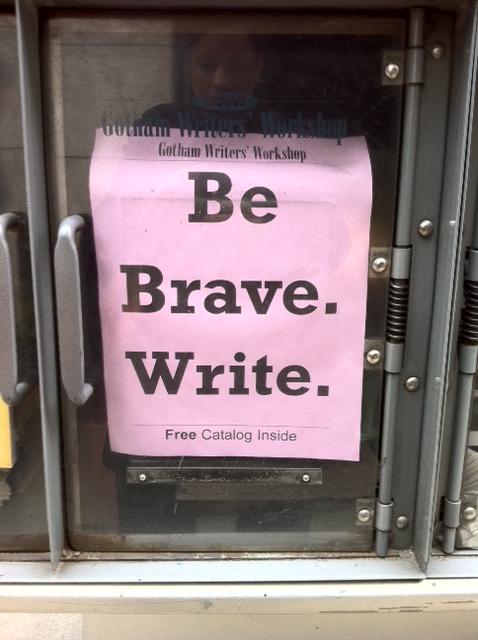
Special thanks to John Klymshyn for this image
I’ve dreamed of writing for years, since I was a child. And I have. Over the last 9 years I’ve written hundreds of articles, blog posts, and newsletters through my coaching business. Before that, I wrote city plans. Before that, my graduate thesis.
But I’ve always dreamed of writing a proper something — a larger writing project with a definitive end, like a book or a screenplay.
Somehow, I never seemed to find the time to write until recently — just in the last year or so. And now I’m writing on a daily basis, soon to finish my first feature length screenplay.
What I didn’t understand, until now, was that my lack of writing WAS NOT tied to all the things I believed about what it would take for me to write, like that I needed more time, better ideas, sudden divine inspiration, the proper writing space, a better computer, or any of the other things I was telling myself.
Instead, I discovered that what was going on at a deeper level was that I was afraid. I was afraid to write.
And this is what I’ve seen with many people who say they want to write but aren’t doing it.
Just like me, they are afraid.
Common fears
If you have fear coming up around writing, you might be experiencing some of these common concerns I hear from writers:
- You’re afraid the writing you’re longing to share isn’t serious, artistic, engaging, funny, clever, dramatic, or fill-in-the-blank enough.
- You’re afraid that you’ll embarrass yourself if you put your words out there for other people to see.
- You’re afraid that you won’t be able to do a good enough job telling your stories — you won’t be able to do them justice and you’ll let your ideas down.
- You’re afraid you won’t be able to come with good ideas.
- You’re afraid that other people will be hurt if you write things they don’t like. You’re afraid they will see themselves in your stories and be offended.
- You’re afraid you don’t know how to write well enough, but you don’t give yourself the chance to learn how because you believe that writing requires innate talent and that if you had it, you’d already be writing.
- You might even be afraid that your best work is already behind you.
What you need to understand is that these fears are ONLY fears. Nothing more, nothing less. They MAY come true, we may fall on our faces and have to pick ourselves up again, just like my son did on his way to school this morning.
You also need to understand that these fears are your ENEMIES. They are the enemies to your dream of writing, and courage is your antidote.
Stay tuned for the next post in this series coming your way tomorrow, “How to Spot the Stealthy Smokescreens that Stop You From Writing.” Watch for it on the blog or subscribe here.
by Jenna | Feb 8, 2012 | Writing Articles
Are you waiting for the right mood to strike before you work on your creative project?
Are you waiting until you have the right room to write or paint in?
Are you waiting until you have the right computer before you can start writing?
Are you waiting until you have the right “voice” or platform before you start sharing your message?
Are you waiting until you’ve picked the right project to start working on?
Are you waiting until you have more money before you do your art?
Are you waiting for big blocks of time before you write songs, start your novel, or get that screenplay off the shelf for a rewrite?
Are you waiting to be divinely inspired before you start your project?
Are you waiting for permission to create?
Wait no longer.
Your art will not happen unless you do it. And sometimes that means showing up and doing it even if you don’t know what you’re doing yet.
Besides, in a study by Robert Boice about academic writers, he found that writers who committed to writing daily were TWICE as likely to have a creative thought as writers who wrote when they “felt like it.”
The key here is consistency. Making the effort to show up every day to your creative passion will foster and spark your creativity, not the other way around.
Warmly,

by Jenna | Jan 26, 2012 | Writing Articles
Elaine Aron, author of The Highly Sensitive Person, says that “almost all HSPs have an artistic side they enjoy expressing … or they deeply appreciate some form of art.” She also says that, “almost all studies of the personalities of prominent artists insist that sensitivity is central.”
Todd Henry, author of The Accidental Creative: How to Be Brilliant at a Moment’s Notice, notes, “It’s not a rule by any means, but many creatively gifted people tend to display a natural tendency toward introversion. Perhaps the isolated nature of a lot of creative work is what calls many of us to our chosen profession to begin with. We love to get lost in the process of moving big conceptual rocks…”
(To be clear, while not all introverts are sensitives, all sensitives are introverts in the classic sense of the word “introversion”: meaning that we recharge our energy by having time alone.)
I think there’s a link between creativity and sensitivity due to the deep, rich, and imaginative inner life sensitives experience. While our vivid imaginations can run amok from time to time, it’s a powerful tool for venturing into new creative territory.
Similarly, our tendency to empathy gives us a great resource when it comes to exploring the emotional depths, which can also be a boon when it comes to creative expression.
Just the other day on Twitter, I joked about my screenwriting:

The challenges of sensitivity and creativity
I notice that the challenging aspect of both being sensitive and creative comes primarily on the audience side of things.
As Elaine Aron puts it, “The difficulty, I believe, is that normally we artists work alone, refining our craft and our subtle creative vision. But withdrawl of any kind increases sensitivity — that is part of why one withdraws. So we are extra sensitive when the time comes to show our work, perform it, explain it, sell it, read reviews of it, and accept rejection or acclaim.”
Some of my private clients and I recently did some work on this topic of “being seen” and discovered the importance of being willing to fully receive acclaim and trying not to block the massive flow of energy that comes with attention from an audience, but rather allowing it to flow through us and around us.
I was also recently reminded through my screenwriting class of the power and importance of intelligent, quality feedback to help us to improve our work.
As artists in the spotlight, we must be engaged in the exchange of our artistic expression for applause, approval, and appreciation from our audience. It is exhilarating, and while it may appear to be purely ego-driven, it is a necessary part of the equation for artistic fulfillment, at least from a life purpose perspective.
So yes, I see a link between sensitivity and creativity, and I think it brings challenges all of its own.
by Jenna | Jan 19, 2012 | Writing Articles
The other day I had an email from a friend about me screenwriting at 6 a.m. every morning. She said, “I admire your discipline. It must come from a deep passion.”
I thought, “Is this passion? Is this discipline? Is that what this is? That doesn’t quite feel right.”
Perhaps this is because I’ve struggled for so long to be clear about what I’m passionate about that the word “passion” has lost meaning for me.
Then, last week I found myself saying to my writing community participants how you would have to fight me off with a sword to keep me from writing.
And I thought, “Huh! Passion.”
But the clincher was when I saw Jeanne Bowerman‘s tweet:
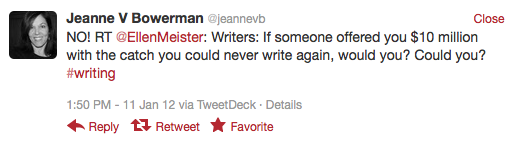
I knew my own answer was “No. Way.”
Then I got it. This is beyond reason, it’s beyond passion. It’s a kind of fierceness I never expected.
What shocks me is that this fierceness has been born out of the discipline of writing on a daily basis, not the other way around. And I hesitate to even call it discipline, because there are days when I have to drag myself out of bed with bribes and threats alike. The funny thing is that it’s gotten more scary NOT to write than TO write.
I didn’t know I would love writing like this. I had no idea until I started doing it regularly. Daily. At ungodly hours.
I’m also fascinated to have discovered that taking a day off or two DOES dwindle this feeling. I find myself drifting and uninspired when I stop.
But as long as I write every day or darn close to it, I’m good.
And I’m doing this by making it a LOT harder NOT to write than it is TO write:
- I set my clock early. If I don’t get up and write immediately, I’ll miss my chance before my husband goes to work and I’ve got kid duty.
- I set public goals with my writing community EVERY DAY. And they notice if I don’t show up.
- I have assignments due every day for my ProSeries screenwriting class. And they’re counting to make sure we’re doing the assignments.
- I’m the coach for the writing community too, so I have a responsibility as a role model too.
I’ve got multiple layers of accountability. Plus a healthy fear that if I stop writing, it’ll be hard to get started again. And a fierce belief that I’ve found my true calling.
by Jenna | Jan 12, 2012 | Writing Articles
One of the most common excuses I hear from people who say they want to write but aren't doing it is that they don't have enough time to write.
If you're attached to that excuse, you might not want to keep reading. (I'm feeling a little feisty today!)
I see frequent articles on the web about "how to find time to write" — and I've even written one of them myself — and yet people are still not writing. This is interesting when you consider the fact that over 81% of Americans answered "Yes" when asked "Do you think you might have a book in you?" in a 2002 study from the Jenkins Group.
ƒSo the desire is there, but not the action nor the results.
Why?
What you're telling yourself:
I know you think you are too busy and that you don't have enough time.
I know you're longing for a whole day off where you can finally sit down and focus on your Big Writing Project, but when that day comes, you remember that the laundry really needs to get done or that you promised Jane you'd go with her to that party and you don't have anything to wear so you have to go shopping and while you're out you remember that you forgot to... Well, you get the picture.
I also know you have too much work to do and the kids need you. And that those things are true.
I know you also want to write but you aren't sure where to start or what to write about. I know you think you need to get a little farther along with your career and save some money (or get the right room or the right computer) before you can devote yourself to your writing career.
I know this because I was telling myself these same things for too many years to count.
And I know something else. These things? They are Not True -- at least not in the larger sense.
Let me tell you what is True.
What is true is that the reason you are not writing is because you are scared.
You are scared that you don't know how to write, or what to write about.
You are scared that your writing won't be good enough, original enough, or that maybe someone else has already said it better.
You are scared to do the hard work of writing, and overwhelmed by the thought of such a big project.
You're scared you might hurt people if you write your truth. Or disappoint them.
So you don't give yourself a chance to do it.
This thing about time is just a story.
You can go on telling yourself that story if you want to, but we both know it isn't true. Because we both know the real reason you aren't writing is that you don't believe in yourself.
I've found the time to write every single day after years of telling myself I didn't have time. Years! And I'm busier now in my life than I ever was before.
Sometimes it exhausts me. But more often, it is the fuel that fires my LIFE. I found myself saying to my writing community participants yesterday that you would have to fight me off with a sword to keep me from writing. And this from someone who thought she could never write fiction to save her life -- except in her wildest dreams -- up until a year or so ago.
Here's what else I know:
I know that if writing means as much to you as you say it does, you will find a way to make it happen. If you want some help, that's the purpose of my writing community.
"The antidote to exhaustion is wholeheartedness."
To close, here's a passage to inspire you:
"You know that the antidote to exhaustion is not necessarily rest?"
"The antidote to exhaustion is not necessarily rest," I repeated woodenly, as if I might exhaust myself completely before I reached the end of the sentence. "What is it, then?"
"The antidote to exhaustion is wholeheartedness."
~ An excerpt from Crossing the Sea by David Whyte, here.